
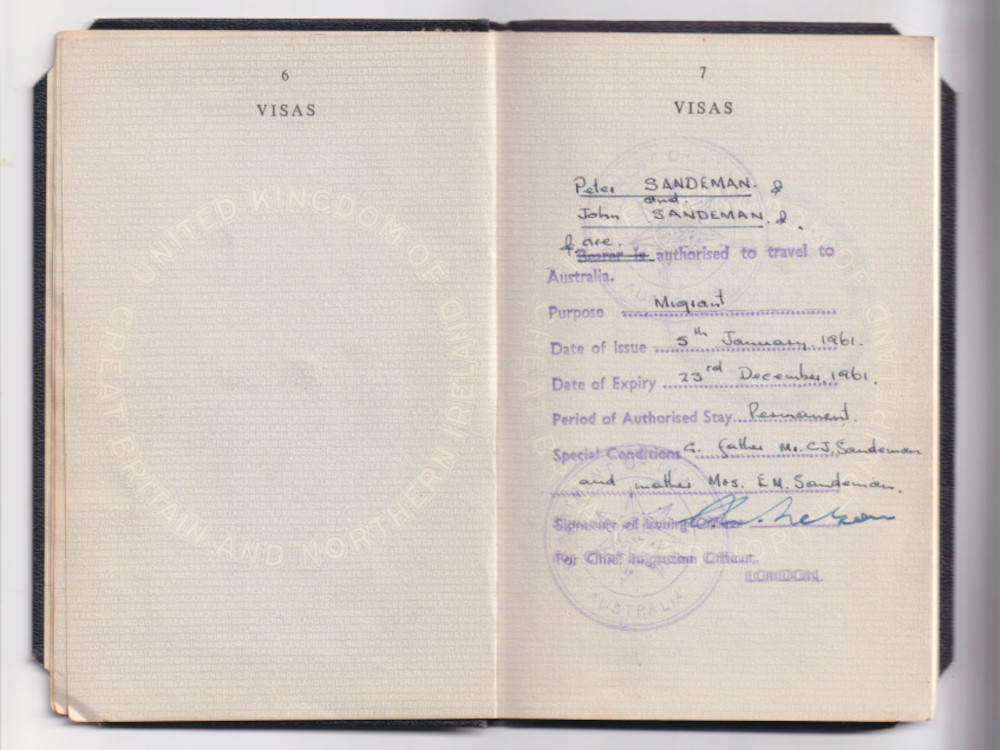
Here’s a story that dispels the suggestion that Australia should favour White people when we welcome immigrants.
It is 1998 in a dusty refugee camp in Kenya, where Sudanese refugees Aduk and Deng Dau, each with some of their children, have been reunited after years of separation by war. They are Christians. The day came when they were interviewed for a chance to leave the camp.
“A Kenyan lady with friendly eyes, a warm smile and a gentle voice ushered us into an interview room without delay.
“‘Can you tell us why you want to leave Africa?’
“Deng answered so wonderfully for our family.
“”There is no hope of safety in Sudan and no guarantee of safety living as a refugee. Healthcare is also inadequate back in Sudan. I would even say non-existent. What if we were there when Aduk contracted malaria and Typhoid? We are so glad there is medicine here to make her better, but our family, our children can’t live as refugees forever.’
“‘If the war ends and things are better in Sudan, would you go back?’
“‘Yes, of course we’d like to. But it has already been more than ten years of war. So much of Sudan has been destroyed. When will there be peace? And what home will be left to go back to?’
“‘Where are you prtepared to go, if given the opportunity?’
“‘We can go anywhere, but we hope to go to Australia.’
“‘Why do you like Australia?’
“‘Australia’s culture is a bit more like Dinka culture. We know we can raise our children in safety with Dinka values. Australia’s way of life is similar to Sudan. Australia’s way of life is similar to Sudan. We would like to live in a place where our children will still be able to learn our ways and our traditions and have them respected by our friends and neighbours.’
“‘What if Australia can’t take you and another embassy will? Will you go?’
“‘Yes. we will not say no to the opportunity to go because wqe are desperate for a chance at a new klife, but our preference is for Australia.’
“‘Well,’ said the interviewer, ‘You are a lovely family and I tryly hope that God blesses you with a wonderful future…”
Then it was months of waiting until their names appeared on a refugee camp notice board… “I scrubbed the children until their ebony skin shone bright. I washed, ironed and dressed them in their best clothes. Deng and I bundled our neat and tidy family of six off to Nairobi for blood tests. physical examinations and chest X rays.”
That’s from For hope love and life itself, by Aduk Dau and Belinda Peoples, the story of how faith, hard work and family values – those Dinka values – have seen a family become an asset in the Great South Land.
This makes it clear that you don’t need white skin to be a great Australian.
The illustration at the top of this story is from my father’s passport from when my family came to Australia – back then, a family passport was fine, apparently. But this stamp gives entry permission for only two of the family, myself and my twin Peter – why did we need an entry permission separate from the rest? It’s because we had been singled out as a little too yellow for the White Australia Policy, which was in place until at least 1968. It took lobbying by the SA government, which wanted my father to work for them, to get us in.
Melbourne blogger and Baptist pastor Murray Campbell is one Christian conservative who, as he headlines, believes “Immigration is a blessing.“
“To allege immigration must stop is to say something about our character and how we view the other. It is building a society based on fear, not grace, on protectionism, not generosity, on self-actualisation, not sacrifice. In that sense, it’s all law and zero gospel. Now, that may not bother the average unbelieving Aussie, but it should surely concern the Christian. What casts out fear? Not hate, it’s love.
“The wonder of the Christian message is that God includes the outsider. God’s only Son gave his life to welcome into God’s Kingdom the very people who do not belong and do not deserve citizenship. God’s Gospel is about grace, kindness, love of neighbour and for the nations.
“While the Gospel and the Parable of the Good Samaritan do not outline an immigration policy, they are doing something deeper and broader. If Jesus died to save people from Morocco and Mexico, and from China and Chad, surely this changes the way we will view these image bearers of God.”
Author, pastor and Theologian Michael Jensen has examined immigration in depth in a five-part series on his Lost Arts substack and in an article for the ABC.
“Christian theology invites us to see immigration through the lens of grace,” Jensen writes in his ABC article, Strangers together: Immigration and the Christian imagination. “The land itself is not our possession but God’s gift: “The earth is the Lord’s and everything in it” (Psalm 24:1). Israel was commanded to hold its inheritance lightly, to remember that it had been a landless people. Gratitude, not entitlement, was to shape its life.
“A Christian posture toward nationhood begins with that same gratitude rather than fear: “What shall I render to the Lord for all his benefits to me?” (Psalm 116:12) — the text, incidentally, of the first Christian sermon preached on Australian soil in 1788. Gratitude reorders our imagination. It reminds us that none of us is native to grace; we are all guests at a table not of our own making.
“Such gratitude opens the door to hospitality. Immigration policy must, of course, reckon with practical limits — infrastructure, housing, labour needs, social cohesion. But when we welcome others, we do so not as economic units or potential threats but as fellow image-bearers whose presence can enrich and transform us.”