
Anglicans are a bookish crowd, and proof that it is not just evangelicals who will persist in seeing the printing press as a preferred form of communication was evident when the launch of A True and Lively Faith attracted an overflow crowd at a side event at General Synod.
In doing the actual launch, Jeremy Greaves, the Archbishop of Brisbane, gave a description of the book’s purpose that was both noble and perhaps too idealistic.
“In an age marked by polarisation and dogged certainty, a “comprehensive” approach to Anglicanism offers a different witness. It calls us to humility rather than triumphalism, to curiosity rather than suspicion, and to the difficult but essential work of remaining in conversation with one another.
“My hope is that this book will encourage not simply debate, but deeper reflection; not simply argument, but renewed commitment to the bonds of affection that hold us together as Anglicans.
“At a time when so many institutions are fragmenting under the pressure of difference, where discourse is increasingly driven by those at the poles, perhaps one of the Church’s greatest gifts to the world is the witness that unity does not require uniformity, and that charity, patience and generosity are not signs of weakness but marks of Christian maturity.”
Speaking during a General Synod lunch break, the peculiar structure of the Anglican Church in Australia gave the book launch a particular context.
Australian Anglicans have an inbuilt quirk – forming them into a federation took six decades longer than the nation, and set up a mechanism of extreme diversity. The Bible Society took even longer but is truly one body. Unlike many other churches in the Anglican Communion, the General Synod, the national parliament of the denomination, does not have to approve a Bishop, or impose rules on its dioceses. Aussie Anglicans select their leaders locally, and dioceses don’t have to adopt rules or canons from the centre. This allows the Australian Anglican franchises to be extraordinarily diverse. If Australian Anglicanism was a fast-food franchisor, you’d have Maccas in one store while down the road the same brand would be selling Soul Origin.
So Greave’s call for Anglicans to learn better how to talk with each other is a high aim, but so noble might have set the book up to fall short.
The initiative for the book has come from a body called the National Comprehensive Anglican Network, and its committee is well represented in the list of contributors. Bishop Stephen Pickard writes in the introduction that “diversity has made Anglicanism a rich and unique synthesis of catholic, evangelical, liberal, charismatic and contemplative traditions of Christianity.”
Which causes this writer to be puzzled that in the context of a General Synod with an increasing evangelical presence – roughly two-thirds of the delegates, by The Other Cheek’s counting – there is not one writer who would see themselves primarily as an evangelical Anglican. There are a couple of fellow travellers.
But the overall effect is of a book heavily weighted toward the non-evangelical parts of the church. When first drafting this sentence, I wrote “progressive”, but that is not accurate or fair. The writers are not monochrome.
This exclusion of, for example, anyone from the Diocese of Sydney, fully a third of the Anglican Church of Australia, with its distinctive style of evangelicalism, means this writer finds it hard to read the former Archbishop of Brisbane on why it is important to include those one disagrees with. He suggests suppressing differences is the wrong way to respond to conflict in a community. “Based on fear and/or unassailable correctness of their own views, parties seek to silence dissenting voices and thereby suppress the conflict itself and the views of those with which they differ.”
Several controversies in Australian Anglicanism are aired in “A True and Lively Faith”.
Peter Carnley, former Archbishop of Perth, on whether Sydney’s Doctrine Commission strayed into heresy in dealing with relationships within the Trinity and the ordination of women.
Muriel Porter, legendary journalist, on the influence of the Diocese of Sydney on the General Synod.
Both of these are well-trodden paths, and have been given book-length treatments by these writers.
Two essays critically address Gafcon, a conservative international Anglican network. Carolyn Tan from Perth considers the question of whether the Diocese of the Southern Cross, the small evangelical breakaway body, is Anglican, and, as a lawyer, turns to the legal definition to come up with a definite “no.” She argues that a diocese must be part of the Anglican Church of Australia and the Anglican Communion to be Anglican, to hold franchise rights.
Tan uses the definition of the constitution of the Anglican Consultative Council.
The Church of Nigeria, still officially styled the Church of Nigeria (Anglican Communion), puts that definition to the test. The Church of Nigeria is on the ACC list but has removed communion with Canterbury from its definition of Anglicanism in its Constitution, and is one of the Gafcon/Global Anglican Communion provinces that never attends communion events.
Keith Joseph, the Bishop of North Queensland, criticises Gafcon’s Jerusalem declaration. He says one clause adds novel material “both for Paul and the 39 articles: “‘The Bible is to be translated, read, preached, taught and obeyed in its plain and canonical sense, respectful of the church’s historic and consensual reading.’ What does this mean? For example, the plain and canonical sense of the Bible endorses slavery, and indeed was largely understood to do so historically until the nineteenth century.”
Nuance on the Bible and slavery is provided by Dorothy Lee’s chapter on Interpreting the Bible, possibly the best reading in the book. She writes that “latter day slave owners ignored … the deeper biblical principles that apply to issues including and beyond that of slavery: that God creates human beingco-equally in the divine image and calls them to communion with God and with one another in Christ. These principles imply that all human beings possess the same access to freedom and belonging, regardless of of race, class or gender (Gal 3:26, 1 Cor 12:13, Col 3:11).
A True and Lively Faith missed an opportunity to interact with one of the authors of the Jerusalem Declaration. Bishop Glenn Davies could have been asked to respond to Bishop Keith, and as bishop of the Diocese of the Southern Cross to Carolyn Tan as well.
Two essays on Mission, by John Deane, executive director of the Anglican Board of Mission, and Peter Sandeman, retired CEO of a couple of Anglicares (and this writer’s twin), are the more irenic pieces in A True and Lively Faith. Both reflect the work of missiologist David Bosch and endorse the Anglican Communion Council’s Five Marks of Mission, which begin with proclamation but lean into social justice. Here are avid readers, it seems, of the Apostle James, while some evangelicals tether themselves to Romans. That seems to this writer to be a reasonable example of the width of Anglican Comprehension.
A volume two in a series titled “Contested Issues in Australian Anglicanism”, of which A True and Lively Faith is the beginning, has been promised. Can this writer gently suggest selecting a wider range of writers for next time?
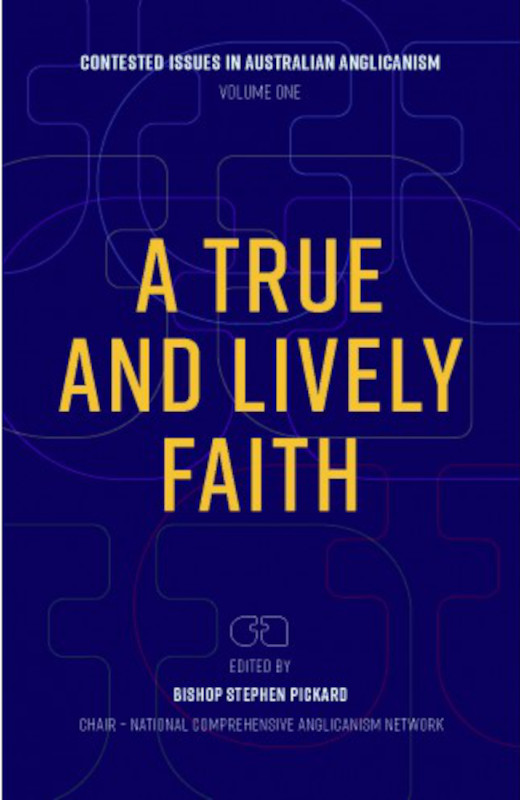
A True and Lively Faith, Edited by Bishop Stephen Pickard. Coventry Press 2026.
Cheapest price from the Publisher $29.95 https://coventrypress.com.au/A-true-and-lively-faith