
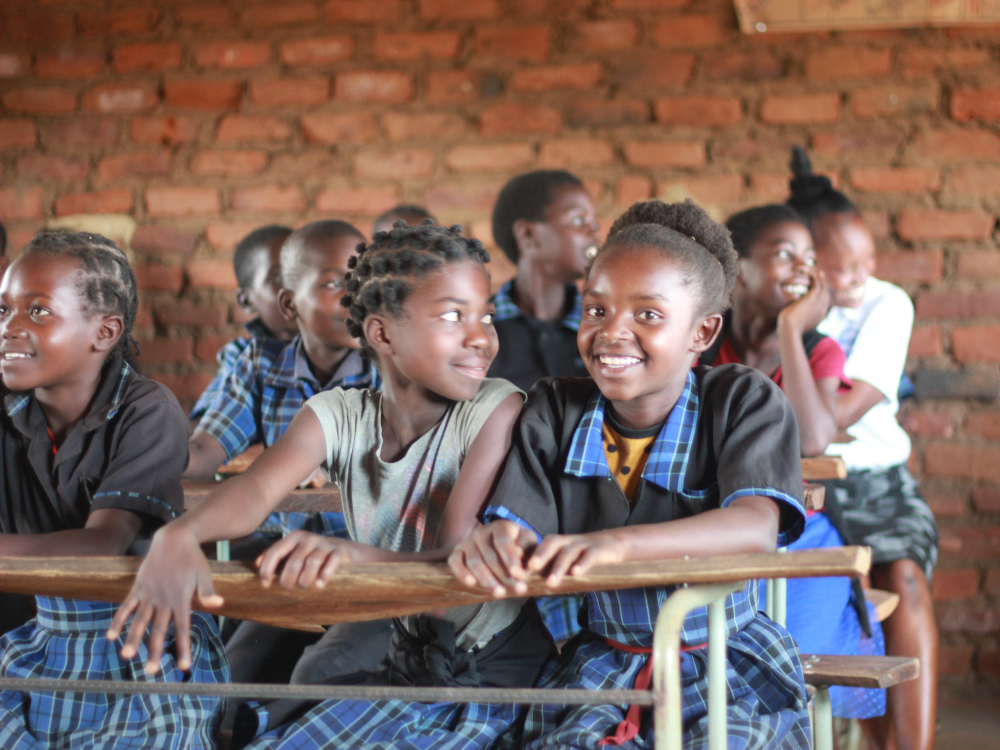
At a gathering for aid agency Tearfund, the subject is their Zambia-based partner with a fascinating name Reformed Open Community Schools (ROCS). This writer expects a story about a small network of schools. Instead Marlon Phiri, who heads up ROCS, tells us they run more than 500 schools with 600,000 students.
Tearfund was there at the start, backing the ROCS team – descended from Reformed Church mission stations, meeting an urgent need.
“Now in the early 90s, Zambia was moving from command column to private or to liberal economy, Phiri told one of Tearfund’s “Strong Roots, High Hopes” meetings, held around Australia this month. “So the government sold most of the state enterprises to a private sector, meaning that the new owners wanted to maximise profit. So they retrenched a lot of people. So quite a number of people lost their jobs. The other thing that was happening during that time was that we had HIV and AIDS was at its peak and there were no drugs. Meaning that if you contracted the virus, it was more or less like the death sentence. We lost a lot of people. So there were a lot of orphans, double orphans and single orphans. Then school was not free. You had to pay.”
ROCS started with volunteer teachers to make sure disadvantaged children could have access to education. “Church buildings would be church on Sunday, on Monday it became a school to absorb those children who failed to go to school, to public schools,” Phiri recalled. “So in response to that, Reformed Church in Zambia created ROCS to respond to the need to support education that was happening in churches. And most of the teachers did not have a teaching qualification. They were just volunteering to support children.
“Roundabout 2000, Reformed Church applied to Tearfund for support. Then Tearfund sent two volunteers, Marjorie and Jeff, maybe someone here knows them. They were educationalists who came to help train these volunteers who did not have teaching skills. So they did good work and normally say that they laid the platform on which I stand today.”
Phiri shows a picture of a school – it consists two toilet blocks in a community where the students are still learning sitting on the ground, waiting for community support to help build the rest. But in front of the toilets is a water tank and tap – its for girls to be able to take care of menstruation – ROCs knows that without it they will be forced out of school.
Phiri says he has a key message to share. “In Zambia, climate change is not in the future. It is already affecting our children. It’s affecting the youths because we largely depend on rain crops. If we don’t have rains, it means there’s going to be hunger. Already we’ve been informed that Zambia’s Southern part will face severe droughts and the Western part might even face floods. Speaker 1 (22:06):
So how do we help to prepare the community for the less rain? Can we also help them to conserve the little food that they have now? Should we not prepare by way of planting crops that are drought resistant like sorghum and cassava that can be havested in one year?”
Replenishing the forest and growing their own food are built into ROCS teaching program.
In question time, Greg Heuston, Tearfund Australia’s CEP prompts Phiri to tell a story about “Roger”. It turns out that Phiri approached Roger Federer’s foundation for help only to be knocked back for making an unsoliticed approach. But the next year the foundation got back in touch and supported a pre school program, and now funds about hald of ROCS.
Was telling that story a clanger – leading people to think that aid needs big supporters onl;y? Not so – it was Tearfund that helped ROCS gets off the ground. Roger is helping now, and Australian Aid helps too.ut Tearfunds ability to partners with locals, and build from the bottom up is key to ROCS story.
At the end of the evening we are encouraged to send a card to Penny Wong our Foreign Minister. Here is what it says:
“Dear Minister Wong,
As a Christian, I believe every community deserves a fair change to grow a resilient future, but climate shocks are pushing this out of reach for our most vulnerable neighbours.
I care deeply about this and I am looking to you to help Australians show just and fair leadership by committing to
• Deliver low-income countries the financial backing they need to build climate-resilient economies and safeguard livelihoods.
• Ensure more projects place climate resilienceas their primary objective to maximise impact on the ground.
Thank you for all you in support of australian Aid. I hold high hopes for what is npossiblewhen we act out of love and solidarityto help our global neighbours thrive.