

Christians closer to the view that you need to be Christian to be truly British, are more likely to be ‘nominal’ when it comes to practice their faith, according to research by Theos, the think tank that is part of the British and Foreign Bible Society.
Their report “Beyond ‘Christian nationalism’”’: Measuring attitudes to Christianity and Britishness today” found that “8% of UK adults strongly agree that you need to be Christian to be truly British, and 9% slightly agree. Only 1% thinks that being Christian is the most important factor for being truly British.”
Theos’ resaerch into Christianity and Britishness found UK society divides into five groups.
• Committed Separatists (34% of our sample)
• Cultural Separatists (16%)
• Values Integrationists (26%)
• Identity Integrationists (11%)
• Belief Integrationists (13%)
The first two groups are largely non-believers. Committed Separatists, a highly educated group, don’t think Christianity has anything to do with Britishness and believe firmly the two should be kept separate. Cultural Separatists, a bit more likely to be middle-aged and lower socio-economic status, don’t want Britain to be Christian, but they are extremely hostile to the idea of churches becoming mosques (whereas Committed Separatists don’t really care).
The other three groups, are dubbed “integrationalist” by theos because they value christianity and want it integrated into British national idenity, but in very different ways.
At this point it is worth quoting the report in detail, and Australian readers may ask whther these groups are opresent here.
“Values Integrationists are slightly older than average, and slightly more likely to be sympathetic to parties on the right. They are highly likely to call themselves Christian but are not especially likely to be practising. They see Christianity as a value-based phenomenon, which has pervaded Britain’s history, culture and institutions, done it good and is worth protecting and preserving.
“Identity Integrationists are more likely to be older, C2DE, and white. They are the most likely of all groups to support Reform. They have a very rich (or ‘thick’: see later) idea of national identity and are very concerned about the state of the nation, with particular hostility to immigration, asylum and Islam. They are deeply committed to the identity of Christianity, which they see as being about creed, culture and heritage, but this commitment doesn’t translate into similarly high levels of practice (they are the most ‘nominal Christian’ of all groups). They come closest to the view that you need to be Christian to be truly British and, in as far as any group merits the label ‘Christian nationalist’, it is this one.
“Belief Integrationists are more likely to be male, Millennial, and non-white. They show the highest level of practising Christianity of all groups. They want to see Christianity and Britishness closely integrated but more to promote Christianity than preserve it. They have a slightly more traditional moral orientation than other Integrationists, but are also inclined away from democratic and deliberative politics. They show high levels of belief in the Great Replacement Theory (the idea that ‘the white population in Europe is deliberately being replaced by migrants from Muslim countries’).”
More ‘Christian nationalists’ than practising Christians?
Theos provides nuance to their figure of 8% of respondents who strongly agreed that you need to be Christian to be truly British. “When we asked UK adults whether they agreed that “you need to be Christian to be truly British”, 8% of UK strongly agreed and 9% slightly agreed. When we pushed it and asked them what (from a list) they thought was the most important factor for being truly British, only 1% said they thought it was being a Christian.”
But Theos believes that somewhere around 10% is a credible figure. But that presents a problem: “But unless every single practising Christian holds these views – an improbable scenario – something strange is going on, because the entire practising Christian population in the UK is not far from 10%. Presumably, these views are held by people who don’t go to church, just as we know many churchgoers don’t hold these views. In other words, there is an unexamined dimension of what Christianity means within this debate.”
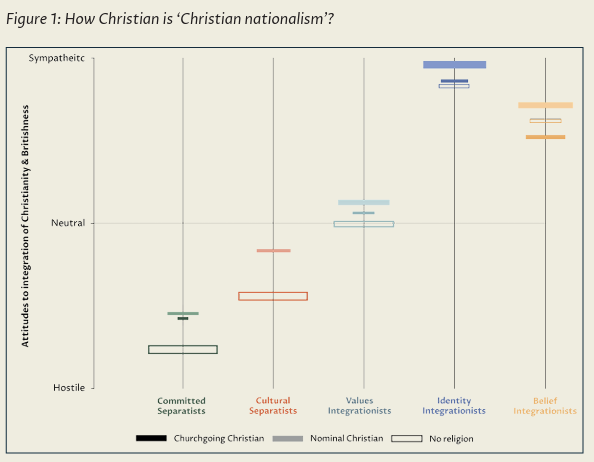
The graph above is key to the contention that Christian practice does not directly correlate with Christian nationalism. Here is how Theos analyses the graph: “The chart shows that in each of the groups, nominal Christians (the part-shaded bars) are higher up the scale of Christianity integration into Britishness, slightly ahead of the practising Christians (the full-shaded bars). Conversely, and not-surprisingly, the nonbelievers (the empty bars) are always most hostile to this integration. This indicates that attitudes to the integration of Christianity with Britishness do correlate with religion, but more so with non/ nominal Christianity, rather than practising Christianity. It is also important to observe that even a practising Christian in the ‘Committed Separatist’ category, for example, will be less sympathetic to the integration of Christianity and Britishness than a non-religious person in other categories.”
Image Credit: Theos