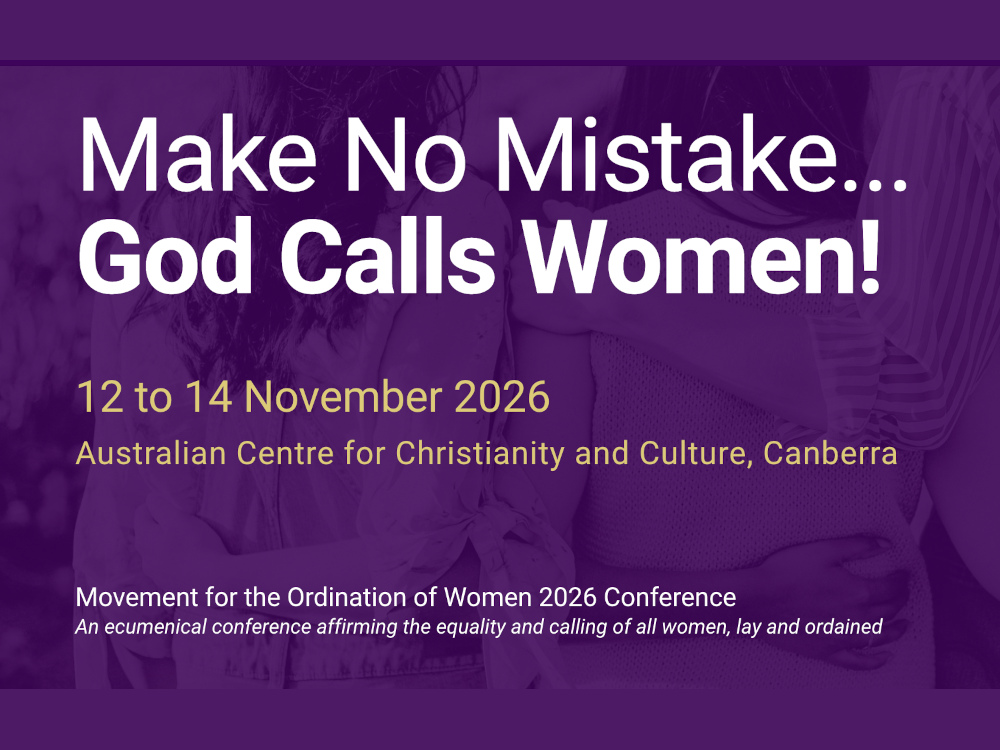
OPINION Prof Robyn Whitaker, a keynote speaker at the Movement for the Ordination of Women (MOW) conference earlier this month who is an Associate Professor of New Testament at the University of Divinity, came up with a much more acute reflection of what that MOW conference meant than I could.
Whitaker placed the conference in the context of her own journey towards her inclusive, progressive theology.
“In the conservative parts of the church that influenced younger me, I was taught that the Bible reigned supreme. IT was the final authority on all matters of faith. No one acknowledged that the biblical authority that seemed so clear was a particular interpretation of the Bible. Biblical authority and male interpretation were entirely conflated…
“Seventeen-year-old me could not have imagined the women’s leadership conference at which I spoke last week. All four keynote speakers were women; two are queer. And together we reflected on theology, power, gender, extremism, biblical studies, and women’s experiences in the church with other women and men gathered from around Australia and New Zealand.
“… as I listened to my colleagues speak and was led in worship by female bishops and priests, I was enormously grateful that God is far more generous and expansive than many parts of the church allow.
“I am now convinced that most of us have an operative theology shaped predominately by experience, rather than the Bible. The difference is that some of us will admit that.”
The Other Cheek was likely the only person at MOW’s gathering who has attended Gafcon conferences in Australia and overseas.
So why was this writer there? And not at the Gafcon conference the same week. Basically for journalism. This site, which is broadly evangelical, has not covered the left-hand aisle of Christianity in much depth, and MOW had speakers on the emerging topic of Christian nationalism. The Other Cheek looks around and sees Christian journalism disappearing, replaced largely by echo chambers, which makes covering people outside The Other Cheek’s evangelical milieu fairly a responsible thing to do.
Prof. Whitaker’s Substack summary of the MOW audience is a real service. While not taking her to speak for all there, the insight that “most of us have an operative theology shaped predominantly by experience, rather than the Bible” rings true to this writer about the general atmosphere of the conference.
The Other Cheek was puzzled by a panel discussion, “Towards a new Inclusive theology of priesthood in the church.” Several of the panellists appeared to this observer to concentrate on describing their own experiences. The panellists were articulate and passionate and told great stories about their journeys. Dr Karen Pack showed what a great public speaker she is; Andrea Dean of the Catholic sister group Women and the Australian Church discussed baptismal theology; John Roffey spoke of the tensions of being a gay man even in a progressive diocese. Experiences of pain and rejection shaped the discourse.
The panel discussion was dominated by their experiences – not strategising. Whitaker’s reflection helps me see that experience and storytelling are precisely the point. People whose “operative theology is shaped predominately by experience, rather than the Bible” will see storytelling, recounting their experiences, as a significant contribution to a “new inclusive theology of the church.”
What The Other Cheek was foolishly tempted to see as a bug is the feature.
But Whitaker’s wording is careful as one would expect from a theology lecturer. She wrote about “operative theology”. The panellists and speakers at MOW include people with a great deal of scholarship behind their position. Many of them hold significant academic jobs. This touches on the distinction between tightly theologically defined institutions like Moore, Morling or Ridley College and broader universities. Those in protest about evangelical churches, as several MOW speakers are, will find broader universities more congenial.
The Other Cheek’s week-by-week experience of church is of expositional exegesis and reflections on experience melded together, well thought out by both women and men. That’s not a claim about all evangelical churches, in the same way that Whitaker’s formula may not fit everyone at the MOW conference.
Many forms of Evangelical Christianity, for example Keswick spirituality or the Wesleyan holiness traditions, centre experience in their theology.
John Wesley was profoundly shaped by his Christian experience. The “Wesleyan Quadrilateral”, which adds experience to the older Anglican formula of scripture, reason and tradition, is a formula coined by the US theologian Albert Outler. But these tri-or quadrilateral schemes have Scripture as supreme, with the other two or three parts subservient to it.
But in accepting an “operative theology shaped predominantly by experience”, Whitaker RW has given a view of progressive Christianity that can be seen to dethrone the Bible to the extent it is tested against experience.
Whitaker has provided a good insight for The Other Cheek to process that MOW conference. The place of the Bible, and its authority, rated alongside experience might be the best rough classification device for the different Christianities we have.