
Charles Brammall
We once took our young kids to a gold panning lesson in NW Vic. The chap who taught us was a lovely, humble fellow. As we chatted, it came out that as a newborn, he was cradled by both John AND Yoko in the corridor outside the Apple Studios. His dad, vocalist with Oz super group Masters Apprentices, was recording with the band in the adjoining studio.
* * * *
Latest Beatles news – on what would have been George’s 83rd birthday, much has appeared in the music press. Outside the media spotlight, fan events like the Kinsale Beatles Festival continue to draw crowds, and urban cultural tributes to John and George are being renewed in places like Naples, Italy. Hindu as he was, we know George heard and discussed the Gospel of Jesus’ death and resurrection, 1-1 with a friend. Here’s how:
On 30 Jan 1969, a cold London wind sliced across the rooftop at 3 Savile Row. Below, traffic stalled. Above, four Liverpudlians and one gospel-raised Texan made history. The Beatles were performing what would become their final live concert.
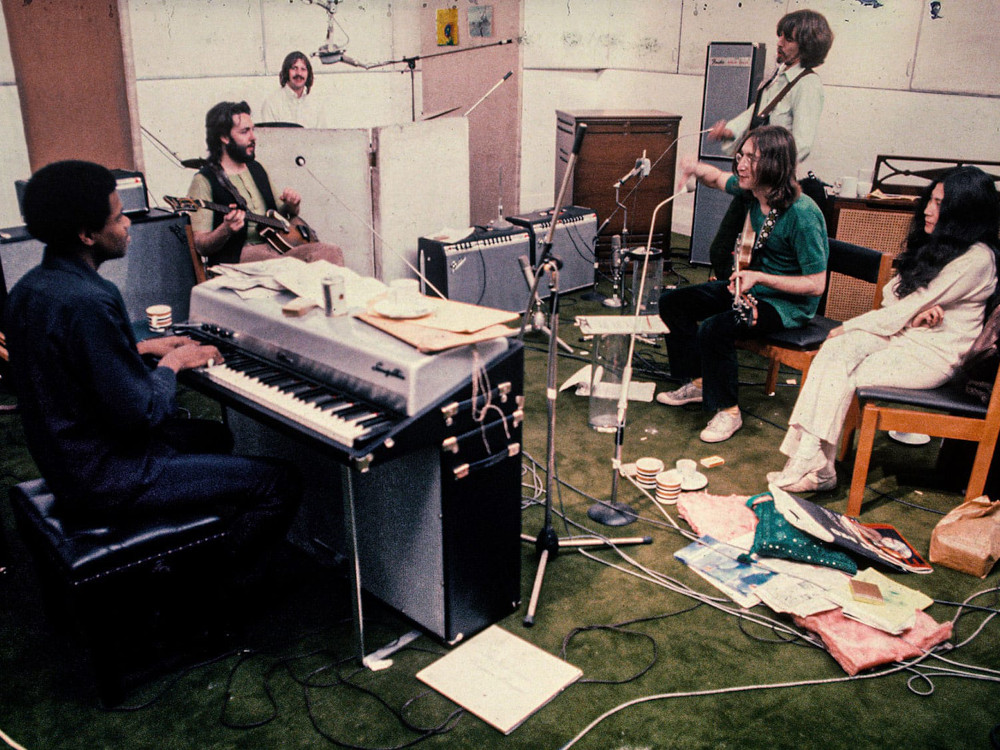
The man at the electric piano – smiling cheekily, buoyant, unflustered – was Billy Preston. When the police finally intervened to halt the set, the band closed with “Get Back,” and the rooftop chapter ended. Cameras rolled, the gale was real, as were the police. And Bill’s smile was real.
To understand how a church-formed pianist came to steady the most famous band on earth at the brink of dissolution, one has to move backwards through biography and forward through theology, because with Billy, those two are braided like a doxology in motion
Born in 46 and raised in LA, he began playing piano in church at 3 years old. And that’s not mythopoesis; it is documented recollection. He later said, “I’ve been playing since I was three years old… I never worked at any other job.”
The ecclesial matrix formed him. Before Apple Corps, before Savile Row, before Fender Rhodes and rooftop iconography, there were pews, lecterns, and Pentecostal cadences. His earliest ontology was doxological. Music was not careerism; it was vocation.
As a child, he performed with Mahalia Jackson, absorbing the Black gospel tradition where pneumatology is not a footnote but atmosphere. Soon he was touring with Little Richard, himself a man oscillating between flamboyant rock spectacle and evangelical proclamation.
The sacred and the secular did not cancel each other in Preston’s life; they created tensile strength. One hears in him not dualism but integration— a lived sacramentality of sound.
By 62 he had met the Beatles in Hamburg. By Jan 69, he was walking into Apple Studios during the fraying Let It Be sessions. Tension hung thick, cameras recorded acrimony, and Into that entropy stepped Preston. His presence altered the room. John Lennon would later say it was like having a 5th Beatle. And that’s not fan-fiction; it is reported testimony.
Preston did not narrate this as a hustle rewarded. He habitually framed his life in providential grammar: “I believe in God. I believe that everything that happened for me has been a blessing from God, because I never auditioned or sought fame.” His was not a vague spirituality, but a teleological conviction. And it has the aroma of classical providence— God as governor of contingencies — refracted through charismatic immediacy.
Then came “That’s the Way God Planned It,” produced by George Harrison. The title is not coy, but a thesis. Asked why he believed what he did about his trajectory, Bill said: “Why? I have to say it’s God… God in me.” There you have it: concursus and indwelling in one breath. Classical theism meets experiential pneumatology. He doesn’t offer a Summa, but testimony.
But the doctrinal architecture is discernible. Providence is not a mechanistic fate, but personal governance. The phrase “God in me” signals a robust, if unsystematised, doctrine of the Spirit of Jesus’s indwelling— charismatic, affective, and embodied.
In 71, as George’s bhakti devotion to Krishna intensified, Preston was asked about their spiritual conversations. He said, “The names change: his is Krishna; mine is Christ. The spiritual promotion, praising God, chanting, spreading it- these are the things we have in common.” This is confessional clarity without polemic. No syncretism, no sneer. Ontologically distinct referents, irenically acknowledged.
That is, Billy actually shared the Gospel of Jesus’ death and Resurrection with “The Quiet Beatle”, and attempted to introduce him to Jesus. Not once, but over some time. Bill was a gentle, relational, but intentional evangelist.
Harrison’s soteriology leaned toward liberation through devotion and mantra; Preston’s language toward providence, blessing, calling, and Christ-identification. If one must categorise, Harrison was plumbing Vaishnava metaphysics; Preston was inhabiting Protestant experiential Christianity— less scholastic, more testimonial; less system, more song.
Throughout the 70s and beyond, Billy endured addiction struggles, legal trouble, and financial strain. Hagiography would be dishonest. Yet there is no documented repudiation of Christ. Instead, one hears persistence: “I do believe that God has His hands on me and that He has work for me to do.” That is vocation theology, Ephesians without the footnotes- a doctrine of calling that survives turbulence. His Christianity was not argumentative; it was interpretive. He read his life theologically.
So we return to Savile Row. The rooftop concert is not merely rock ephemera, but ecclesiological irony. A gospel-formed pianist helping to conclude the live career of the most influential band in modern music. The man who sang that God planned it was there when the police climbed the stairs to stop it. The event is archived; the laughter is audible; and the chill is visible in fur coats, scarves and breath. Providence, if you share his grammar, wears a wool coat and keeps time in 4/4.
Scholars may debate whether “That’s the Way God Planned It” reflects Augustinian providence or Pentecostal immediacy. I believe the honest answer is, both. Structurally, it affirms divine sovereignty over biography. Tonally, it exudes indwelling empowerment. It is not Reformed scholasticism, but lived theodicy set to groove. He does not parse decrees; he praises.
Inside Apple Studios, one could overhear a peculiar interreligious colloquy. Harrison chanting the names of the lord in Sanskrit-inflected devotion. Lennon probing existentialism. McCartney embodying pragmatic humanism. Ringo steady at the kit, disinterested. And Preston, quietly but unmistakably, saying, “His is Krishna; mine is Christ.” Not belligerent, or embarrassed, simply, located.
Which brings us to an utterly true, attested, and very funny, coda. During the rooftop concert, as the performance spilled into the street and complaints mounted, the police arrived to shut it down. Inside, while officers negotiated with Apple staff, the band kept playing.
At one point, amid the chaos, Paul McCartney ad-libbed lines about the authorities- cheeky, defiant, amused. The concert ended not with a sermon but with a grin and a goodbye. Billy was there at the keys, smiling through the cold, as London’s Metropolitan Police became accidental extras in rock history. No embellishment needed. It happened exactly like that.
Providence at Apple. Christ named in a Krishna moment. A Fender Rhodes as doxology. And a rooftop where the police came to stop the music— but not, apparently, Father’s plan.
Prayers:
Father of mercies,
We thank You for rescuing Billy Preston through the death and resurrection of Your Son, our Lord Jesus Christ. Thank You that the cross was sufficient, that the empty tomb was victorious, and that grace outruns weakness. Thank You for placing Your hand upon him, for the music formed in church pews, and the gift that flowed through his fingers. Thank You that what You planned, You fulfilled- and that in Christ, every faithful note now resounds in eternity.
Amen.
Lord Jesus,
We thank You that in the swirl of studios, fame, incense, and searching hearts,
Billy named Your name. Thank You that when asked, he said plainly, “His is Krishna; mine is Christ.” Thank You for every conversation unseen by cameras,
for every quiet word, for every moment where Christ was spoken without aggression and without shame. You are sovereign over seeds planted in private.
We entrust to You whatever fruit grew from those conversations. Your mercy triumphs even Your justice.
Amen.
Sovereign God,
Thank You for every trace of truth that may have lingered in Apple Studios— for any sentence, melody, or conviction that rubbed gently against searching souls. If Billy’s confession echoed beyond George, and stirred questions in John, Paul, and Ringo— thank You for that mysterious work of Your Spirit. We ask You humbly and without presumption, that where there is still breath, there may yet be saving faith. Please have mercy, Lord. Open eyes. Grant repentance and joy in Christ. You desire that none should perish. We entrust them to Your wise and sovereign grace. Through Jesus Christ our risen Lord.
Amen
Image Credit: the Beatles Get back on Disney+
George Martin is indisputably the fifth Beatle