
Charles Brammall
In 1980, some elderly Aussies travelled to England and forked over $23,000AUD (£12,000) for a one ton (1000 kg) copper, bronze and steel, actual church bell. They couldn’t buy it off the shelf, but had to commissioned it from a Leicestershire foundry, John Taylor Bellfounders in Loughborough. It was for the intro to their song “Hell’s Bells”…
This was a tribute to their lead singer Bon Scott’s tragic, premature and avoidable death. I have seen and heard that “Bourdon” bell up close, twice, as it was struck multiple times by vocalist Brian Johnson.
He sprints 100 m across the stage, leaps high into the air, and swings 13 times from a thick jute rope inside said Sub-Bourdon, as the clapper hits the Tenor bell’s interior. tolls 13 times in the intro to AC/DC’s “Hells Bells”. The 13 tolls represents 3 things:
1.A Tribute to Bon Scott. 13 is the standard number of funeral knells.
2.”Unlucky 13″ and Defiance– as well as bad luck the number is often associated with unholiness, acting as a “bad omen” or a symbol for the rock-and-roll rebellious spirit Scott was known for.
3.The so called “Hour of Reckoning”. This signifies going beyond the normal 12 hours of a clock, and entering the non-existent-in-this-world “13th hour” or hour of judgement, when we will be called on to account for our lives.
The Great Bell is ear-bleedingly, cavernously, viscerally loud. Nerve tinglingly, Marinara Trench-like, bone shakingly voluminous. Deeply, stimulating cacophonous. It almost feels “living and effective and sharper than any double-edged sword, penetrating as far as the separation of soul and spirit, joints and marrow. It is able to judge the thoughts and intentions of the heart”, Heb 4:12.
The gargantuan Signum is a sound effect, not studio trickery, but a properly cast, ecclesiastical brute of metal, engraved, tuned, and freighted with historical resonance.
Engraved with the band’s monica and tuned meticulously to the correct pitch, it is engineered to swing with ominous solemnity- and that above stages which are therwise devoted to overdriven amplifiers. Instead, during early attempts to suspend it, the thing twisted, lurched unpredictably, and very nearly decapitated someone in rehearsal.
There is something peculiarly biblical about that episode, as though a minor prophet were lurking backstage taking notes. Ecc 10:8 says, with unnerving understatement, “He who digs a pit will fall into it.” Substitute “hangs a Tower Bell imprudently” and the theology requires very little imaginative extrapolation.
The delicious irony is that a band repeatedly accused during the 80s of satanic theatrics went to the trouble of importing traditional English church hardware, only to be endangered by it. One almost hears Zech 14:12 clearing its throat about inscriptions upon bells and unintended consecrations (and consequences)- said Tolling Bell was almost lethal in rehearsal:
“On that day, the words ‘Holy to the Lord’ will be on the bells of the horses… This will be the plague with which the Lord strikes all the people who have warred against Jerusalem: their flesh…, eyes,… and tongues will rot…”
From that clangorous near-miss emerged one of the most recognisable openings in modern rock history. The toll is funereal, measured, and implacable- curiously dignified. It does not smirk or leer; it announces, with pig iron sobriety, that mortality has entered the room and taken a seat.
The context, of course, was grief. Months earlier, Bon died after a night of heavy drinking, his passing neither glamorous nor mythically operatic, merely bleak. Psm 88 would have felt uncomfortably apt, without editorial softening: “Darkness is my closest friend.”
The surviving members contemplated stopping altogether, which would have been understandable and perhaps even decorous. Instead, they continued, recruiting Brian, whose Geordie (Novacastrian) understatement later framed the seismic transition as simple fortune, “just lucky to be in the right place,” providence disguised as happenstance.
The resulting album, Back in Black, became both memorial and defiance, an enacted lament that refused to remain minor key. Its very title functions like a narrative reversal reminiscent of 2 Kings 13:21, where contact with death yields unexpected vitality rather than contagion: “Once, as the Israelites were burying a man, suddenly they saw a raiding party, so they threw the man into Elisha’s tomb. When he touched Elisha’s bones, the man revived and stood up on his feet.”
Their earlier record, Highway to Hell, has often been caricatured as metaphysical allegiance rather than autobiographical velocity and tour-bus exhaustion. Yet Deut 29:19 describes the man who blesses himself inwardly while walking stubbornly onward, a far closer analogue than any occult manifesto:
“When someone hears the words of this oath, he may consider himself exempt, thinking, ‘I will have peace even though I follow my own stubborn heart.’ This will lead to… destruction.”
Hos 4:17 delivers the unsettling verdict, “Ephraim is joined to idols; leave him alone.” In biblical theology, judgment frequently appears as permission granted to pursue one’s own momentum. The “highway” is not a pentagram sketched in eyeliner; it is autonomy without brakes.
Touring life in the late 70s for Acka was punishing and relentless. Frequently sodden with fatigue and alcohol (except Angus), and often joyously chaotic. Asphalt theology shapes lyrical imagination more than demonology ever did. The language of hell, thunder, and storm was inherited cultural vocabulary, not constructed creed.
Nah 1:3 insists that the Lord has his way in the whirlwind and the storm, imagery of irresistible force and awe. Thunder in Scripture signals disclosure and dread. In the band’s lexicon, thunder becomes amplification of survival, noise as stubborn testimony that they were still standing.
Think about “For those about to rock, we salute you”, a track whose communal shout resembles 2 Chron 13:15, where Judah raises a battle cry amid improbable odds. Ez 3:13 describes a roar so mingled with weeping and joy that it cannot be distinguished from afar.
The band’s gigs operate as secular liturgies structured by anticipation, release, and collective embodiment: call, response, and cannon fire. Malcolm Young once observed, with blunt Presbyterian minimalism, that if you play rock and roll, you play it loud, a creed admirably free of metaphysical garnish.
Is 5:14 personifies Sheol opening its mouth wide, an image of appetite rather than costume drama. The prophets deploy hyperbole to awaken moral stupor. The boys deploy infernal imagery to awaken the bored. The resemblance is rhetorical strategy, not doctrinal alignment.
There is, despite decades of accusation, no elaborate demonology embedded in their catalogue, no systematic infernal metaphysic waiting to be diagrammed. Angus has drily remarked they are “the most boring people in the world”, magnificently Scottish understatement masquerading as biography.
Joy and suffering braided their years together with stubborn resilience. The Young family emigrated from Glasgow to Sydney seeking work and stability, hardship preceding acclaim. And that migratory grit faintly echoes the Apocryphal Tobit 4:7, a seldom-quoted exhortation towards fidelity and steadiness amid precocity: “Give generously to anyone who faithfully obeys God. If you are stingy in giving to the poor, God will be stingy in giving to you.”
Later decades brought further loss, including Mal’s decline into dementia before his death, a quieter tragedy than stadium pyrotechnics suggest. I am unaware if he was a believer. But the Deuterocanonical Wisdom 3:1 murmurs that “the souls of the righteous are in the hand of God,” a fragilely resonant sentiment. But diminutive, tea totalling, non-drug taking Angus in particular, was and still is in deep grief over his beloved brother
Through it all, the Tolling Bell remained a centrepiece. Cast in the Mother Country, shipped across hemispheres, nearly lethal in rehearsal, it became an icon of endurance and theatrical gravitas. The band accused of summoning infernal forces were, in fact, touring with Midlands ecclesiastical craftsmanship suspended overhead.
And here lies the entirely true, faintly exquisite tail of the same story. After all the satanic panic headlines and moral hysteria, the most overtly “religious” object associated with AC/DC was a traditional church-style bell that initially refused to behave.
One imagines a weary Leicestershire artisan polishing the bronze and muttering something dryly Midlands under her breath about “Antipodean theatrics”. Meanwhile Zechariah’s vision of inscribed bells lingers, amused and faintly ironic, as rock history continues to toll on regardless.
Please pray with me for the “boys” (av. age 72!🤣)
Dear Father of Prayer, Surrender and Grace,
thank You for the joy, art, and unrestrained thump that AC/DC has poured into the world. Please touch their hearts with Your general AND specific grace, and draw them to Jesus. In this overlap of the ages, let the headbanging of today point toward the worship of the age to come, the inaugurated eschatology where Your kingdom breaks in now yet awaits its fullness.
In Jesus’ ascended Name,
Amen.
Heavenly Father,
please guide Christians who know the band to be instruments of Your love, introducing them to the gospel of Jesus’ death and resurrection with wisdom and patience. Let the rhythms and riffs they have crafted echo Your glory, revealing both the now and not yet of Your promises, the tension of our fallen yet redeemed nature.
For the Name of the mighty human-God One,
Amen.
Father of All might, thank You for the wild joy, electric artistry, and unstoppable energy of the band, gifts that stir our souls. May their music, a taste of earthly delight, remind us of Your sovereign grace, and may it someday serve to bring them into the fullness of Your kingdom, where worship and wonder are perfected.
That Messiah’s Name might be exalted,
Amen
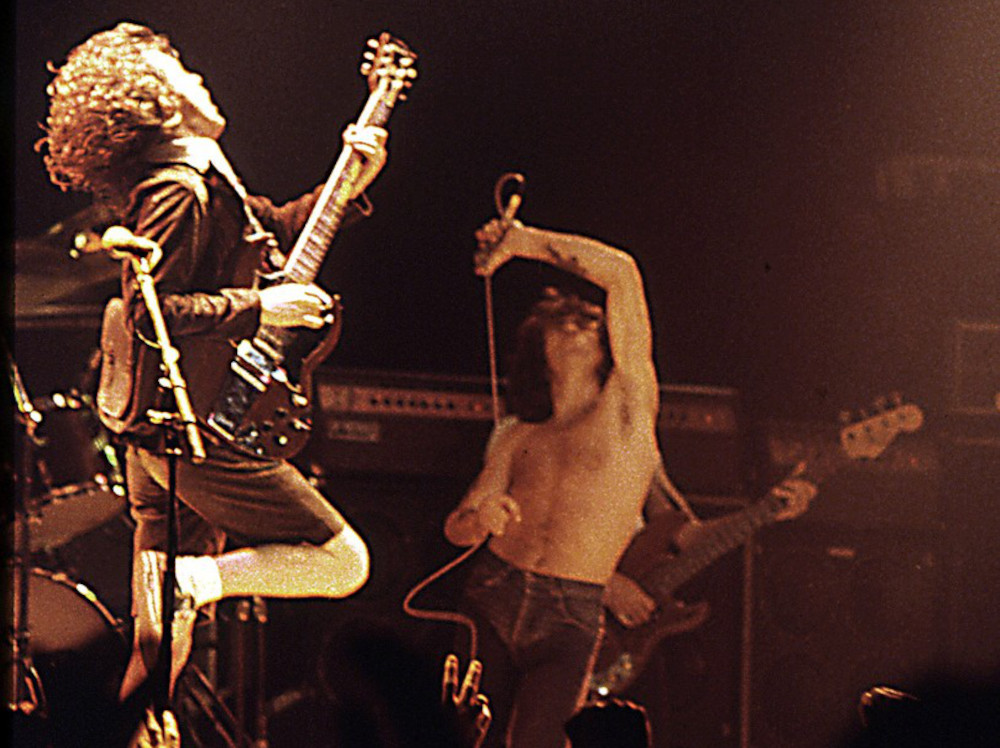
Image AC/DC in Ireland late seventies. Image Credit James Hughes Lost Parables /Wikimedia