
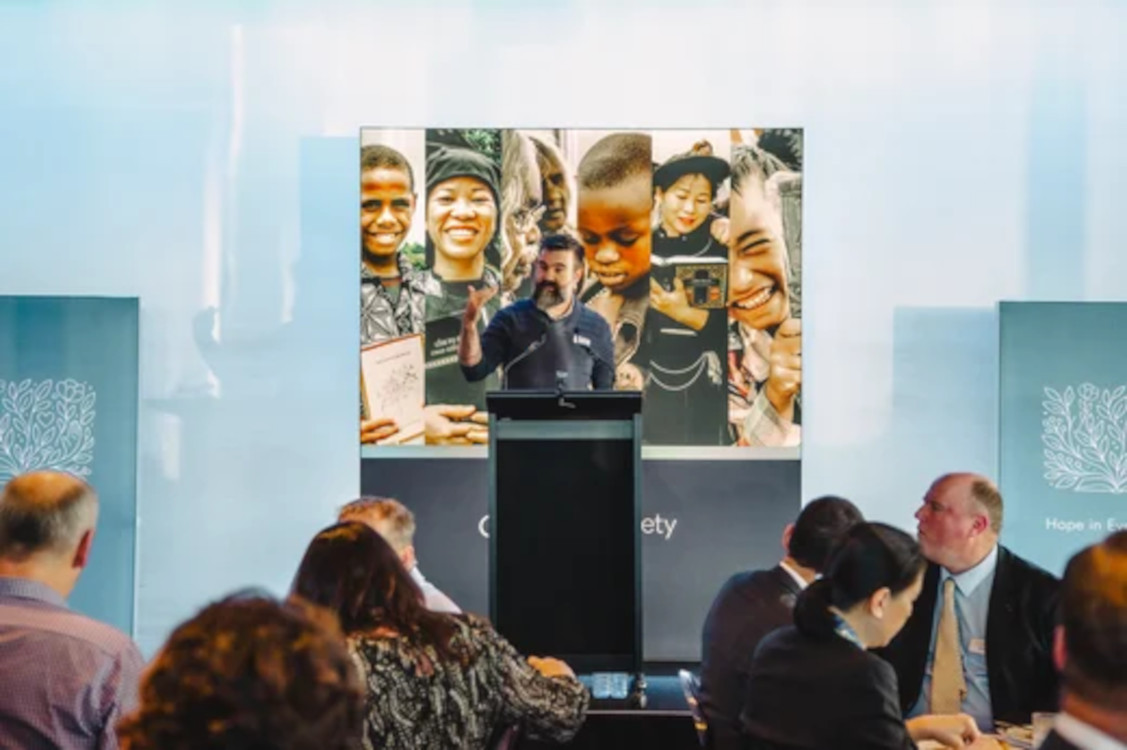
Sam Freney, the translation consultant for Bible Society Australia, gave a demonstration of how hard it is for those without a Bible in their heart language at a recent supporters’ lunch. He began with reading this in Pitjanjatjara:
Mayatja nyuntu panyaṉin aṯunymaṟa wiṟuṟa kanyilpai.
Panya wati tjapatangku tjiipi tjuṯa wiṟuṟa kanyilpai,
palu puṟunytjuṉin nyuntu ngayunya aṯunymankupai.
Nyuntu ngayunya ngura wiṟungka kanyilpai,
mai puḻkatjarangka ngalkula paḻtja nyinanytjaku.
Munuṉin ngayunya mina wiṟukutu katipai tjikiṟa
nyantulpa nyinanytjaku.
Ka panya ngayulu kurunpa uparingkunyangka nyuntu ngayunya kuṉpulpai.
Munun ngayunya katiṟinkupai iwara tjukaṟurungka ngaṉmanytju kalkuntjatjanungku.
Tjinguṟu ngayuku tjituṟu-tjituṟu puḻka wirkankunyangkaṉa nguḻuringama ilunytjaku-tawara.
Palu nyuntu ngayula tjungu nyinanyi, kaṉa palulanguṟu nguḻu wiya rapa ngaṟaku.
Panya tjapatangku tjukaratjarangku tjiipi tjuṯa aṯunymankupai, palu puṟunytjun nyuntu ngayunya aṯunymaṟa kanyini.
Nyuntu panya ngayuku puḻkaṟa mulapa mukuringkupai.
Munun ngayuku mai puḻka puṟunypa palyalpai ngayuku mukuringkula.
Munutjun palu puṟunytjuṯu ngayuku walpayaṯangka tjaalyngaṟatjunkupai tiṯutjara ngarinytjaku.
Palu ngayuku mirpaṉtju tjuṯaku nyuntu alatji palyalwiyangku wantipai.
Uwa, nyuntu pukuḻtjungku ngayunya wiṟuṟa aṯunymankupai, kaṉa puḻkaṟa pukuḻaripai.
Mulapa ngayuku nyuntu tiṯutjara puḻkaṟa mukuringanyi,
munun wiṟu kutju alatjiṯu ngayuku palyaṉi.
Kaṉa nyuntula tjunguringkula tiṯutjara nyuntula kutju nyinaku mantangka nyanga wanka nyinaralpi.
Then he read a Kriol version:
YAWEI, yu jis laik det brabli gudwan stakmen. Yu oldei maindimbat mi, en ai garram ebrijing brom yu. Ai kaan wandim mowa
Yu lukaftumbat mi jis laik det stakmen weya im deigim im ship olabat blanga abum spel langa kwaitwan pleis garram bigmob gras en springwoda.
Ebridei yu meigim mi jidan strongbala. Yu shoum mi det raitwei blanga bulurrum, dumaji ai trastim yu neim blanga dum wanim yubin pramis.
Nomeda if ai go thru langa brabli dakbala pleis weya enijing gin meigim mi dai, bat stil ai kaan bradin dumaji yu iya garram mi olataim. Yu garram yu spiya en yu longwan stik blanga lukaftumbat mi.
Yu meigim det padi redibala blanga mi, weya main enami olabat garra luk yu welkam mi en meigim mi jidan haibala, en yu filimap main kap til im randan.
Ai sabi yu na oldei gudbala langa mi, en yu laigim mi brabliwei ebridei weya mi jidan laibala. En ai sabi ai garra jidan langa yu haus garram yu olagijawan.
And revealed it was Psalm 23 by reading the NLT version – choosing something still a little unfamiliar with his audience.
The Lord is my shepherd; I have all that I need.
He lets me rest in green meadows; he leads me beside peaceful streams.
He renews my strength. He guides me along right paths, bringing honor to his name.
Even when I walk through the darkest valley, I will not be afraid, for you are close beside me. Your rod and your staff protect and comfort me.
You prepare a feast for me in the presence of my enemies. You honor me by anointing my head with oil. My cup overflows with blessings.
Surely your goodness and unfailing love will pursue me all the days of my life, and I will live in the house of the Lord forever.
A re-reading of the Kriol got appreciative sounds from the audience as they could recognise more of it,.
Freney commented “For a group of people around Australia, when they hear the Bible in English, it’s like that first experience you just had. It’s a completely different foreign language. They don’t understand it. For another pretty large group of people, it’s like the second experience or maybe the repeat version [of tye Kriol] where it’s a little bit more intelligible, maybe you can understand what’s going on a little bit, you can work something out, but you certainly don’t get everything. For a significant number of people around Australia, that’s their experience when they encounter the Bible in English. You might have even found the last one in English a tiny bit foreign because I’m guessing that for most, if not all of you, the version of Psalm 23 that links in your head is not the NLT version. It’s a different version of the Bible. And even that English, that’s not your favourite translation. It’s a little bit odd.
“How much more so if it’s a whole different language.
“Getting the gist of things, even getting a full understanding, that can be a very different thing to hear in the Bible or hearing the Bible read in your tongue in the language that you talk with your family and that you think in, and that you pray. One of the first times that I realised this was a few years ago was my first taste of Bible translation with the Bible Society. We were in Abelade checking through the translation of 1 Samuel with a few of the Bible Society Pitjantjara translators. Pitjanjatjara is the first language that I read out just before. It’s a language, central Australian language, a Western Desert language.
Uluru is Pitjanjatjara country. It estends out into South Australia and over into Western Australia as well. So we were looking through the book of one Samuel, and we’re in chapter 16. This is where God sends Samuel off to Bethlehem to find the new king of Israel. Samuel turns up, he invites to the feast and then he’s checking out all of the sons. ‘Is it this one?’ ‘No, not that one,’ God says. ‘No, not him either.’ And they kind of run out of sons, and they have to go and fetch David off from the field where he is looking after sheep and anoint him. No,w all the way through, the way that we check this, is we’re trying to check the accuracy of the text. It doesn’t mean the same thing once it’s been translated. That’s essentially my role. I’m the Greek and Hebrew nerd. That’s my training, and that’s what I contribute to the translation things. The locals, they are the translator,s and I don’t really know Pitjanjatjara very well at all.”
This video introduces two of the Pijanjatara Bible translators.
Freney continues. describing the translation process.
“They’re the experts in their language. I’m the expert in the original languages. We meet in the middle and make sure that we don’t have a game of telephone going along the way as we do a translation of the translation.
“And so we’re aiming to see that the meaning for the type of audience n their language, does that match what it meant in the original language … All the bits of how does this word connect to that word and how does the longer passage works. Who’s David speaking to? How many people are there in the room? All the aspects.
“Now, one of the translators has been a Christian for considerably longer than I’ve been alive, and she knew this story really well. She’s never read it in her language before, but she knew it really well. She gets to answering questions from stuff that we haven’t read yet.”
“And then we got to verse 13. ‘From there, Samuel took the horn with oil and despite the older brothers poured oil on David’s head, and immediately the Lord’s spirit came into him, and from then on always remained.’ She knew this story so well. She could tell you what was about to happen, but this was the very first time that she had read her language. The very first time that she met in her language of God’s spirit coming onto God’s Messiah and remaining with him, being within him for the rest of his life. The work of the spirit in history, in this particular person, this important person, was the first time that she had read that in her language, and it was this incredibly profound spiritually.
“She was crying. The rest of us were crying. It was a wonderful thing because she read this in her language for the first time.
‘Another time about this time last year, out in Amata, a couple of hours south of Uluru out in the desert. We were working on 2 Samuel this time. 2 Samuel chapter seven was fascinating because a chapter that was not at all familiar to the people that we were working with. You probably know it quite well. The section where David wants to build God’s house, the Temple. He’s got a fairly fancy house, quite nice and it doesn’t mean right to him that God is still in a tent, but he wants to build God a house, and God turns around and says, “No, no, I’m going to build a house for you, a family. So after you and your time as King, your descendants after you will be on the throne.” And the translators, they just jumped immediately to Jesus. I mean, I guess about Solomon, but not really, it’s about Jesus.”
“They were putting biblical theology together in real time because they had read this section for the first time in their language. They were seeing God’s promise to David how this tracks through history, how it was fulfilled in Jesus, bringing the Bible in their own language made it clear of this tangible difference to them right there in English. And so how much more so for a whole community over time.
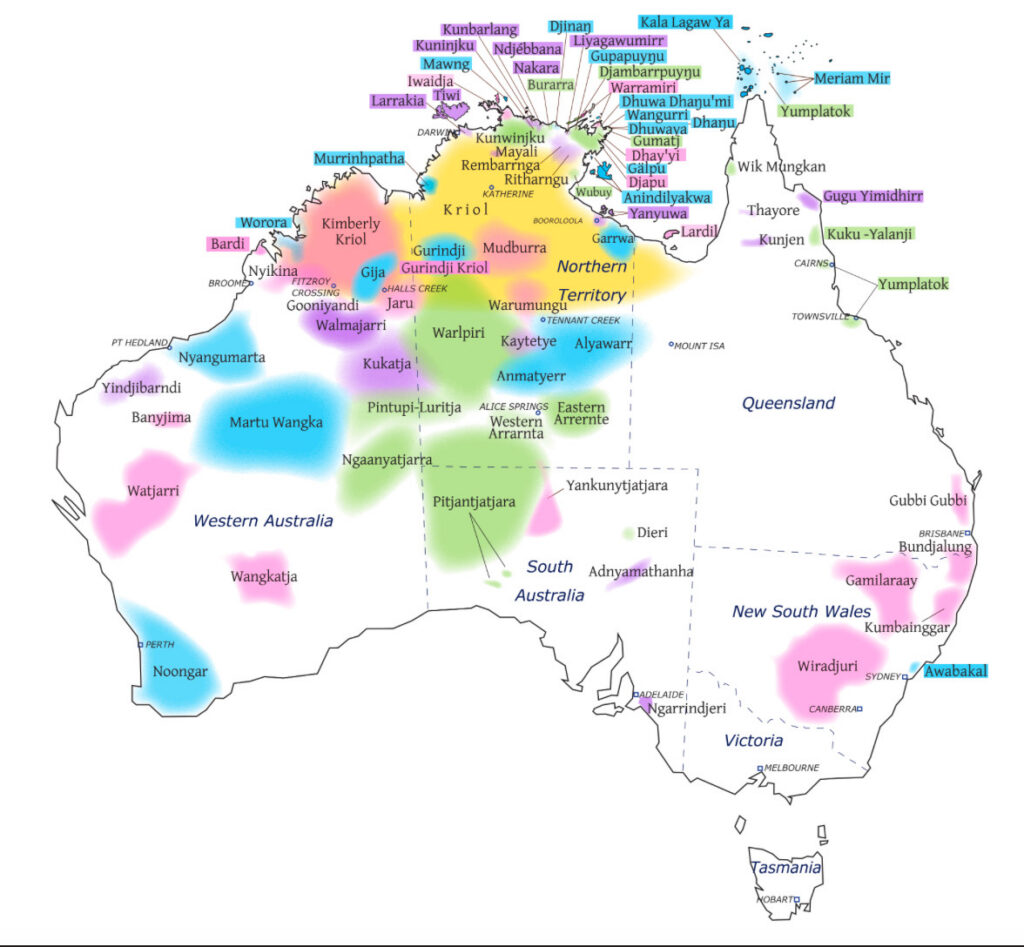
“This kind of translation work is incredibly transformative for those who receive it and there’s a lot of it about. The map of Australia shows you all the languages that have some amount of Bible translation done already, ranging from a few short stories and some languages to whole books or whole new testaments to some languages through Kriol, which is the only Bible with the whole scripture. It doesn’t equate to active projects or needed translations. We work with Christians and churches to meet the needs that they see. We’re not going in and language and say, “Here’s the translation for you. We are working.” But it gives you a sense of the scale of the task in terms of the number of translations and where they serve.
Freney goes on to describe the Bible Society building a translation centre in Vanuatu to serve an even more linguistically dense population than First Nations Australia.
“This facility will have places for multiple teams to come together or larger groups for training or workshops, be a recording studio for audio Bibles, and sleeping quarters to accommodate people. It’ll be earthquake and cyclone proof, as much as possible. It will be available for partners to work there as well.
But each of you knows personally how the Bible in your language is transformative for you in your life, in your faith, in your understanding, in the way you interact with your family and your work, and so many other things. In the Bible Society we’re already involved in a whole lot of projects working towards getting scriptures so that God can do that transformative work in other people as well, and this project in particular, this translation centre is likely to have a positive impact on lots of those communities now and over time.
“We’re working to get the Bible into languages for people in our region so that God can do his work in the languages that they think and they sing and they pray in. It is our hope that you join us.”
Read more: https://www.biblesociety.org.au/projects/australia-bible-translation/
Main Image: Sam Freney at the supporters’ lunch. Image Credit Bible Society