
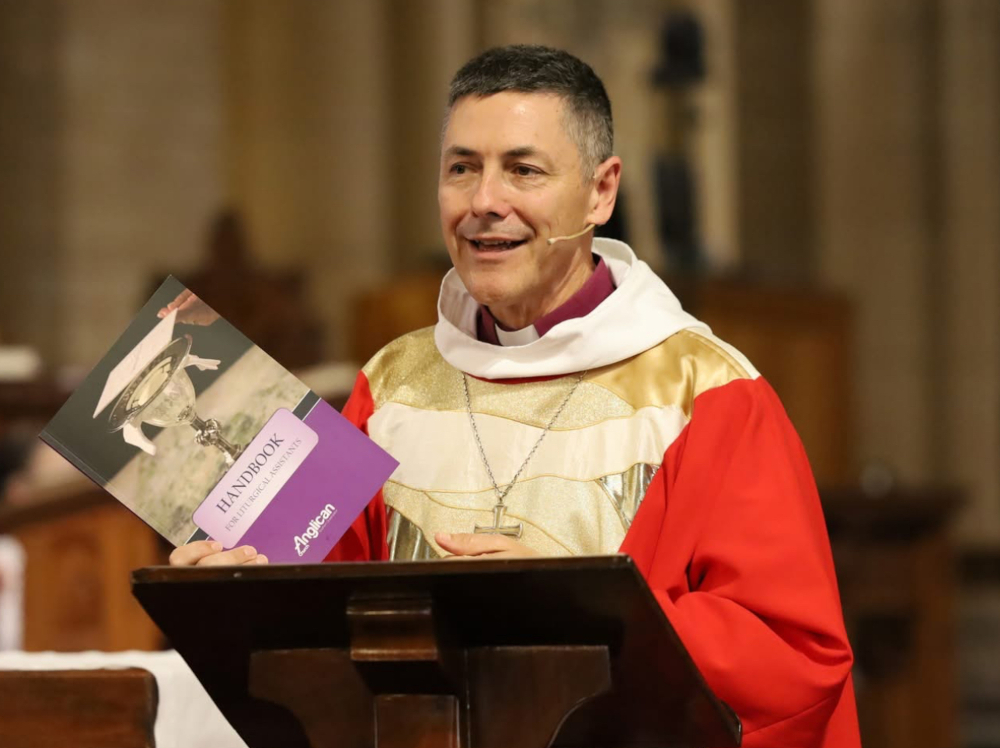
The strange patchwork that makes up the Anglican Church of Australia was analysed by Jeremy Greaves, the Anglican Archbishop of Brisbane, in his Presidential Address this week. (In Anglican synods (church parliaments), the Presidential Address is a chance for the bishop to have his or her say.)
He asked, “How does a national church maintain genuine communion when one theological tradition increasingly dominates its representative structures? How are the voices of smaller dioceses, First Nations Anglicans, regional communities, differing theological traditions, and minority perspectives heard and valued? How can influence be exercised in ways that strengthen rather than diminish mutual trust?”
This is a case of “let the reader understand”. But in case, dear reader, you don’t get it, the dominant theological tradition Greaves is talking about is the Evangelicals. Not just the hard-edged Sydney Anglicans, but the growing evangelical chorus from Bathurst, Tasmania, Central Queensland, and the Northern Territory, joined by an increasingly evangelical Melbourne and Canberra-Goulburn.
Archbishop Greaves has an example of where he believes mutual trust has broken down. Every presidential address has a line that will be noted and quoted. Here is Southern Queensland’s 2026 entry: “When Anglicare Sydney recently announced it had acquired aged care provider Infinite Care, a residential aged care provider, operating 18 facilities in QLD, NSW, VIC, and SA, breaking a long-held agreement amongst bishops about how agencies might operate across diocesan boundaries, the CEO of Anglicare Sydney was surprised by the reaction from Anglicare Australia and other Anglicares around the country.
“A decision Anglicare Sydney said was purely commercial, was received by others with suspicion and cynicism in a national church climate where the Diocese of Sydney has clearly articulated an agenda over many years to colonise the rest of the church.”
Looking at the purchase itself, Anglicare Sydney’s announcement made it all about scale: “The deal will establish a national platform of ~4,600 beds across 42 homes in NSW, QLD, VIC, and SA with ~7,000 staff.
“At a time of critical need in aged care, this combined platform will be well-positioned to bring new beds to the market, with development opportunities across the portfolio.
“Anglicare Sydney CEO, Simon Miller, said the transaction is a strategic step to deliver benefits to residents and staff and build scale and quality in a rapidly changing sector.”
The lessons of Prescare, which plunged the Queensland Presbyterians into receivership, and the sell-off by the NSW Presbyterians of their Aged Care operations that followed, show it is difficult to maintain state-based aged care networks. There are other examples of church bodies leaving the field or expanding out of their region. Get big or get out is part of the mantra of the aged care sector, driven by the way federal rules benefit larger networks. So, Anglicare Sydney does have a commercial point.
The spectre of the Presbyterians – Prescare in Queensland asked other states to merge with them not long before they went under, dragging down the church – probably rules out a combination of the Anglicares running any joint aged care.
But here’s an example of a progressive Anglican body operating across state boundaries. Now known as Anglischools, the Anglican Schools Commission was formed in WA in 1985, and now has 16 schools across Australia, three in regional Victoria, and one just across the river in NSW. Their vision is “To be Australia’s leading provider of quality, inclusive Anglican schools united in faith and living our Anglican Identity.” “Inclusive” in Anglican-speak is a hallmark of a progressive approach. In terms of welcome in other dioceses, Anglischools can point to the visitor of their interstate schools being the local bishop.
The fact that there is a similar network, the Anglican Schools Corporation operating in NSW, but observing “doctrines, tenets, beliefs and teachings of the Anglican Church Diocese of Sydney,” would have been rather confusing until Anglischools did their rebrand. The two networks have differing views on what Anglican identity is.
Greaves is championing “comprehensiveness,” a notion that comes mostly from the left aisle. He quotes an essay by Bishop Stephen Pickard in a forthcoming book to be launched at General Synod, the national church parliament for Anglicans. “Authentic Anglican Christianity is characterised by its value of ‘unity in essentials, liberty in doubt, and charity in all things.’ This means that within the essential parameters of the creeds, the scriptures, the sacraments, and the threefold ministry, a legitimate diversity and practice exists amongst Anglicans. This diversity has made Anglicanism a rich and unique synthesis of Catholic, Evangelical, Liberal, Charismatic, and Contemplative traditions of Christianity, [which] make for generous orthodoxy; a liberality in thought; and affirm a fidelity to the gospel and the church’s mission.”
The evangelical wing of the Anglicans will point to the Anglican church’s constitution declaring “the Old and New Testaments as being the ultimate rule and standard of faith,” and defining as “ruling principles,” the 1662 Book of Common Prayer, Ordinal, and 39 Articles declaring what the church should believe.
Pickard heads the National Comprehensive Anglican Network, founded in August 2023, after a solid evangelical majority emerged at the General Synod in May of the previous year. Until then, the progressive wing of the church had enjoyed an enduring majority. Think of the 1972 Whitlam victory over the conservatives, only in reverse; it was a big change for Australian Anglicans and unique in the mostly white parts of the Anglican Communion, with those national churches becoming more progressive. This is the background to Archbishop Greaves’ question, “How does a national church maintain genuine communion when one theological tradition increasingly dominates its representative structures?” The appeal to comprehensiveness comes from a theological grouping that has found itself in an unaccustomed minority.
Archbishop Greaves quotes Glenn Davies, former Archbishop of Sydney: “What Sydney does best is to continue to proclaim Christ and to do so far and wide without fear and without favour, and so therefore weneed to continue to populate the country with lay people and clergy. If you really care for Australia, we want to send our best clergy, and where you’ve got welcoming bishops, let’s do that… we need to populate, and not just with clergy, lay people too, we need to populate, and we need to pray that people will find opportunities to move outside of Sydney and to do so.” Is it churlish to point out that this would increase the comprehensiveness of those dioceses that champion comprehension?
Bishop Davies heads the Diocese of the Southern Cross, not part of the Anglican Church of Australia, which supports and plants churches in places where evangelicals believe they are sometimes not welcome. (In fairness, it may be that Archbishop Greaves would offer to welcome Southern Cross churches into his diocese, which has most of them, guaranteeing their ethos, maybe like Adelaide’s Trinity network, but this writer is not aware of this happening.)
The charge of colonialism by Sydney needs to account for the fact that neither the Diocese of Bathurst nor Southern Cross, both supported by Sydney, have adopted Sydney’s line on Women’s ordination. Broadly Evangelical, but not clones of Sydney
General Synod will be held again this year in Melbourne in August. Will the evangelicals still be in a majority? Probably, but we shall see.
Image: Archbishop Jeremy Greaves. Image Credit: Adelaideuser Wikipedia
Where could I find the full transcript of AB Greave’s presidential address
https://anglicanfocus.org.au/2026/07/02/synod-presidential-address-2026-archbishop-jeremy-greaves/