
In pure dollar terms, the Christian Brothers might retain the Australian title for the religious body that has evaded most responsibility for harm to survivors of child sexual abuse. But there are other contenders for religious groups evading responsibility for debts to banks and other organisations. Sadly, Christians can be slippery. Let’s look at some of the offenders.
The Christian Brothers, a religious community within the Catholic Church, founded schools and staffed them with members of the order. The Royal Commission into Institutional Response to Child Sexual Abuse forund that 22 per cent of Christian Brothers between 1950 to 2009 were alleged perpetrators. (ranking about the middle of the worst orders, the much smaller St John of God order had 40.4 per cent of its members as alleged perpetrators.
This week, the Christian Brothers were granted a pause by the NSW Supreme Court in payouts to victim/survivors due to alleged financial strain – with $216 million in property holdings left, facing 540 applications in process with the National Redress Scheme for abuse survivors and 32 court cases with known liabilities of $774 million to abuse victims.
But the deeper scandal is the much larger $2bn property holding signed over to Edmund Rice Education Australia, named after the founder of the Christian Brothers, according to the Financial Review. These school properties included Waverley College in Sydney’s East, St Joseph’s Nudgee College in Brisbane, and St Kevin’s College in Melbourne, which is now independent of EREA. Effectively, the Christian Brothers, by transferring the school properties to the new trust, reportedly in some cases for $1, have taken away the prospect of compensation for victim survivors.
The Ellis defence: A second low point also relates to the Catholic Church. The Ellis defence prevented survivors from suing unincorporated organisations, including churches and other institutions. Being legally unincorporated meant there was no specific legal entity with accessible assets to sue.
It was named after John Ellis, a survivor of abuse who was put through cross-examination that even Cardinal Pell agreed “was just too long, too intrusive, hurtful,” followed by the adoption of the strategy og not identifying a proper defendant. Ellis’ story is covered in Case Study Eight of the Royal Commission into the Institutional Response to Child Sexual Abuse.
Like the Christian Brothers case, the effect of the Ellis defence was to prevent survivors of clerical child sexual abuse from gaining proper compensation from church or school assets. This defence has been abolished across Australia,
The other cases in this list do not involve survivors of abuse, but are examples of the church or church agencies seeking to avoid paying creditors. In this sense, they are lesser forms of sin or evil. But this story is mostly about evading paying bills.
Bathurst Anglican Diocese tried to say that they were not responsible for the debts racked up by committees that set up schools in Orange and Dubbo. But the landmark Supreme Court case Commonwealth Bank of Australia v Palmer [2015] established that unincorporated church bodies are legally accountable for debts guaranteed by their diocesan organisations. A paper by Associate Professor Neil Foster details the case and the precedent it set.
“To cut a long story as short as possible, the ADF [Anglican Development Fund] borrowed a large amount of money, to the tune of some $40 million, from the Commonwealth Bank. It lent that money to the management of some newly established church schools. Those schools proved not to be self-sustaining, and more money was lent (in some cases, contrary to advice the Board of ADF had received from external advisors). In the end, the money was all lost, and the diocese was not able to repay the Bank.”
Foster quotes Justice David Hammerschlag’s summary of the diocese Bishop in Council’s response. “It denies the existence of the Diocese as an institution capable of incurring obligations which it formally and solemnly undertook. It denies the authority of its former Bishop and titular and spiritual head to have incurred obligations on its behalf which he formally and solemnly undertook. It denies that obligations formally and solemnly undertaken are legally binding. It denies the existence of formal documents of obligation where there is clear and cogent evidence of their existence.”
This is one case where Christians should be happy the big bank won.
PresCare and the Queensland Presbyterians: When aged care provider PresCare incurred $31m of debt after an arrangement to expand its operations with a deal with a borrower failed to generate enough income, receivers were appointed to the Presbyterian Church of Queensland, which argued that the church was shielded from liability. The Queensland Supreme Court found that the church was liable for the $31m plus costs and interest. A fundraising appeal prevented the loss of the Queensland Theological College campus after it was put up for sale by the receivers. A detailed account of the case by Neumann and Turner lawyers is here.
The Uniting Church and Acacia College: An ambitious plan for a school in northern Melbourne collapsed with the Uniting Church owing $32 million. At first, the church brought a case against the overcommitted developer who had failed to source funds to build and lease back the campus in Mernda. The complex relationship between the church and the developers was reminiscent of Prescare and other cases of churches signing up to complicated deals and landing in debt. The case settled, and from then on, the Uniting Church became a model of responsibility, selling over $50m in church assets, causing controversy within the church. North Queensland’s Anglicans are a good example of Christians accepting responsibility in the current vast property sale,
There is no doubt that sexual abuse hurts people more deeply than financial chicanery, and no moral equivalence is implied by listing these lesser sins. But the tactic of going to court to avoid payment of debt has occurred far too often, and most culpably when seeking to avoid compensation of survivors
So perhaps the worst offenders are those who sought both to cover up abuse and avoid paying compensation
Newcastle Anglican Diocese is arguably the leading example of systematic concealment of abuse by clergy, with the aim of preserving the reputation and assets of the diocese. Case study 42 of the Royal Commission traced the decades of concealment and minimisation of victim/survivors’ accounts. The Case Study report found: “historical and contemporary systemic issues are as follows:
- a minimising of the nature and impact of the offending
- a reluctance among some clergy to implement risk management strategies for accused or convicted clergy, where those clergy shared longstanding professional or personal relationships
- a focus on protecting the reputation of the Church and of individual members of the Church, particularly those in positions of power and influence
- a misrepresentation of abusive and predatory sexual relationships as consensual homosexual relationships.
“A cumulative effect of each of these systemic issues was that a group of perpetrators was allowed to operate within the Diocese for at least 30 years.”
This group of perpetrators and some supporters, especially among the legal community, effectively stifled the efforts of survivors to gain justice, and so must rank with deliberate efforts bt churches to avoid their debts.
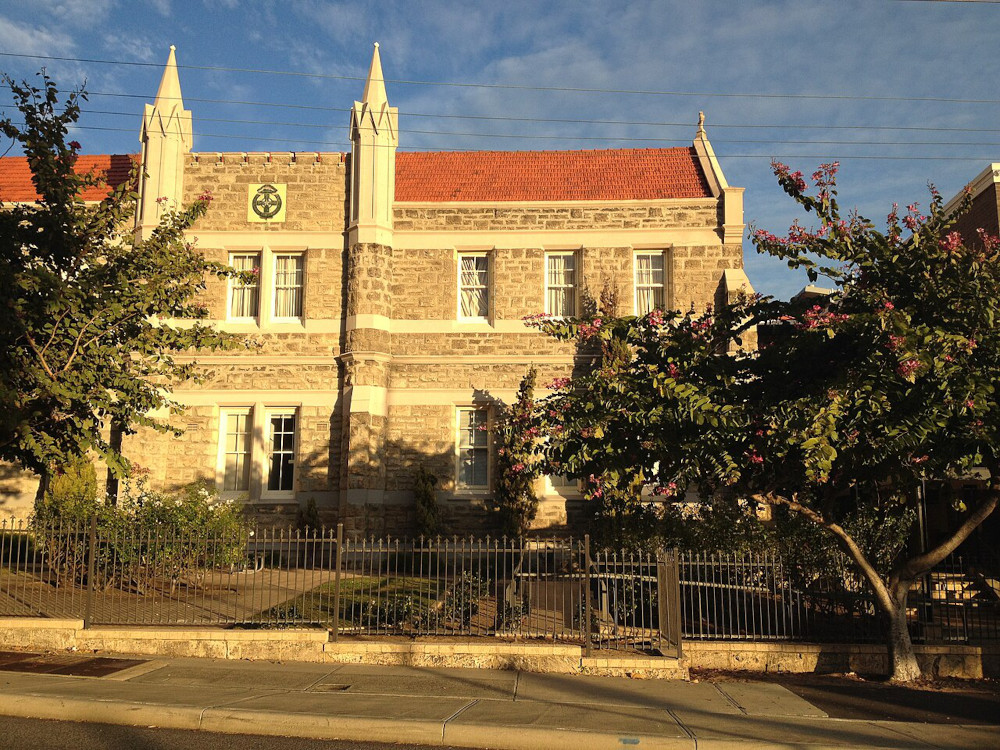
Image: Christian Brothers College, Fremantle. Image Credit: Josh Muir, Wikipedia
What can be done to lessen the legal costs which absorb so much of the compensation?
In the case of the redress scheme, costs are covered by the scheme itself.