
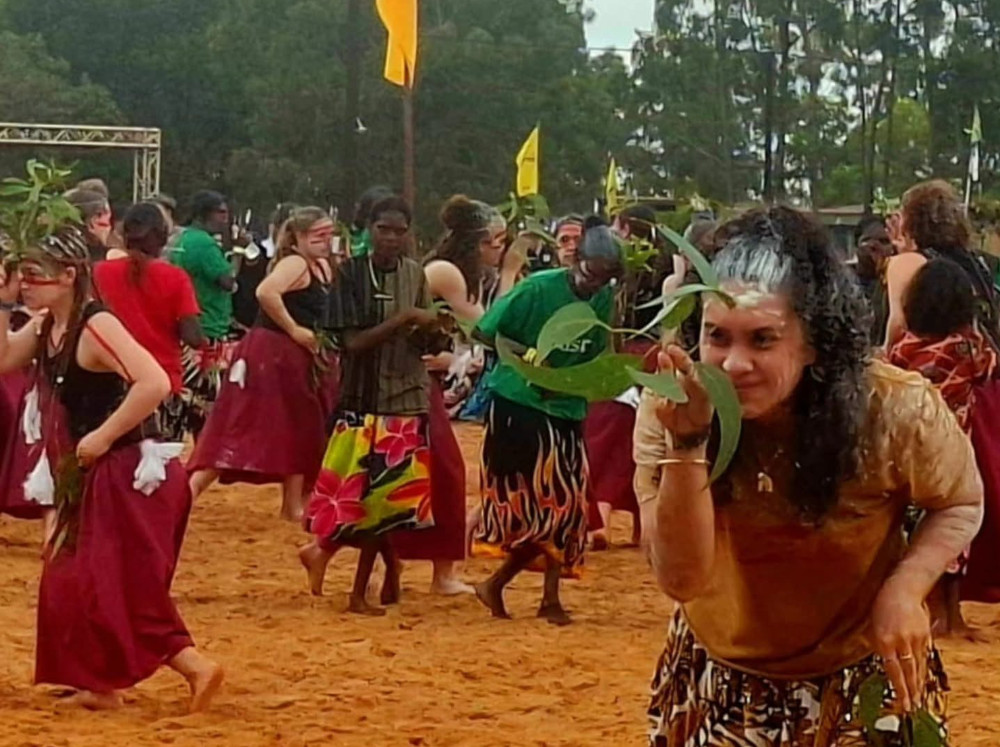
Julian Leeser, the Shadow Minister for Indigenous Australians and the Shadow Minister for Education, highlighted a tragic statistic at the Garma Festival this week. “In Australia, an Aboriginal boy is more likely to go to jail than university.” But Leeser went on to commend schools that are working with First Nations communities, especially those schools that are lifting retention rates. He pointed to Dhupuma Barker as providing the same type of opportunity the students at the Barker campus in Hornsby receive. The schhols boosting retention rates are often faith-based schools with room for more of them to be involved.
Here is an excerpt from his speech from the section dealing with education.
There is no real doubt in my mind that the single best thing we can do to improve outcomes across the board in Indigenous Affairs is to get the kids to school and get them to complete school.
School attendance and meaningful school completion are determinative of so many different outcomes.
The Australian Institute of Health and Welfare reported in May of this year that Aboriginal and Torres Strait Islander people who complete Year 12, or a higher qualification, are more likely to be employed, to work full-time, and have higher-skilled jobs than early school leavers.
The AIHW says that education, and particularly school completion, is also one of the strongest protective factors against the risk of arrest for Indigenous people.
School completion creates further opportunities.
In Australia, an Aboriginal boy is more likely to go to jail than university.
But as I have said before: on graduation, an Indigenous graduate will earn at least on par with a non-Indigenous graduate.
And after 10 years in the workforce, the incomes of Indigenous and non-Indigenous are in effect level. Put another way, the gap closes.
Education, and particularly school education, is part of the secret sauce that drives success in Indigenous Affairs.
So what drives success in this field?
Last year there were 263,611 Aboriginal and Torres Strait Islander students enrolled in Australians schools, making up 6.8% of all students.
The best measure to look at here is the Apparent Retention Rate that is published by the Australian Bureau of Statistics.
Retention isn’t exactly the same as completion, but it is a good indicator. Unlike completion, which relies on the census and can vary between jurisdictions, it is updated every year; it expressly disaggregates by Indigenous status and by school type, and it is more comparable across jurisdictions – which is important when you’re dealing with communities that move around.
And it is hard to complete school if you don’t stay in school!
Last year, the retention rate from year 7 through to year 12 for non-Indigenous students was 82.9%. The rate for indigenous students was 58.6%. While that figure for Indigenous students is a slight improvement on the previous year, it is below our best.
ABS data shows that, in the 15 years since 2011, our biggest single jump in school retention came in 2014, when rates leapt by 4.3% in a single year, and they stayed in the 59-62% range until 2022, when they dropped quickly.
But when you dive into the data, some powerful trends emerge.
The first is that the drop in school retention since 2022 has been almost entirely confined to government schools. In 2021, the Year 7-12 retention rate for Indigenous children in government schools was 53.9%. That fell to 51.5% in 2022, and then below half in 2023 and 2024.
But in the non-government sector, the trend is reversed.
Far from dropping, the Year 7-12 retention rates last year for Indigenous children in non-government schools across Australia reached an all-time high – with a retention rate of 91.4% across the country. To put this in context, that is higher than the retention rate for non-Indigenous children in non-Government schools, which was 90.2%, and much higher than the retention rate for non-Indigenous students in Government schools, which was 77.6%.
This is not me saying this. It is the ABS data.
In non-government schools last year, the Indigenous kids are lifting the whole cohort up.
But what is it that the non-government schools are doing that is so successful?
What can we learn from them? And how do we roll it out across the board so that every Indigenous child benefits?
Dhupuma Barker
Here in Northeast Arnhem Land, the Gumatj have led the way.
It was the vision of Yunupingu to create the Garma Institute as an “education pipeline” for Yolngu people – marrying Yolngu knowledge and traditions with Western knowledge and traditions.
He also worked with one of Australia’s outstanding educational leaders, Phillip Heath, who brings decades of experience in Indigenous education on Country to create Dhupuma Barker – a partnership with Barker college, an Independent Anglican school.
Dhupuma Barker, located at Gunyangara, teaches in community, but its students, among other things, compete internationally in robotics competitions, against hundreds of schools from around the globe.
The school has become the centre of the community.
It has a great attendance rate and its teachers foster a love of learning.
The school provides the same values and education as the main campus in Hornsby in my electorate.
It provides children the opportunity to learn in Yolngu Matha and English, so they can walk in two worlds in the vision of Yunupingu.
It is a school that eliminates the needs for students to leave their community, but allows them to stand proud among the best in the world.
Other Indigenous education experiences
Earlier this week I spoke with a roundtable of other faith-based school principals in majority Aboriginal and Torres Strait Islander schools who are achieving extraordinary outcomes in some of the most difficult and remote communities.
They spoke about autonomy and flexibility that the private sector brings; they spoke about the unifying effect of faith; they spoke about the extraordinary effort that goes into wrap-around and outreach services.
These things are driving success – slowly, and over years – but they are only possible because these schools are independent schools.
As one principal with experience in both the government and non-government sector put it:
The behaviour policy for my school is the behaviour policy for my school. It works in my community. The behaviour policy for the government schools is the same across the board, whether you’re in Logan or Ipswich, Mount Isa or Cloncurry.
Another principal in a school in remote Western Australia said that every morning, she had 5 staff including herself spending an hour visiting 30 different houses, every single day, to bring the kids into school.
Another principal said that he’d changed the fee policy for his school to take it from low fee to ultra-low fee. Previously, about a third of the students paid $2,500 a year to educate their child. He is bringing those fees down to $700 and even $500 dollars – $10 a week – so that a much higher proportion can pay it. In his words:
Each parent can look you in the eye and say: I have contributed to my child’s education.
They spoke about the importance of being on country, of finding staff.
They all spoke about the unifying effect of faith; how families can spot a phony from miles away but where there’s sincerity and genuineness, respect and care and the ability to bring staff, students and community together, it builds a stronger community.
Government schools
These stories are not limited to the non-government sector.
Government schools take all comers.
That is part of their reason for being, and that can affect the performance outcomes for government schools.
But I have also seen amazing Indigenous education outcomes in government settings, in places like Albury and last week in Cherbourg.
I visited Cherbourg State School and met their inspirational principal, Boyd McLean.
He told me of the school’s success in improving student performance.
Taking C students and turning them to A students.
Like Philip Heath, he spoke of the importance of engendering a love of learning.
He spoke about the school as the centre of the local Indigenous community and how they have reading circles where children read to parents, and how they are developing an adult literacy class.
He showed me the difference the Clontarf and Broncos programs are making, providing great mentors for both boys and girls.
His school involves indigenous people in the classroom on a pathway to becoming teachers.
Importantly, he told me how the Department had granted him greater autonomy and flexibility to deliver what works in Cherbourg, in a challenging environment with intergenerational educational disadvantage.
Autonomy, flexibility and partnership
What these stories show is that the government can’t do this alone, and it can’t do it from Canberra or the state capital.
It needs Indigenous community buy-in.
But the school itself also needs more autonomy and flexibility in providing Indigenous schooling.
We see this attitude in non-government schools – which have fewer bureaucratic layers to contend with and can be naturally more flexible.
But it needs to become more of a feature of government schools with high Indigenous populations too.
And these stories show we need the private sector – either through non-government school partnership, like at Dhupuma Barker, or through philanthropic partnership like the Clontarf and Broncos programs to help achieve the successes we seek.
When those kids get out of school with a Year 12 or equivalent qualification, the evidence shows that they are more likely to find work, send their own kids to school and value education for their children as a priority. That’s the intergenerational element.
I would like to find ways to roll these success stories out across the board. Because the first pillar of my approach to the Indigenous Australians portfolio is transformation through school education.
And we have in front of us some extraordinary examples of things that work, and there are dozens of others too.
Image: Garma 2026. Image Credit: Julian Leeser Facebook