
Charles Brammall
The Final CUT
Lights up.
A woman lies on a gurney.
She is fifty years old. Thirty-one years earlier she murdered another young woman. She has spent more than three decades on death row, much of it in extraordinary isolation.
The room is in Tennessee. The procedure is lethal injection. The state has prepared everything with the solemn precision of modern bureaucracy.
Two syringes.
Nothing theatrical.
That is the point…
Except that the woman does not die.
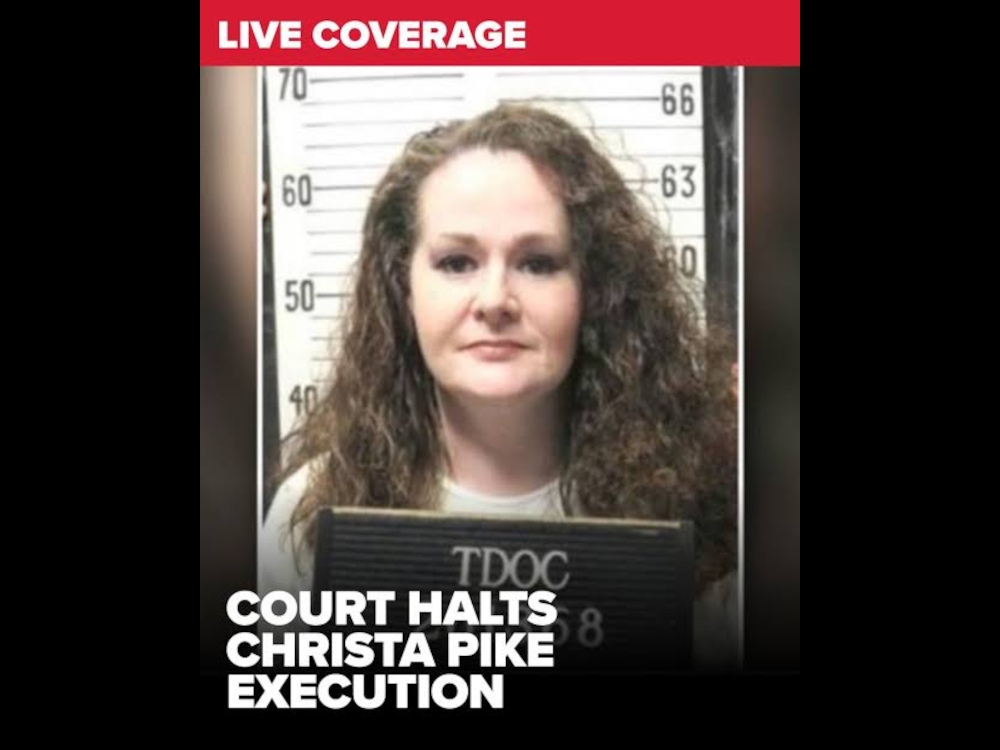
Christa Pike remains alive, complaining of pain in her arm, and a burning. Witnesses hear breathing, snoring and gasping. The curtain opens and closes. An ambulance eventually arrives. She is taken to hospital. The state later announces a review.
The execution has become, unexpectedly, a medical emergency.
And suddenly the vocabulary changes.
Patient.
Hospital.
Treatment.
Life-saving care.
There is something almost obscenely strange about that reversal. The institution has spent decades preparing to end a life; suddenly it must remember what hospitals are for.
Pike’s case is especially complicated because she was eighteen at the time of the crime, not seventeen, and her lawyers presented evidence of severe childhood abuse, trauma and later psychiatric diagnoses. The Inter-American Commission on Human Rights had already issued a 2026 “merits report” concerning her death sentence, representation and prolonged death-row confinement.
CUT to the LABORATORY
The modern death penalty has an odd relationship with medicine.
Lethal injection was partly born from the desire to make execution look less like killing and more like clinical procedure. The electric chair was itself promoted historically as a supposedly more humane technological improvement. The guillotine had similar origins.
Humanity keeps inventing nicer-looking machines for doing the oldest ugly thing.
Today lethal injection dominates American executions. Electrocution remains authorised in several states, firing squads have returned in a handful of jurisdictions, and nitrogen gas has become another contested method. Since 1976, the United States has recorded 1,488 executions by lethal injection, 163 by electrocution and six by firing squad. (Death Penalty Information Center)
Beheading belongs mainly to an earlier historical world in Western literature, though the guillotine remains one of its most haunting symbols.
Albert Camus understood the peculiar comedy of euphemism.
His father went to watch a guillotining, expecting justice to look like justice. He came home physically sick.
Camus later observed that the execution had revealed something hidden beneath respectable language: the reality of what the state had actually done.
The joke, if there is one, is that the machine was advertised as humane.
The man watching it was not convinced.
CUT to the PSYCHOLOGIST’S rooms
The newest research complicates another assumption: that execution affects only the person being executed.
Research on prison personnel describes insomnia, nightmares, panic attacks, substance abuse, suicidal thoughts and what psychologists call moral injury. Former executioners have sometimes subsequently opposed capital punishment. One former executioner described the work as like being in “a car wreck that goes on forever.” (Death Penalty Information Center)
There is also a psychological paradox.
A punishment designed partly to deter assumes that human beings contemplating murder calmly calculate future consequences.
But murder is frequently associated with rage, intoxication, impulsivity, severe psychological disturbance, desperation or circumstances in which the rational calculation assumed by deterrence theory may simply not be operating.
Mark Costanzo’s 2025 Oxford study of the deterrence literature concludes that research does not provide evidence that capital punishment deters murder; the National Research Council had already concluded that existing studies could not reliably establish whether execution decreases, increases or has no effect on homicide. (OUP Academic)
That does not settle every moral question.
It does, however, remove one remarkably convenient certainty.
CUT to: the VICTIM’S FAMILY

Here the psychology becomes still more difficult.
The death penalty is often spoken of as though victims’ families form one unified moral voice demanding execution.
Recent empirical research by Amelia Inglis challenges that assumption. Her 2025 study found that victims’ perspectives are neither universally shared nor necessarily static, and that capital proceedings can themselves become sources of retraumatisation. (The Death Penalty Project)
Grief refuses to behave like a courtroom diagram.
Some want execution.
Some oppose it.
Some change their minds.
Some want justice but not vengeance.
Some simply want the person they loved to have existed as something more than Victim No. 1.
The HEAVENLY LINES
The Bible is considerably stranger about death than many Christian arguments suggest.
Genesis 4 contains the remarkable Cain episode. Cain murders Abel, yet God does not execute Cain. Instead God places a mysterious protective mark upon the murderer.
The text does not call Cain innocent.
It does something more unsettling.
It preserves the life of a guilty man.
Then comes the strange law of Numbers 35, where the “avenger of blood” is prevented from becoming an uncontrolled instrument of vengeance. Cities of refuge interrupt the apparently straightforward arithmetic of you killed; therefore you die.
Deuteronomy 19 similarly creates procedural space between accusation and execution.
And then there is one of the Bible’s quietest theological sentences:
“Do I take any pleasure in the death of the wicked?”— Ezekiel 18:23
The answer is no.
But neither does Scripture pretend that murder does not matter.
That tension becomes even stranger in 2 Samuel 14, where the woman of Tekoa tells David that God “does not take away life.” Yet David is himself a king whose kingdom possesses the sword.
Then Romans 13 speaks positively of the governing authority bearing the sword.
The Bible therefore gives us no embarrassingly simple equation.
Justice is real.
Judgement is real.
The state has real authority.
Human life possesses astonishing dignity.
And God himself repeatedly demonstrates mercy toward the guilty.
CUT To: Executed JESUS
Then the whole argument walks into Jerusalem.
Jesus is arrested.
He is examined.
He is mocked.
He is condemned.
He is mercilessly flogged to within an inch of death.
And Rome executes him.
Not by injection.
Not by electricity.
Not by firing squad.
Not by beheading
By crucifixion: a public, intentionally agonising humiliating Roman execution designed to display what happened to people whom the empire regarded as threats.
Medical scholarship continues to debate the precise physiological mechanism of Jesus’ death, although asphyxia or an asphyxia-dominant account has become prominent in modern medical discussion. (PubMed Central (PMC))
But the New Testament’s great theological surprise is not principally how Jesus died.
It is who was dying.
The Judge is judged.
The righteous man is condemned.
The innocent man receives thepunishment.
The one who possesses life enters death.
And then, three days later, death discovers that it has made an administrative error.
CUT To: The FAILED EXECUTION
This is where Christian theology makes the death-penalty question particularly uncomfortable.
Jesus does not merely survive execution.
He rises.
The execution has not been reversed in the ordinary sense. The resurrection is something stranger: God vindicates the condemned one and annihilates the power of death itself.
Acts 2 therefore describes the crucified Jesus as raised by God.
Acts 3 calls him the “source of life”.
Revelation 1 gives Christ the astonishing words:
“I have the keys of death and Hades.”
The man whom the state executed is now portrayed as holding the keys.
That changes the scenery.
The Christian question is not merely, Can a government justly kill someone?
It becomes:
What does it mean for human beings to pronounce an irreversible sentence when the God revealed in Jesus is the Lord of resurrection?
That is a much more awkward question.
INTERMISSION
Recent scholarship has noticed precisely this theological difficulty.
Peter Garnsey’s 2026 Rethinking Capital Punishment devotes a chapter specifically to Jesus, exploring how Christian thought has wrestled with the sanctity of human life, state power, judgement and the apparent tension between Jesus’ teaching and Christian participation in systems of execution. (Cambridge University Press)
Susan Kramer has likewise examined the religious assumptions embedded in modern ideas of “future dangerousness”: the capital jury is effectively being asked to make a judgement about what sort of person someone will become, something medieval Christian thought treated with considerably more theological caution than modern legal systems sometimes do. (Sage Journals)
There is an irony here.
A death sentence requires the state to say, in effect:
We know enough about this person’s guilt, future, identity and irreformability to justify an irreversible act.
Christian theology begins somewhere else:
God alone sees the heart.
That does not erase justice.
But It does make human certainty look rather smaller.
CUT To: LITERATURE
Literature has understood this for centuries.
Dostoevsky knew it literally.
In 1849 he was taken with other prisoners to a Russian execution ground, sentenced to die by firing squad. Three men were tied to posts. Dostoevsky and the others waited for their turn.
Then, at the last moment, the sentence was commuted.
He later described the experience as transforming his consciousness of time: suddenly every minute became enormous.
That is perhaps one reason executions occupy such peculiar territory in literature.
Victor Hugo’s The Last Day of a Condemned Man turns the condemned person’s waiting into the central drama.
Camus begins Reflections on the Guillotine with his father’s experience of watching an execution and coming home violently ill.
In The Stranger, the condemned man’s imagination becomes trapped inside the machinery of approaching death.
And Shakespeare repeatedly understood that the condemned person is not merely a legal category.
He is still a human being standing beneath a sentence.
FADE OUT
There is no need to sentimentalise murder.
Colleen Slemmer (Pike’s victim) was murdered.
Nothing about Christa Pike’s abuse, trauma or psychiatric history makes that fact disappear. Her victim’s life cannot be turned into a footnote merely because the person convicted of killing her subsequently became the subject of a death-penalty debate.
But neither can the murderer cease to be human merely because she committed murder.
That is precisely where Christianity becomes unnerving.
Jesus did not die for people who had demonstrated sufficient moral worthiness.
He died for enemies, rejectors, enemy servicemen, sinners.
Paul’s formulation is almost offensively blunt:
“While we were still sinners, Christ died for us.”
The cross therefore refuses two easy conclusions.
It refuses sentimentalism about evil.
And it refuses despair about evil people.
The condemned person can be guilty.
The victim can be genuinely wronged.
Justice can matter enormously.
And mercy can still be possible.
Those statements do not cancel one another.
They collide.
LIGHTS UP
In 1849, Dostoevsky stood waiting for a firing squad.
He thought he had minutes left.
Then someone arrived with a reprieve.
Decades later he transformed that experience into literature, and literature transformed it again into one of history’s great meditations on death, punishment and the possibility of another life.
Christa Pike has now had her own grotesque version of the reprieve.
She was supposed to die.
She did not.
The machinery designed to make death final suddenly became machinery surrounding a living human being.
And somewhere beyond the prison, beyond the lawyers, beyond the medical reports, beyond the arguments about justice and vengeance, Christianity quietly asks the strangest question of all:
What if death is not the final scene?
For Christianity, that is not a metaphor.
It is the claim on which the whole drama turns.
Merciful Lord of forgiveness & resurrection,
you know what it is to be condemned, mocked and executed.
You know what it is to stand where human judgement has left no way out.
We do not know what justice requires here.
We do not know what mercy requires.
We are frightened by our own certainty.
Please have mercy on the guilty.
Please have mercy on the innocent.
Please have mercy on those who must decide.
And where repentance is possible,
please do not let it arrive too late.
For the sake of your risen name.
Amen.
Dear Lord of life and death,
we remember Sudan Kramer, who was killed by Christa Pike. Thank you for her.
Her voice was silenced, and her future was stolen.
Please do not let our compassion for the condemned
make us forget the dead.
Please comfort those who still grieve.
Thank you for receiving those who die in a trusting relationship with you.
We beg you to judge what we cannot judge rightly.
And somehow, mysteriously,
Please let justice and mercy meet
without either becoming cheap.
In Jesus living, breathing, speaking name,
Amen.
Dear Jesus,
Our resurrection and life,
you were judged by human beings
and then raised from the dead.
We do not understand that mystery well enough.
Please keep us from cruelty disguised as justice,
and from sentimentality disguised as mercy.
Please give wisdom to our governments,
compassion to victims,
truth to judges,
repentance to the guilty,
and humility to everyone who speaks.
And when we reach the place
where we simply do not know what to pray,
please teach us to whisper:
“Lord, have mercy.”
For Jesus,
Amen