

There’s a great anecdote in the introduction to Moore College’s Tony Payne’s new book, Let the Word Dwell Richly: The vital power of the one-another word, that explains the reason for the book. “I recently heard two separate comments that support this diagnosis. First, ‘at the yacht club, all we talk about is yachts. At church, we never talk about Christianity after the service.’ Second, ‘the people in my Bible study group provide social support, not spiritual challenge’”. That’s from Peter Adam, former principal of Ridley College, who will crop up again soon.
Despite these two being eminent evangelical Anglicans, this book strikes this writer as being friendly to the often Baptistideal of the priesthood of all believers, offering a vision of all of us having a ministry of the word.
Early in the book, Payne turns to Peter Adam in laying the foundation of the book (no wonder he got him to write the introduction). “While preaching … is one form of the ministry of the Word, many other forms are reflected in the Bible and in contemporary Christian church life. It is important to grasp this point clearly, or we shall try to make preaching carry a load which it cannot bear; that is, the burden of doing all that the Bible expects of every form of the ministry theWord.”
So what are those other forms of ministry of the Word? Answering that question turned into a PhD project for Payne and now this book.
He leads us into Colossians, discovering an interesting parallel in what Paul writes:.
• Addressing all at church in Collossae, “Let the word of Christ dwell among you richly, teaching and admonishing one another with all wisdom, singing psalms and hymns and spiritual songs with thankfulness in your hearts to God, and whatever you do, in word or in deed, let it all be in the name of the Lord Jesus, giving thanks to God the Father through him. (Col 3:16–17)
• Describing his own ministry “Him [Christ] we proclaim, admonishing every person and teaching every person with all wisdom, that we may present everyone complete in Christ. (1:28)
Payne writes: For now, we should simply note that 1:28 and 3:16 envisage a varied ministry of the word within a Christian community—one that includes both the proclamatory speech of certain leaders and the mutual, one-another speech of believers generally.
In the rest of the book. Payne concentrates on the one-another speech of believers. (He’s very clear: this is not the only thing believers should be doing BTW.) He finds 26 examples of one-another speech in the New Testament, ranging from disciple-making to prophecy, to rebuking and forgiveness.
He found 577 books on preaching in the Moore College Library and only 7 on one-to-another speech.
Payne works carefully through how one-another speech is treated in 1 Corinthians, Ephesians and Hebrews, and this is the core of the book. There’s no proof-texting here.
Here’s one insight from his treatment of Hebrews: “The whole letter is an exhortation, and the author, in two very significant passages in the structure of the epistle, urges his readers to exhort one another—that is, to urge and appeal to one another, and to spur on one another in their obedience to the word.”
“The frequent exhortations of the author of Hebrews—appealing to his readers to draw near to Christ, to hold fast to him, to persevere in him, and so on—are all based on his theological exposition of the gospel, and in particular the contrast he draws between the types and shadows and promises of the old covenant and their fulfilment in the new.”
This call to exhortation is the antidote to the aimless Bible study group that Peter Adam was warning about at the top of this piece.
Payne sets out a great question: What is the difference between two Christians discussing a passage (he uses Philippians 2) over coffee, perhaps reading it, and the preached sermon? “This leads us to a crucial point: the preaching-teaching ministry of congregational pastors and the one-another word ministry of Christians are best seen as different forms of the same kind of action. They are two species of the same genus, of which the apostolic proclamation is the author itative original. If we agree with the Reformers that congregational preaching and teaching (practised faithfully and by God’s enabling) does succeed in bringing God’s own word to its hearers, then we must say the same thing about the one-another word ministry of Christians, for they are alike in all the necessary respects.”
This is itself an exhortation; for us non-preachers: what we say to one another is very important. Perhaps unconsciously, pew-dwelling can lead us to think the sermon is so much more important than what we say. If i have read Payne right, that’s just not true.
“I have been in many ministry seminars where my Trellis and Vine [an earlier Matthias media book] co-author Colin Marshall has posed this curly question to the pastors and preachers who were present: “Do you think the word of God is as powerful in the loungeroom as it is in the pulpit?”
“The reaction was fascinating. The preachers present have often felt duty-bound to agree theologically—of course, the spiritual power of any human word comes from God; so, whether that word was spoken from a pulpit in a church building or to just one other person in a loungeroom, it would still be powerful, because its power comes from God. God’s word can meet an Ethiopian eunuch in his chariot or a couple of fishermen mending their nets or a woman sitting at the feet of her master while her sister is busy with the housework.
“And yet … there was an obvious objection to be expressed: is my sermon really no more powerful than a casual loungeroom chat? In which case, why do I bother with the hours of hard work required to prepare and preach? Is it reasonable to compare the potential power of a weekly, carefully prepared, rhetorically structured, 40-minute deep- dive into the content and purpose of a passage of Scripture with a Bible-based chat over coffee?
“Our intuitions at this point are correct. There are obviously things that a sermon achieves that a conversation in the living room can’t and won’t achieve. A sermon is powerful in ways that a living-room chat is not.
“But it is also important to recognise that the converse is also true.
“The right personal word delivered at the right time can profoundly move and change people in a way that a sermon rarely does. The living- room word also contains all the might and power of the word of God, but employs it or directs it in different ways.”
But perhaps the key takeaway is that God stands behind his word. “By God’s own power, the words we speak to each other, which from a human point of view seem weak, trembling, ordinary or unimpressive, may in fact reveal the powerful wisdom of God to the one who by God’s Spirit is given the ability to understand. That’s what Paul says about his own gospel proclamation in 1 Corinthians 2:1–5 and about the gospel wisdom-speech of believers generally in the following verses (2:6–16).”
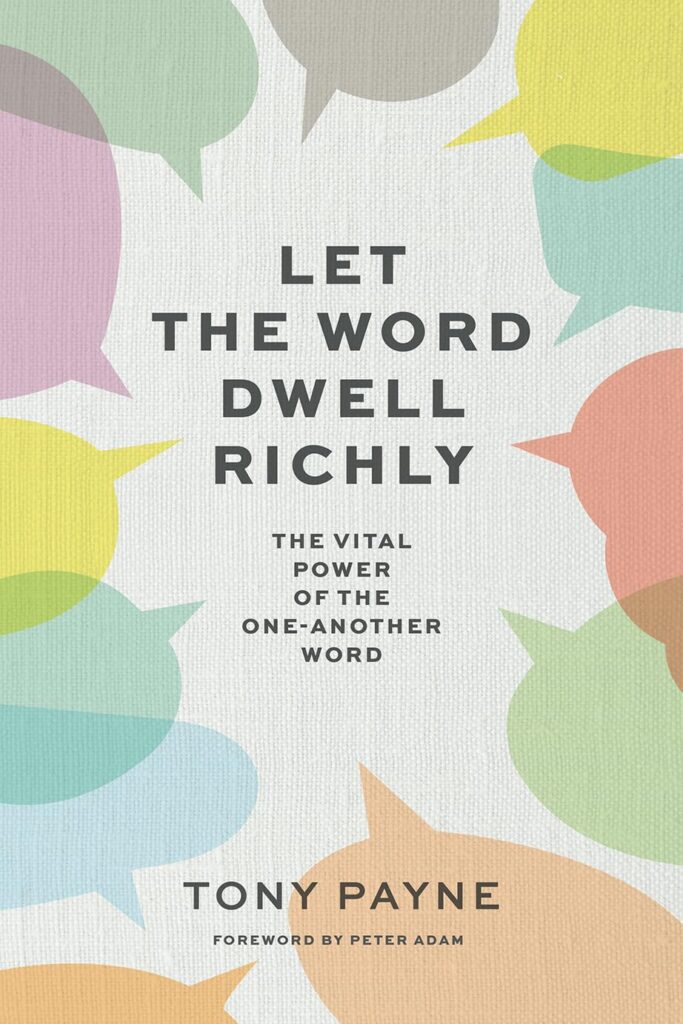
Let the Word Dwell Richly: The vital power of the one-another word, Tony Payne, Matthias Media 2026. Available from The Wandering Bookseller: $25.49