
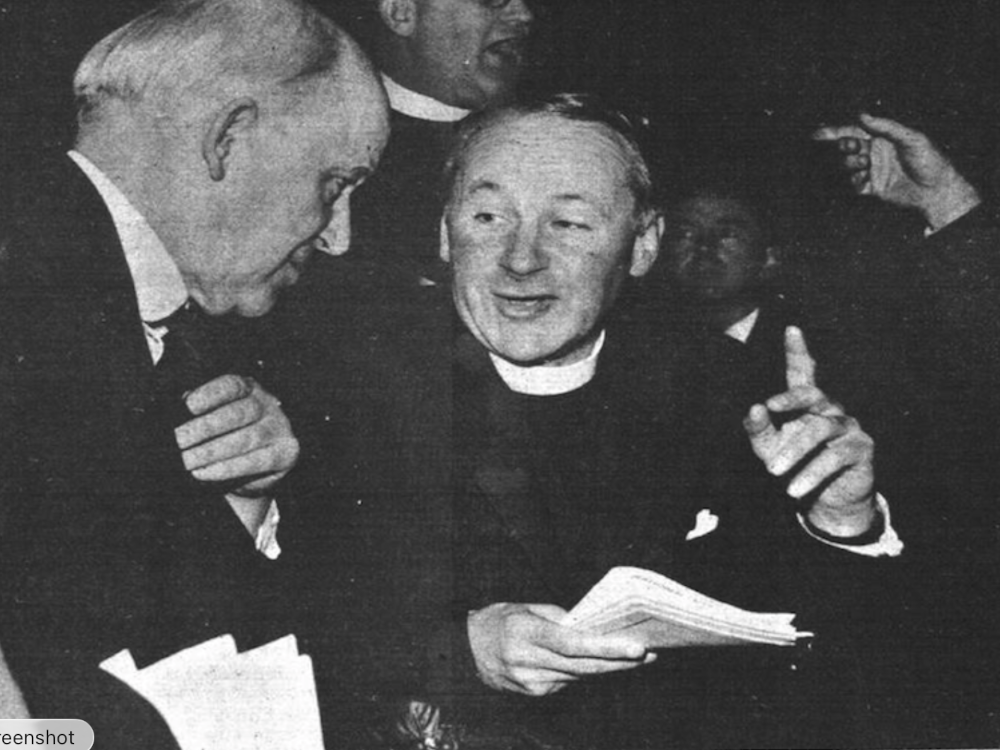
A recording of a speech that sent shockwaves around the evangelical world, Dr Martyn Lloyd-Jones speaking in 1966 in London, has been rediscovered and made public on the internet by the Martyn Lloyd-Jones trust. A Youtube version is here. (A text version was published in Banner of Truth’s book Knowing the Times in 1989.) Lloyd-Jones, a key evangelical leader, speaking at the National Assembly of Evangelicals in London, called for visible evangelical unity and for evangelicals to leave mixed denominations like the Church of England.
The result was less unity, with the chair of the meeting, John Stott, the leading Anglican evangelical leader, rebutting Lloyd-Jones’ argument, with many evangelicals staying in the Church of England.
If anything, the topic has become more controversial with the rise of alternative conservative Anglican and, more recently, Methodist fellowships, such as the Global Anglican Communion and the Global Methodists.
Lloyd-Jones’ speech
Lloyd-Jones was speaking at a time when moves toward church union were getting stronger. In England, the Presbyterian Church of England and the Congregational Church in England and Wales were talking, leading to the United Reformed Church forming in 1972. Methodists and the Church of England had been talking since 1950, with an attempted covenant failing in 1972.
Lloyd Jones described this ecumenical atmosphere: “Something entirely new has come amongst us, and there is that all the nature denominations throughout the world are telling us now quite friendly and openly that they’re prepared to reconsider the whole of their position. They’re prepared, as it were, to throw everything into the melting pot in order that a new world church might come out of it and be the result.
“Now this is a great fact which we’ve got to fix. They’re prepared basically to give and take, they’re prepared to reconsider, they’re prepared to make accommodations and new arrangements.”
Evangelicals, focused on their local churches, had been left behind, Lloyd-Jones explained.”Can we deny the charge that we as evangelical Christians have been less interested in the question of church unity than anybody else? I say we cannot deny that charge. Everybody seems to be talking about church unity except evangelicals.
“Whereas in our view of scripture and our knowledge and understanding of scripture, we of all people ought to be the first to preach the vital necessity of church unit, but we are the last to do so.”
However, Dr Lloyd-Jones spoke against the idea of evangelicals being one part of a big church union.
“Are we content to be nothing but an evangelical wing making our protests, exerting our influence, or being that that we gradually convict them and get them to see the wrongness of their ideas and the correctness of ours? Are we content to go on doing that, to remain in a church in which there are many who may hold views on sacramnets which we regard as the entirely wrong, views of the Bible which we deplore, views on the very being of God, some of them of the death of God movement.”
Instead, why shouldn’t evangelicals form their own ecumenical movement? And he neatly goes on to turn around the charge of schism, sometimes directed at evangelicals leaving traditional denominations”Why are we just divided as evangelicals? Why are we divided up amongst the main denominations? I think if we are honest, we’ll have to admit this, but most of us really don’t know. It’s an accident of birth. I was born a Baptist or a Congregationist or a Methodist or whatever it was. And because I was born there, I stayed and I was there to fight for it. … Now I’m arguing that for us to be divided, we were agreed about everything that really matters for us to be devided from one another in the main tenor of our life and in the bulk of our time and activity is nothing but to be guilty of the sin of schism and we really must face this most urgently. Let me therefore make an appeal to you evangelical people here present this evening. What reasons have we for not coming together?”
And in a phrase that has been quoted from accounts of the speech “
“I’m a believer in ecumenism, evangelical ecumenism. To me, the tragedy is that we are divided.”
The story recounted from Sydney
This year’s Moore College lectures covered the same period from the Anglican side. “Anglican evangelicalism in the age of John Stott, Jim Packer and Dick Lucas: Surviving and thriving in a mixed-up denomination,” was the topic for the lecturer, Andrew Atherstone, Professor of Modern Anglicanism at Oxford University. The full series is available at https://moore.edu.au/explore-resources/.
Atherstone has a special interest in following the lives of Anglican evangelical ministers who followed Dr Martyn Lloyd-Jones’ call and left the Church of England.
Atherstone recounts the climactic 1966 meeting: “This major national event is mired in misunderstanding and controversy from the very beginning. At the heart of Lloyd Jones’ address, so this is an event where the Evangelical Alliance in England have invited a thousand evangelical leaders together and the whole three-day conference is going to be on ecclesiology. And they say to Lloyd Jones, ‘We want you to give us your view of the nature of the church, your ecclesiological teaching.’ And he says to them, ‘Are you sure you want me to do that?’ And they said, ‘No, no, we think that’ll be okay.’ So he stands behind the lectern, and he delivers really what some commentators described as a prophetic address. At the heart of it was this call for visible unity amongst evangelicals to match their spiritual unity…”
“It was a passionate exhortation, and many young Anglican curates were on the edge of their seats, and they were going to go home that very evening and write their letters of resignation.
“And then John Stott, who you can also see in the picture, rises to announce the closing hymn, but first he interjects. He says, ‘Well, I’m grateful to Lloyd Jones for his address, but I have to say history is against him because many others have tried this without success. And scripture is against him because the biblical remnants,’ says Stott, ‘is always inside the church. It hasn’t left it.’ Well, Stott later apologised to Lloyd Jones for what was seen as a misuse of the chair at that event, but it did cause something of a public breach between these two evangelical figureheads and their followers, which has taken maybe 40 years to begin to heal. These public pyrotechnics, as they were called, brought the differences of ecclesiology out into the open. Do we believe in a gathered church of evangelical believers together, the truly converted, the born again, or do we believe in a geographical church, maybe a national church?”
Image: Dr Martyn Lloyd-Jones and John Stott