Charles Brammall on how God Fosters Jodie
Recent Academic scholarship has increasingly treated Jodie Foster not merely as a famous actress, but as a significant cultural figure through whom questions about gender, childhood, and authorship are examinable. Through whom Questions of spectatorship, trauma and female agency can be examined.
Postgrad scholarship swarmed like hornets around The Silence of the Lambs, The Accused, and Contact. Like wasps around Little Man Tate. Also her later work such as Nyad and True Detective. Night Country increasingly complicates the old image of Foster as simply the precociously intelligent child star who became a serious director.
Her public atheism should not therefore be confused with an indifference to religion. Foster appears fascinated by religious ritual, history and meaning, while declining religious trust herself. She is no Theist. But she desires her now adult kids to understand why people believe, fight, and suffer. Why they build civilisations around sacred ideas->
There is something almost wonderfully bizarre about that. A woman who says she is an atheist has nevertheless spent much of her life asking questions religion takes very seriously:
What makes a human being valuable? What is courage?
What happens when power corrupts? How should the vulnerable be treated? Can evil be resisted without us becoming evil ourselves?
None of that makes her secretly Christian. But it certainly makes her a fascinatingly interesting atheist.
* * * *
As a child, Jodie was once picked up in a lion’s jaws and carried while filming. The extraordinary incident did not end her career; she simply went back to work.
The episode makes an oddly appropriate introduction to our lived thespian: famous almost beyond comprehension, remarkably controlled, and intensely private. And apparently, rather less frightened by danger than by nonsense.
Foster has repeatedly said she is an atheist. In 2007 she told Entertainment Weekly that she “loves religions and the rituals”, while explaining that her family (syncretistically- ed.) celebrated virtually every religion.
In 2010, she said they deliberately “ritualise” holidays because she wanted her children to have a “real religious basis, a knowledge”, adding, “You need to know why all those wars were fought.”
That is religious literacy, not Christian faith. She allowed the kids to choose their own religion when they turned 18. There is no reliable evidence that she has subsequently converted to Christianity.
Her attitude is nevertheless unusually respectful for an atheist. Religion interests her historically, culturally and psychologically.
Her mother, Evelyn “Brandy” Foster, had been Catholic before becoming Muslim and believing in one God. Foster once told Andy Warhol that her mother was “the biggest part” of her life and that they were “like Laurel and Hardy”.
The relationship was complicated by its intensity. Jody has spoken about guilt, control and emotional defensiveness. “I’m a pretty defended person,” she once said. “I’m not somebody who’s particularly emotionally available.”
She described herself as internal and cerebral, with her life historically being “from my chin up”.
She has also joked mercilessly and self-deprecatingly about herself. Asked about appearing cold, she once imagined seeing an injured bird and thinking, “I think I’ll just kick it.”
It was self-deprecating humour, but it captured something real: Foster has spent a lifetime resisting the sentimental expectations attached to child stars.
Her childhood was extraordinary. She began acting professionally very young, appeared in Taxi Driver, and won Oscars for The Accusedand The Silence of the Lambs. Yet she has said, “I never wanted to be an actress, I just always was one.”
More recently she said she “would never have chosen to be an actor” and called acting “a cruel job”.
That helps explain Foster’s concern for other child performers. She has described feeling “maternal” towards Kristen Stewart, Seth Green and Claire Danes, because they share an experience most people cannot understand.
She deliberately kept her own sons, Kit and Charlie, away from show business when they were young. She raised her sons with her former partner, Cydney Bernard, whom she has described as a “righteous soul sister”.
She later married Alexandra Hedison, whom she has publicly thanked alongside the boys. Foster says her children did not even properly understand what she did for a living until surprisingly late.
Her relationships reveal a recurring paradox. She is private, guarded and cerebral, yet deeply loyal. Her friendship with Aussie Mel Gibson, a devout Opus Dei Roman Catholic, became particularly controversial.
Foster called him a “great friend”, a “complicated person” and the “most beloved actor” she had worked with, while explicitly saying, “I’m not defending his behavior.” That distinction mattered to Foster. Lynda Obst, producer of The Beaver, said, “Integrity is an incredibly important thing to Jodie.”
Foster’s loyalty to Gibson was therefore both admirable and rather shocking for Hollywood. It showed personal fidelity, but also demonstrated how difficult it can be to separate knowing a person from approving everything that person does.
Robert De Niro occupies another important place in her story. Foster first met him while making Taxi Driver (“Are you talking’ t’ ME?!”), and initially found him rather uninteresting. But he repeatedly worked through scenes with her, took her to diners and introduced her to improvisation.
Eventually, she realised that acting could be something much stranger and deeper than simply saying lines.
Issa López, who directed Foster in True Detective: Night Country, called her a “beast of an actor”. Christopher Eccleston has said he accepted a small role partly because Foster had been a heroine of his for years.
Kali Reis, Jodie’s co-star, impressed her because she needed remarkably little direction (some directors’ dream!). Foster’s admiration tends to be directed towards competence rather than celebrity.
Her own directing philosophy has changed. She admits that when directing Little Man Tate, fear made her excessively controlling, and she later apologised to Dianne Wiest. She now sees a good director rather like a “fully realized parent”: someone providing structure and expectations while respecting the person being guided.
That is perhaps one of the strangest threads in Foster’s career. She distrusts emotional manipulation, dislikes celebrity culture and does not particularly enjoy being examined.
Yet she has spent decades examining human beings for a living. Her lauded leading lady roles often involve precisely that contradiction – Silence’s Clarice Starling is vulnerable and powerful simultaneously.
Foster has spoken about giving Clarice a trembling hand, allowing fear to exist without making the character weak. Her films repeatedly return to intelligence, isolation, and danger. To moral responsibility and the difficult business of becoming an adult.
* * * *
So perhaps the lion is still the best simile- a child actress is picked up by an aggressive, awe-fully kinetically energised animal, survives… and just returns to work.
The little lass grows up into a multi-Academy Award-winning actor and film-maker, taises her little brood outside the leonine machinery of Hollywood, and defends friends when doing so costs her popularity. Then continually, conclusively, calmly informs the world she does not believe in God.
The lion can be explained.
The questions cannot.
Prayers:
Thank you,
our creator God, for joy.
Thank you for entertainers, especially Jodie, who make us laugh, cry, wonder and enjoy an ordinary evening. Thank YOU that they make us see the world differently. Thank you for the simple happiness of watching them work.
For the sake of Jesus’ beautiful, musical, artistic Name,
Amen
Thank you, God,
our dearest Father of Jesus’ family,
for imagination, including Jodie’s and her colleagues’.
Thank you for their stories, our God-given stories, and their music. For their comedy, drama and plays. Their puppetry, dance and song. And for their symphony, jazz, and grindcore. Bless You for all the strange human creativity that can brighten an ordinary evening. And praise you for people whose gifts become gifts to millions of strangers.
Bless you, universal everlasting almighty sustainer, provider and creator.
In Jesus’ mighty, merciful Name,
Amen
And thank you,
our gracious God, and loving Heavenly Father,
for entertainment.
Praise you for the simple pleasure of watching someone do something astonishingly well. Even when we do not know the artist, you do. And every good gift ultimately comes from you.
You brought all performers out of dust, will return them to it, and raise them again if they rely on Jesus.
For His praise, honour & eternal joy,
Amen
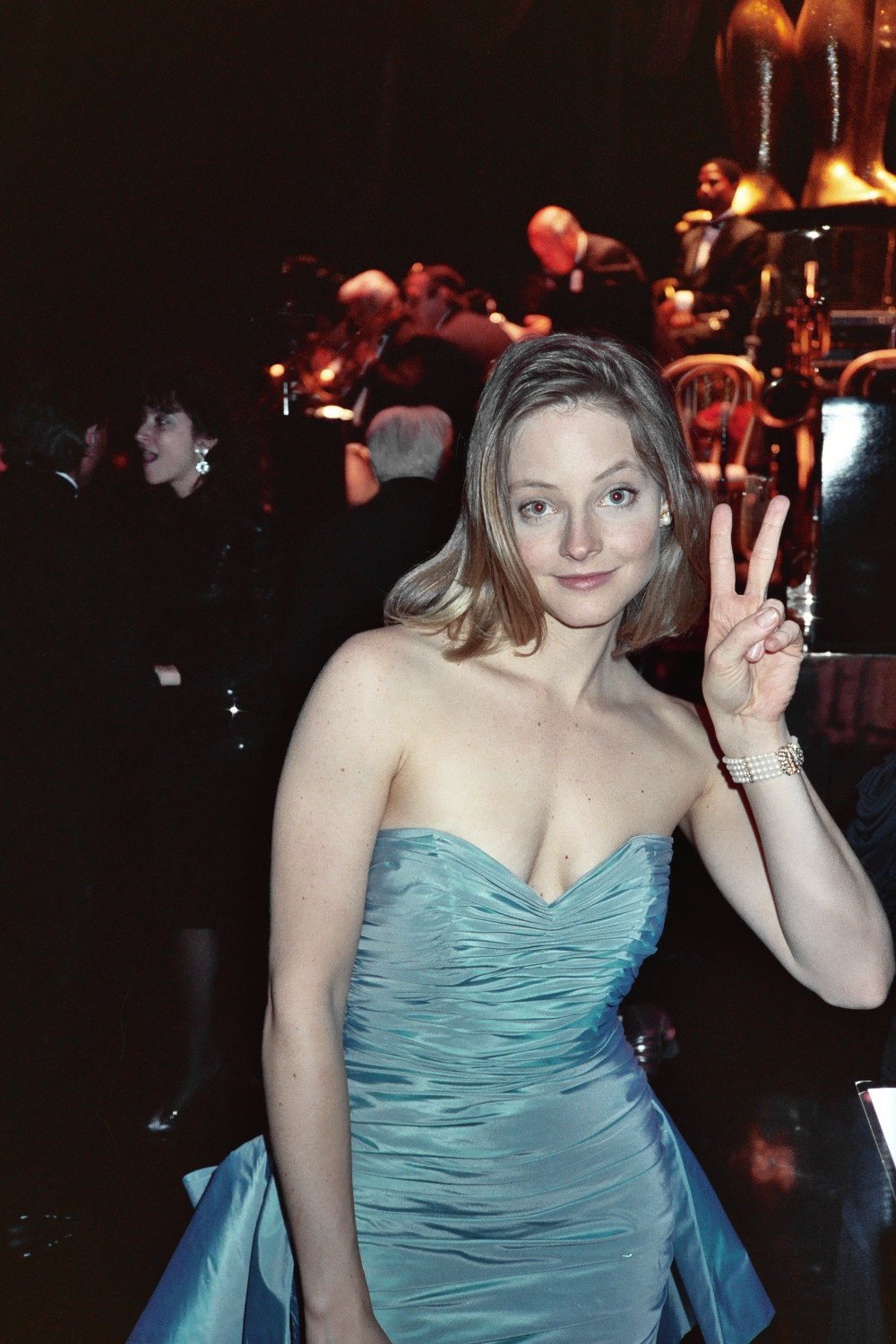
Image: Jodie Foster after winning an Academy Award in 1989. Image credit: Alan Light / Wikimedia