
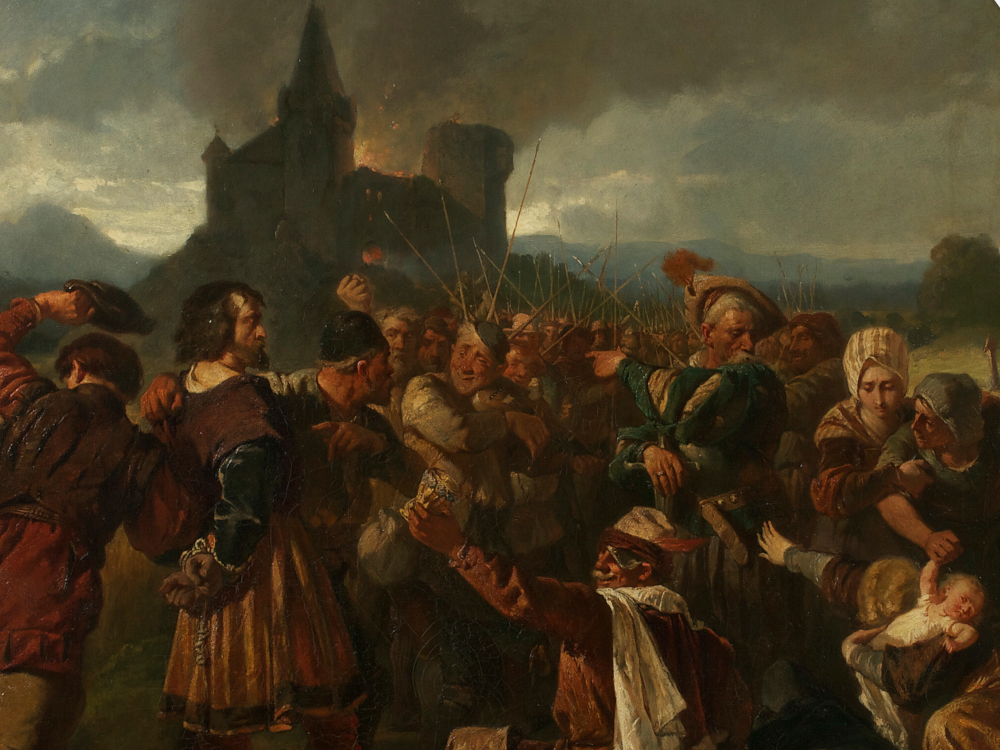
After Martin Luther launched the Reformation on October 31, 1517, prompting some Christians to celebrate Reformation Sunday this week, a rebellion followed about seven years later.
Charles Brammall recounts the mystical influence behind the Reformation’s early split when peasants rebelled.
In 1525, Thomas Müntzer promised peasants that God was about to overturn the wicked world. Martin Luther, meanwhile, thought rather less of his colleague’s eschatological programme. After Müntzer was captured at Frankenhausen, Luther wrote that anyone who had seen him had “seen the very devil, and at his worst”.
The astonishing thing is that Müntzer’s theology really was much stranger than the conventional “Luther versus communist revolutionary” story suggests. Recent scholarship, particularly Vincent Evener’s Enemies of the Cross (Oxford University Press, 2021), stresses the mystical dimension:
Müntzer believed suffering and inward spiritual transformation could produce Christians sufficiently illumined to recognise and enact God’s will. Luther instead insisted that salvation came from outside the believer, extra nos, rather than from an allegedly divinely illuminated inner capacity.
Dreams and Voices
Müntzer was not simply anti-Bible. His problem was where authoritative revelation continued to occur. In his 1524 Sermon to the Princes, he argued that God’s Word had to work within the human heart, and that visions and dreams must be tested against Scripture.
Yet he also insisted that genuine revelation would actually come to pass. The result was an unstable mixture of biblical exegesis, medieval German mysticism, prophecy and apocalyptic expectation.
E. M. V. M. Honée’s Cambridge study traces precisely these mystical and apocalyptic traditions, while Andrew Bradstock’s research describes Müntzer’s thought as an unusually tangled combination of “mystical”, “apocalyptic” and political-revolutionary elements.
Müntzer could therefore interpret contemporary politics through Daniel, Revelation and prophetic patterns. In April 1525 he wrote to his former congregation: “The whole world is awake” and urged them to fight the “fight of the Lord”. His theology had moved from inward spiritual testing towards interpreting the peasant rising itself as an instrument of divine judgement.
Why Luther Recoiled
The deepest disagreement was theological before it was political.
Müntzer distrusted Luther’s sola fide because he thought faith could become passive; he opposed Luther’s sola scriptura insofar as it excluded the continuing “inner word”; and he rejected Luther’s doctrine of the two realms because it seemed to leave existing political authority substantially intact. Hans-Joachim Hahn’s study in Oxford German Studies identifies these as central fractures between the two reformers.
Luther’s objection was consequently not merely, “Thomas has become too political.” He thought Müntzer had made subjective spiritual experience into an authority capable of overriding Scripture, ordinary vocation and lawful government. Evener’s analysis places the disagreement over the human heart at the centre of their quarrel.
And then came the extraordinary language. Luther called Müntzer “that archdevil who rules at Mühlhausen”, accusing him of stirring up “robbery, murder and bloodshed”.
Müntzer returned the compliment in his own idiom, attacking Luther’s “Lutheran gruel” and “Wittenberg soup”. The Reformation, one discovers, was not conducted entirely in the serene prose of stained-glass windows.
Lords, Slaughter and Water
The Peasants’ War itself was vastly bigger and more complicated than Müntzer. Recent research by Gerd Schwerhoff argues against older heroic narratives that reduce 1524–25 to a straightforward proto-revolutionary class struggle.
Philipp Rössner’s 2025 research adds economic history, emphasising peasants’ long-standing grievances over dues, services, rents and increasingly monetised exploitation.
Nor was the violence one-sided. The new Taylor Editions of Luther’s anti-peasant writings explicitly note severe lordly violence, alongside atrocities committed by rebels, including the Weinsberg massacre, where peasants killed captured nobles.
There is, however, a useful correction to the picturesque story of peasants drowning in a Frankenhausen swamp. The documented mass drowning occurred elsewhere: at Leipheim, where thousands of fleeing peasants were driven towards the Danube, and some were forced into the river and drowned. The Frankenhausen massacre was principally a catastrophic slaughter on land.
At Frankenhausen on 15 May, the princely army annihilated the poorly armed peasant force. Modern scholarship gives casualty estimates in the thousands; Müntzer himself was subsequently captured and executed on 27 May.
And here history supplies its own black comedy. The great prophet who had promised that God would overthrow the mighty was discovered hiding in a bed, attempting to pass himself off as an innocent sick man. Much like the hirsute Saddam Hussein in his subterranean burrow. In Muntzer’s case, documents in his possession gave the game away.
Luther ≠ Lutheranism
This distinction matters. Luther was not “Lutheranism” in 1525. Lutheranism developed institutionally and confessionally over subsequent generations. Andreas Stegmann’s Oxford Research Encyclopedia study notes that sixteenth- and seventeenth-century Lutheran Orthodoxy both inherited Luther and developed, clarified and sometimes moved beyond particular elements of his theology.
So the 1525 quarrel should not be lazily reconstructed as “Lutheranism versus radical Christianity”. It was a collision between two competing accounts of revelation, faith, and suffering. Of political authority and the Holy Spirit, both claiming biblical legitimacy.
And there is the final, wonderfully awful twist: Müntzer believed the approaching catastrophe would reveal who truly possessed God’s Spirit; Luther believed Müntzer’s inward certainty was precisely the danger.
On the battlefield, the man who claimed divine certainty ended up underneath a bed, while the man who called him the devil spent the rest of his life explaining what Christians should do when theology meets an army.
The devil, it seems, had excellent eschatology but rather poor arrangements for getting out of town.
Prayers:
Dear Lord God,
Please save us from confusing our own strong feelings, dreams or convictions with your voice. Give us hearts shaped by Scripture, humble enough to be corrected, and wise enough to test every claim of spiritual certainty. Keep us close to Christ, who is your Word made flesh.
For the sake of Jesus’ mighty name,
Amen.
Peace-giving Lord Jesus,
Please forgive us when our theology becomes a weapon rather than a means of knowing you. Keep us from pride, fury and contempt for those who disagree with us. Give rulers justice, give the oppressed courage, and give your people peace without surrendering truth.
That Jesus’ name might be praised,
Amen.
Our Gracious God and Loving Heavenly Father,
Please make us honest about our own weakness. Müntzer preached courageously until courage became costly; Luther thundered against him while carrying his own failures and fears. Please keep us from imagining ourselves as heroes. Please give us repentance, humility and steadfast faith when our grand theories meet reality.
In Jesus’ eternal, international, almighty Name,
Amen
Image: Rebels capture a count in an 1867 painting of the German Peasants’ War by Hermann Eichler (detail). Image Credit: Wikimedia Commons / Österreichische Galerie Belvedere