
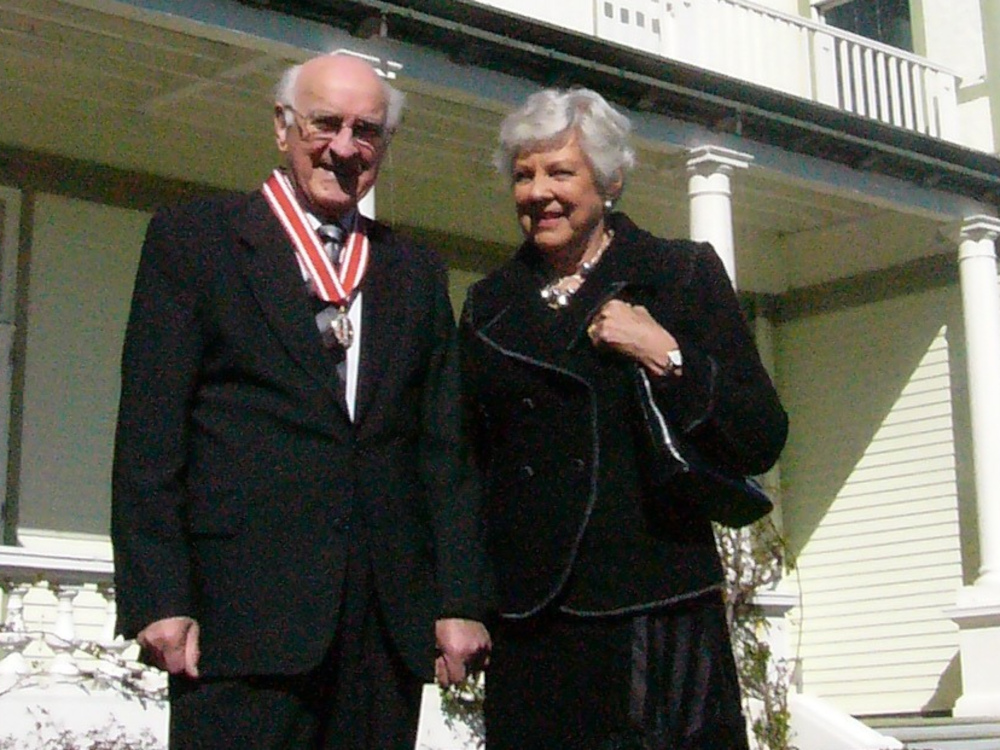
Sir Lloyd George Geering ONZ GNZM CBE (26 February 1918 – 5 November 2026)
Lloyd Geering was New Zealand / Aotearoa’s oldest living man from 17 September 2025 until his death. But he was more famous, certainly among Christians, for his heresy trial.
He grew up the youngest with parents who worked in the Kaiapoi woollen mills and on small farms where he grew up without electricity. A bright student, Geering was a product of the Student Christian Movement, which he encountered at Otago University in Dunedin on the South Island in 1937 after a friend invited him.
A pacifist and exempted from war service, he entered the Presbyterian Church’s Knox College in 1940.
“Once ordained as a Presbyterian Minister, Lloyd served in Kurow, Dunedin, and Wellington, and held Chairs of Old Testament Studies at theological colleges in Brisbane and Dunedin,” a Victoria University Wellington profile recounts
“Lloyd’s intellectual curiosity led him to ask big questions—one of his earliest sermons was entitled ‘What is God like?’ In 1966 he published an article called The Resurrection of Jesus where he explained that the resurrection and ascension could no longer be taken as fact. A lecture and further article denying the immortality of the soul led the Presbyterian General Assembly in 1967 to charge him with ‘doctrinal error and disturbing the peace and unity of the church’…
“While it would be unfair for Sir Lloyd’s lifetime accomplishments to be defined by the trial, it created “a great dividing line” in his life and for religious debate in New Zealand. Sir Lloyd maintains that he wasn’t saying anything that hadn’t already been discussed by other theologians overseas and pointed out that his accusers ‘hadn’t kept up with their reading!’”
Looking back, Geering told a 2004 meeting at Pitt St Uniting in Sydney, “But before there had been very much time for any adequate discussion of the real issues, a motion was put to the House, and later carried firmly on the voices – and it said that ‘the Assembly judges that no doctrinal error has been established, dismisses the charges and declares the case closed.” During the trial, he had maintained that Jesus’ bodily remains were somewhere in Palestine, and the bodily resurrection had never occurred.
After the trial in 1967, which had been televised, Geering became a powerful voice for a Liberal version of Christianity, establishing the Religious Studies department at Te Herenga Waka / Victoria University in Wellington, and becoming a high-profile commentator in Aotearoa / NZ media. He had columns in the Auckland Star and the New Zealand Listener and published 20 books.
But his legacy of significant change in NZ can be seen as a Pyrrhic Victory. A successor of his at the Religious Studies department, Professor Paul Morris, describes how Geering’s powerful advocacy for liberal Christianity had perverse outcomes in a profile of Geering for his 100th birthday.
“He was absolutely nodal in our recent national cultural narrative, and he has a significant place in our national story,” says Morris, a student of Geering’s during his time teaching Religious Studies at Victoria University.
“He empowered a whole generation of New Zealanders, within the Church and without, to overcome the challenges to religious beliefs by rendering them compatible with modern thinking. ‘This is what it was really all about, this is the framework and get on with it.’”
“He effectively closed down public debate about religion and muted religious voices in the country. It wasn’t just the closure of debate around religious liberalism, it was a more general closure of religious debate in New Zealand,” says Morris.
“I think that’s an ongoing legacy, and it’s proved difficult to revive those voices. In the main there hasn’t been a religious voice outside of a more right-wing one with a particular ‘traditional’ theological view, so there hasn’t been much of a public debate.”
Rather than create a bastion of liberal Christianity, Geering weakened churches according to Morris.
“Another part of Geering’s legacy has been providing a conduit out of the Church for considerable numbers of New Zealanders, says Morris.
The profile adds, “Churches were already ‘in freefall’ by the time of the televised heresy trial that brought Geering to the general public’s attention, but his ‘modern’ stance on religion exacerbated the trend by showing people how they could think religiously outside of the established churches.”
By the end of his life, Geering was disillusioned with the church in NZ but believed in humanity: TVNZ reported on this 100th birthday that “he says he’s watched the church ‘go down hill fast’ and that we’re learning ‘as a human race to accept ourselves and our differences and become more of a global community.'”
“I have a good deal of optimism about the community at large,” Sir Lloyd says.
The 1967 heresy trial marked the Presbyterian Church of Aotearoa New Zealand as a liberal church, tolerant of those who deny the resurrection. But perhaps the more contemporary “progressive” label does not apply, with the church officially not supporting same sex marriage – but with some high-profile churches performing them.
PCANZ statistics: Sunday attendances for adults
• 13961 in 2025 (18+)
• 17139 in 2015 (18+)
• 29008 in 2095 (25+)
New Zealand’s scene bears the marks of Geering. The traditional protestant churches- Methodist, Presbyterian and Anglican are dominated by progressives or liberals, with evangelicals in a (small?) minority.
There are large Pentecostal churches, but there is a tendency for these to be aligned with right-wing politics, with Destiny Church, for example. Nelson Diocese in the Anglicans in the Province of Aotearoa New Zealand remains a Kiwi echo of the Diocese of Sydney. The Open Brethren, organised as the Christian Community Churches of NZ, have 170 to 202 assemblies. Baptist Churches of New Zealand (Te Hāhi Iriiri o Aotearoa) draw some 25,000 people each Sunday to their 250 evangelical churches. Conservative Presbyterians joined various breakaway churches into the Grace Presbyterian Church in NZ, which is similar to the Presbyterian Church of Australia, in 2002. The GPs have 27 local churches.
Image: Lloyd and wife Shirley at Government House at Lloyd’s investiture with the Order of New Zealand in 2007. Image Credit: gg.govt.nz
Do you mean 2005 above rather than 2095?
1995? We’re witnessing the 2nd coming of the Y2K bug.