
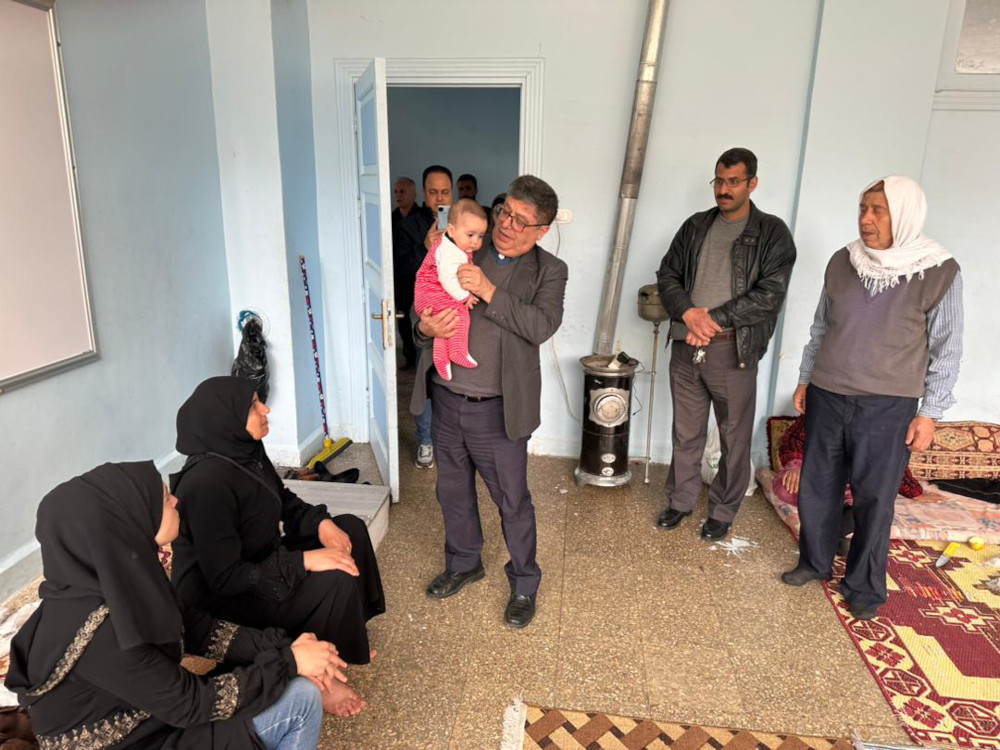
Pastor Samir Yacco pastor of Christ the Redeemer of the World Baptist Church in Dwelia a suburb of Damacus has been in Australia speaking to Anglican Aid and churches about what happening in Syria. Pastor Yacco runs Damascus Church Aid, a project providing emergency relief to vulnerable people, in partnership with Anglican Aid.
The Other Cheek interviewed pastor Yacco, Samir Yacco, the pastor of Christ the Redeemer of the World Baptist Church in Dwelia, a suburb of Damascus, has been in Australia speaking to Anglican Aid and churches about what is happening in Syria.
The Other Cheek interviewed Pastor Yacco.
Pastor Yacco: I have been in the ministry for 41 years after graduating from Sydney Bible Baptist College.. Also, I am the President of the Baptist Union in Syria till the end of September next month.
Pastor, where is your church located?
It’s in a Christian middle-class area in Damascus, the capital city of Syria. This middle-class suburb is called Dwelia.
It’s interesting you tell me, you are in a Christian suburb. So, in Syria, are there places where Christians live and how is life for them after the fall of the Assad government?
Formerly, this suburb was like 90% Christians. For this reason, we call it a Christian suburb. Now, after the war, the Civil War broke out [in 2011, beginning with protests leading to a savage crackdown and lasting to the fall of the Assad regime in 2024], many were displaced and found shelter in this area. But still, the Christians are dominant, or let’s say in the majority. After the fall of Assad, demographically speaking, the picture of Syria’s map was changed. Many came back to their houses after being evacuated. But others left the city for safety, especially those who are Alawites, I mean those who belonged to the ethnicity or denomination of Assad: it’s sad, but this is the profile of real life in Syria.
Do Christians feel reassured after the fall of a sad or are they still wondering what’s going to happen next?
Actually, from the beginning, [Syria’s new leader] Ahmed al-Sharaa tried to calm down all our fears and phobias, [saying] that nothing will happen. I mean, the Christians will be facing any danger or a threat, [only when] individual things could happen here and there.
Yet [any attacks] are not justified because Christians in Syria don’t resort to weapons or to use arms because they think and they believe that it is the state’s responsibility to protect all citizens.
For this reason, when the suicidal attack took place in the Greek Orthodox cathedral, it caused the current regime to be perplexed because they couldn’t justify it or even explain it. Clashes between Sharaa’s army and Alawites or with Druze were actually explained by the encounter of two armed groups. But in the church, it took place in a place where people don’t even have a knife to peel an orange. So the regime, the present regime, was actually embarrassed.
So you are fully expecting to return to Syria from this visit to Australia?
Yes, absolutely.
And your life simply goes back to being normal living as a pastor in Damascus?
Yes, actually, this is our fate, our destination, our choice, and our decision. We can’t give up what the Lord has put on us to do his work. Any threat, any danger, anything bad looming on the horizon. It’s not an indication or a licence to give up and to flee. No.
I have been in the ministry for 41 years, 15 years out of them during the civil war, when it was like a spree of killing, kidnapping, imprisonment, et cetera. And we were there, till now.
Thank God, we are continuing our mission there, not only to preach the gospel, but also to lighten the burden of what the people are facing, of different needs, physical and spiritual. And the church has the profile of a good Samaritan, being acknowledged by all denominations and walks of life in Syria. They know that we are peacemakers and we don’t hold any grudge or resentment against anybody, and we are ready to forgive.
Now, there’s a group called Damascus Church Aid that you lead. Can you tell me about them?
Our local resources are very poor, so we have to rely on Christian organisations that have a heart to come to our rescue. From Australia, let’s say Anglican Aid comes first and other sister churches individually, plus some Christian organisations in Europe.
And recently, after the fall of Assad, Samaritan Purse came in a strong way to establish their station in Syria and to help people in need. They started with food, hampers, detergents, and accommodation. Maybe in the future we’ll have extra plans to relieve the burdens and distress that people are living under.
It’s obviously been a more difficult place than Australia to be a pastor. So, can you tell me what keeps you going, serving Jesus in Damascus?
Speaker 2 (09:05):
Actually, it’s the call, the invitation. If you do something over decades, there is no excuse, no justification to leave. We have examples in the Bible. Those who were facing some threat or hardships, let’s say. But they stayed till they finished their mission, and they came to achieve their goals. And for this reason, if I live or give up or leave the country, I would ruin all my testimony, all my CV in serving Christ.
What should we be praying for you and for the country of Syria
In a country like Syria, which is likened to a hospital and nursing home and as a place of special needs. All people, all people in Syria, are needy because the trauma touched all classes of society and all ages, from the babies to the elderly. So when you pray for us, whatever comes to your mind, we’re in need [of it].
Image: Pastor Yacco with a family in Syria. Image credit: Anglican Aid