

Peter Bentley
A review of Sarah Irving-Stonebraker’s ‘Priests of History: Stewarding the Past in an Ahistoric Age’ (2024) [1]
I did not need to be converted to Sarah Irving-Stonebraker’s primary thesis, but after reading the book it has confirmed many of my thoughts over the last three decades.
Sarah’s area is intellectual history and that is certainly evident throughout the book, though the foundation is based in the philosophy of history and specifically in the Christian context of understanding history. The title links to the concept of the priesthood of all believers, encouraging all believers to be priests or stewards of history. Sarah coins the phrase “Ahistoric Age”, and this provides the context as it mirrors other ages, such as the ‘mediaeval age’ or ‘early modern age’. It is a timely book, and I emphasise that word timely, as time is a significant matter examined in the book as well.
I have a distinct memory of one of the interviews I conducted over many years of research. [2] This was nearly two decades ago, and the questions were quite wide ranging, with some on contemporary issues and faith, Christian doctrine and beliefs, all within a conversation. It was before the centenary of World War I, which provided the focus of many significant memorial events. The young student, about 15 years of age, told me quite emphatically that she would not know anything about that event because she had been born a long time after. Apart from providing an enlightening ‘ahistorical’ illustration, my primary concern was her seemingly thinking I had been born before the war.
I have written in a more popular way on this topic, and have spent many hours in church settings (through sermons and seminars/talks) raising these issues and using examples from church history to illustrate our common journey of faith. I have found it to be an increasing struggle with the growing focus on the immediacy of the contemporary context, and meeting some Christians who have little interest in, or even regard for, the faith of those who have gone before, yet alone the faith once delivered. This is the context that Sarah writes for, outlining the changes in society and culture and in the church, and the impact of the ‘Ahistoric Age’.
Sarah’s book considers the spirit of this age, namely the focus on the individual and identity which has had a fulsome impact on historical consciousness, ably facilitated by social media, and enhanced by the smart phone (some very interesting comments on the latter).
Sarah explores where this ‘ahistoricism’ has come from, its impact on society, and particularly on the church. In terms of the impact on the church, Sarah outlines and elaborates on the following topical and relevant points.
1. Doctrinal drift from orthodoxy
2. Individualism and comfort
3. Entertainment and celebrity culture
4. A consumerist and marketing model
5. Corporate and depersonalised ministry models
While Sarah is an academic, the book is not primarily a work for other academics, though they would be well helped by reading. It is aimed at encouraging all people, but particularly Christians to think more about their faith and practice in this contemporary era. The writing style is also very easy to digest, particularly helped by the succinct chapters and framing of stories and points. The academic part is highlighted by the extensive and relevant footnotes, and I always find these helpful for elaboration and further reference.
People who have read widely, particularly in church history will be familiar with many of the authors mentioned. Those who are familiar with the particular area of Christian history will appreciate the synthesis that is brought to understanding the continued importance of the past.
Sarah highlights the need to understand the complexity of historical contexts and particularly to review the swift and more regular judging today of prominent people from the past. The framework is founded in an understanding of our continued sinful nature. Perhaps this may help moderate some people’s immediate and sometimes biased judgement of other times and even people today.
There is practical advice on reviving historical spiritual practices today, and how these can enhance our personal faith and life, and renew our local church. Stories from the past and the present, including her own church and family worship and examples of devotional Christian practice enhance the theoretical framework.
Interestingly Sarah’s testimony of coming to faith is woven throughout the book and consolidated at the end. It is unusual for an academic to share their Christian conversion, but it is integral to her historical development and foundation.
There are many case studies, and inspiring examples of Christians and their impact on the church, culture and the wider society, including now more well-known Australian Aboriginal leaders William Cooper and Doug Nichols, US abolitionist Frederick Douglass, and people I was not familiar with including the Hart sisters, Anne and Elizabeth.
One small critique in relation to illustrating the first of her five characteristics of the present ‘ahistoric age’; ‘The Past is Seen as a Source of Shame and Oppression from Which We Must Free Ourselves’, Sarah mentions the campaign to remove a statue of Edmund Barton in an unnamed town. [3] Having grown up near the town that I think this is referring to, I acknowledge the overall point that the campaign focusses on one aspect of Barton’s life, namely ‘his racist views’ (page 25), but I believe there are other elements as well, with some campaigners having a nuanced approach, particularly on the issue of location. Sarah mentions this example in relation to the concept of cancel culture (not surprising given the book’s theme), and given her Christian and reformed Anglican foundation, I believe some people will unfortunately and immediately put her in one camp, rather than seriously consider the overall thesis she is making, and her fifth characteristic of the ‘Ahistoric Age’, ‘We Are Unable to Reason Well and Disagree Peaceably about the Ethical Complexities of the Past’. This particular and very contemporary example would have been better served by a fuller reference and perhaps an interview to highlight the complexity of times past.
It should be very clear from my review that I have found this to be an invaluable book, and one not only to be read, but used in a wider way for serious study within the church to help change the ahistorical understanding and spiritual habits of local members. I believe this study would be enhanced by undertaking in conjunction with reading Jeffrey Bilbro’s book Reading the Times. A Literary and Theological Inquiry into the News, as he focusses on the substantial issue of contemporary news consumption and social media, and like Sarah encourages a renewed spiritual life and discipline framework.
Coming back to ‘time’, I wonder how we can enable people to grapple with this overall issue when there are indeed so many Netflix shows still to watch and less reading being undertaken, and less considered dialogue and conversation, and even more social media bites.
I believe it would be helpful for Sarah to do a podcast series, as this will connect with another audience, and also a series of short documentaries, using some of the stories of people mentioned in the book to illustrate the issues, and provide a greater awareness that there is more to this life than the present and your or my presence.
Peter Bentley
Blog: pkbentleyarchive
30 August 2025
[1] The book has been recognised by The Gospel Coalition, winning the 2024 Cultural Apologetics Award, and was short-listed for the 2025 Australian Christian Book of the Year.
It was only near the end of the book when a brief comment is made by Sarah about her Labor historian father that I realised the ‘name’ connection and being familiar with his work, this made her testimony even more interesting.
[2] I have interviewed over 2000 people for a variety of projects and articles, mainly school and church related during the last four decades.
[3] This contemporary debate reminded me of the Utopia episode ‘Grand Designs’ (Series 5, No.2)
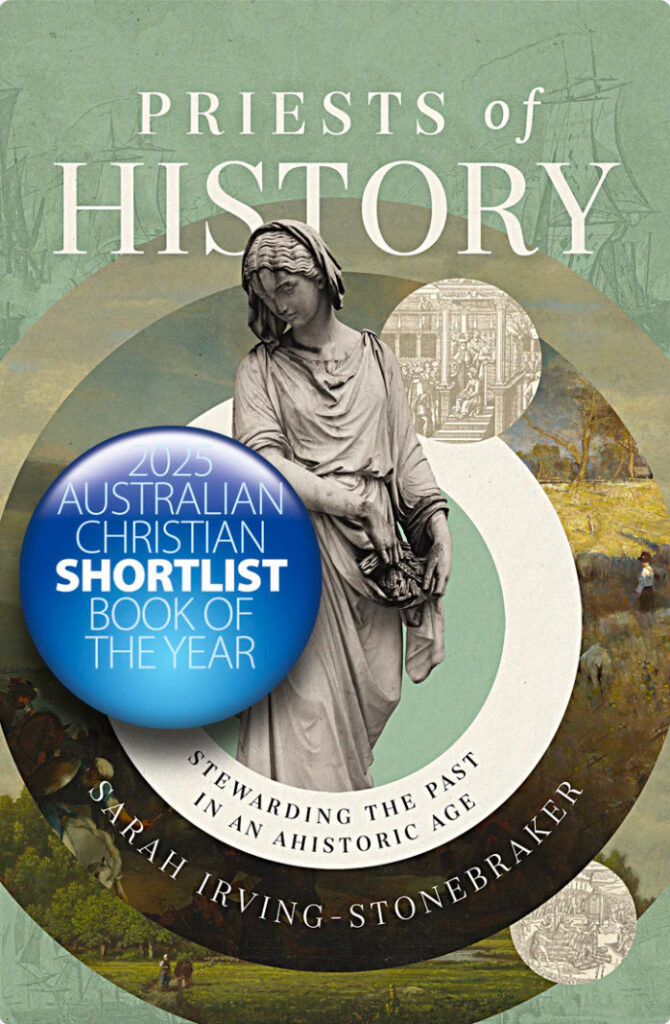
Priests of History: Stewarding the Past in an Ahistoric Age
Sarah Irving-Stonebraker,
HarperCollins Religious US
Available at The Wandering Bookseller $27.99