Premier Chris Minns is being urged to keep his promise that prayer would be protected under the Conversion Practices Ban Act 2024 by the Sydney Anglican Synod. The motion notes, “The Hon Chris Minns MP, as Opposition Leader, stated – ‘Taking offence at the teachings of a religious leader will not be banned. Expressing a religious belief through a sermon will not be banned. And an individual, of their own consent, seeking guidance through prayer will not be banned either.’”
The Other Cheek covered the Parramatta faith communities town hall meeting where Minns made the promise Labor’s Chris Minns promises no ban on preaching, prayer in conversion therapy bill.
Bishop Michael Stead, in moving the Synod motion that the government keep the promise by correcting the ACT or changing its implementation, recalled that he briefed church ministers “based on assurances that had been given to faith leaders about the scope of exemptions in the act, which were included at the specific request of the faith leaders that the government had consulted to ensure that the act would not prevent a person of faith from seeking help, including prayer to live in accordance with their faith. And it wouldn’t prevent faith leaders, people from any faith, calling on members of their congregation to live in conformity with the teachings of that religion. So, praying with somebody at their request and telling them what the Bible says and saying, ‘You should live this way.'”
Faith leaders had been assured that assisting someone not to act on their unwanted desires through prayer was not suppressing their sexual orientation, Stead recounted. In addition, they were assured of a second safeguard in section 33B, which states that genuinely facilitating an individual’s coping skills, development or identity exploration to meet the individual’s needs is not a conversion practice.
An Anti-Discrimination NSW website interprets the Act differently, significantly narrowing religious freedom. “…praying with or over a particular person in an attempt to try to change or suppress that person’s sexuality or gender is unlawful. It is not unlawful for a person to seek counsel or guidance from within their faith. Counsel and guidance, including prayer, can still be given as long as it is not an attempt to change or suppress the person’s sexuality or gender identity.’”
The Anti-Discrimination NSW website also impacts freedom to discuss marriage as being between a man and a woman. “‘…telling a person who is same-sex attracted they must be celibate or never marry, in circumstances where a heterosexual person would not be given the same guidance, could be regarded as suppressing a person’s sexuality and may be unlawful, depending on the circumstances.”
Prayer is a conversion practice only when the person praying believes prayer works.
“The Attorney General’s second reading speech states that section 33B does not apply to programmes or services which have a predetermined outcome that a person ought to suppress their sexual orientation or gender identity,” Stead told the Synod. “Ever since he said that, we’ve been asking for clarification about what happens if somebody comes asking what the Premier has said you’re supposed to be able to do. And at that time that question was finally answered for us at the Senate Estimates Committee by Mark Follett, who’s the executive director of policy reform and legislation of DCJ, which has oversight of Anti-Discrimination NSW. He was asked whether responding to the requests, and I quote, ‘Please pray with me so that I won’t act on the same sex attraction that I feel was a conversion practice.'”
Stead reported that Follett’s answer about prayer was that it was only a conversion practice if the person praying believed that prayer was effective. The Minister, not the person receiving the prayer.
“If you don’t think that God’s going to answer the prayer, then you’re right [as far a the conversion law is concerned]. But if you actually believe that God could and might answer the prayer that you’re praying and the intention is that this person won’t act on the same sex attraction that they feel, then it’s a conversion practise.”
Stead told the Synod that DCJ had reinterpreted the Premier’s promise. “When Mr Follett was then asked whether this interpretation of the legislation contradicted the Premier’s promise that an individual, of their own consent, seeking guidance through prayer will not be banned, that seems to be very much within the parameters of their promise. He sought to redefine the Premier’s promise as only applying to seeking guidance; if the person can seek guidance, they’re not being banned.
“The person there who is going to pray, they’re the ones who are in trouble. If this interpretation is correct, then ministers are in breach of the act. If they pray with someone who asks a prayer about exercising their sexual desires in accordance with the scriptures, you will be in breach for providing mutual support groups for people who seek guidance on how to faithfully as believers like the ministry of. This is untenable for us as Christians.”
Mike Southon, Executive Director of Freedom For Faith, the Christian Think Tank, told the Synod that election forums held in churches before the last election had led to the Premier’s assurances that Bishop Stead had discussed.
“Thousands of emails streamed in to MP’s offices and I heard the stories of how many they were receiving. And as a result, that’s why the government … negotiated with faith leaders, and the result we got was not perfect. The result we got is not even good, but it is significantly better. It’s miles better than what the Victorian model was and what the proposals were before the election.”
Southon urged senior ministers to support election forums this time around. And to form relationships with their local MP. “If we keep going in this pattern, we have every chance under God to fix this legislation. So what do we do? Well, unless we get a breakthrough in negotiations in the next couple of weeks, you will be receiving emails from Bishop Stead and me asking you to start again. Let’s get your people writing emails to your MP. And again, we’ll give you all the resources you need.”
A lay member of Synod and barrister, Tim Robertson, spoke against the motion, pointing out that the legislation had yet to be interpreted by the courts. “The concern is, can we talk to people about their sexuality? Is it going to be against or not in compliance with the act? The answer in my view is it is in compliance with the act to have that conversation and starting an argument about amending an act that’s not yet been interpreted isn’t the main argument. Our argument is to show people Jesus. So why would we distract people with something else and then just leave them back there?”
Minister Andrew Barry did not advocate for voting either for or against the motion but raised another concern, “I feel like we keep on asking and seeking for freedom for our faith. And I didn’t realise that we needed it. I thought Jesus gave us freedom. And I thought all authority in heaven and earth has been given to Jesus, and he has given it to us. And so there is no government law that can say we cannot pray. I feel like when we’re asking for more freedom from the government, we are asking the wrong person or the wrong organisation. When we’re seeking freedom from the government, we’re actually implying that the government has authority over what we believe, over what we do and how we pray. We should be petitioning not the king, but the king of kings.”
Minister Michael Paget spoke of his church community: “As many of you know, St. Barnabas Broadway is actually privileged to be the spiritual home to quite a number of faithfully celibate single people, both heterosexual and same sex attracted, as well as to many who are seeking to be faithful to God’s creative purposes and intentions in the midst of the experience of gender incongruence. We are no means alone in this. The same is true for many churches around us and throughout the diocese…
“And in my view, such sisters and brothers are seeking to heed Jesus’ voice are exemplars of faith for us, modelling for us what it is to trust in the goodness of God. Now, there are many communities in our society where these sisters and brothers could find encouragement to pursue sexual desires outside of lifelong exclusive heterosexual marriage or sexual identities outside of God’s good purposes for them. However, they have come to us. You have come to us and entrusted themselves or yourselves in Christ to us, knowing our convictions about the shape of Jesus call upon all of our lives, not merely the initial profession of faith…
“But spaces such as these, where it is safe for such followers of Jesus to seek out the refuge as well as encouragement and support in pursuit of their deep convictions are genuinely at risk. And there are members of my church who are fearful that one day they will no longer find someone who is able to stand alongside them and not merely explain what the Bible has to say to them, but to pray that they might have the courage and the perseverance to live out to the day that Jesus calls them home. Please keep that in mind as we consider this motion.”
The motion passed on the voices.
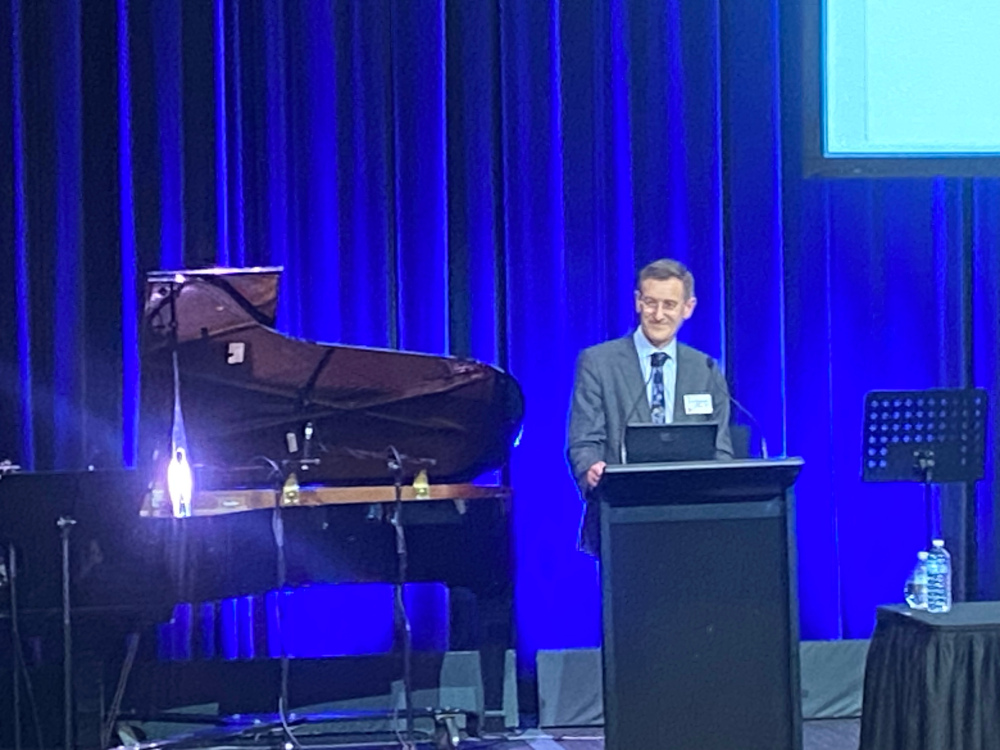
Image: Bishop Michael Stead addresses the Synod
A useful and thought provoking article about this contentious question. Thanks, John.
However the writing between “Ken Follett” and “Mike Southon” is a little confusing. I think the quotation ends at, “… that I feel”. And “…for people who seek guidance on how to faithfully as believers like the ministry of.” looks like it’s missing words or part of the sentence had slipped out of joint.
Thanks for the work you do in keeping us informed.