
Charles Brammall
Rev Jesse Jackson (18 Oct 1941- 17 Feb 2026)
Christian, US Civil rights activist & former Shadow US Senator,
An ontological quandary clings to certain men as if a second shadow. If he builds his identity on proximity to greatness, who is he when it shrivels or falls? What’s left extant when the spotlight slides six inches left? Jesse Louis Jackson belonged to this narrow category.
April 4, 1968, at Memphis, Tennessee’s Lorraine Motel, and Dr Martin Luther King Jr., namesake of our great 15th-century Deutschland, a protesting reformer, leaned over the balcony and called down to Jesse about his missing tie. Rev Jesse quipped, “I’m dressed for victory.” The crack that followed was dry, punctilious, aorist. efficient.
Jesse ran upwards into shouting confusion and the spreading stain. Later, there would be disputes about inches, angles, and who reached the body first, because memory edits under grief. But there was no editing the blood marking the younger preacher’s shirt.
Advisers urged the Rev to change shirts before facing cameras, but he refused. He continued appearing in that shirt as cities burned – He said he wanted America to see what it had done. Malcolm X might have warned about symbolism; King had warned about ego.
In the years that followed, Jackson perfected the art of standing near. Proximity can eclipse a man, or illuminate him. The pastor chose the latter. When King lived, the evangelist orbited him. When King died, Jackson became the living witness.
He built organisations, negotiated releases, ran for President – twice – and delivered lines that stuck. His warning, “if you are not at the table you are on the menu,” was famed. Critics called the proclaimer theatrical; supporters, a prophetic Bible Teacher.
Four decades later, in Grant Park, cameras found Reverend Jesse standing near history, as Barack Obama claimed the presidency. Tears streamed down our leading man’s face. The dream that once bled at the pastor’s feet had risen without him at its centre.
He had stood near Malcolm’s fire, and ex-convict “Madiba”’s reshaped South Africa. Standing near became his calling. Mirrors, however, reflect position rather than essence. When position shifts, reflection changes- it left our vicar unsure whether he was flame or silhouette.
Eventually, a condition akin to Parkinson’s slowed the gestures that once commanded rooms. In a late interview, a journalist asked Jesse who he might have been had he not been in Memphis. Our protagonist smiled dryly and said that night had made many careers, including his.
Years later, aides found the bloody, sanguine preserved shirt folded with care, still stiff and stained, a relic of that balcony. Inside lay a small note, simple and chilling: the preacher had “kept the shirt on so they would never forget me.” That pronoun — “me” — did more work than any sermon.
That sentence did not make our hero a villain. Sincerity and strategy can share a breath. But it stripped the halo and revealed the machinery beneath. Movements need martyrs and organisers, and sometimes the roles overlap uncomfortably.
Near the end, a young pastor asked the cleric the secret to his influence. Jackson replied that “one should stand close…” When pressed, he added: “… close to whatever is about to explode.” The room laughed, but the cleric did not.
* * * *
The balcony did not create the Godly man; it exposed him. Some are remembered for dying for the dream. Others because they keep the evidence. Jesse, standing very close but outside the line of fire, had kept the bloody, folded shirt. Not talisman-esque, but as a reminder of LORD’s neatly folded grave clothes— and blood-stained garments.
And with it, had kept himself.
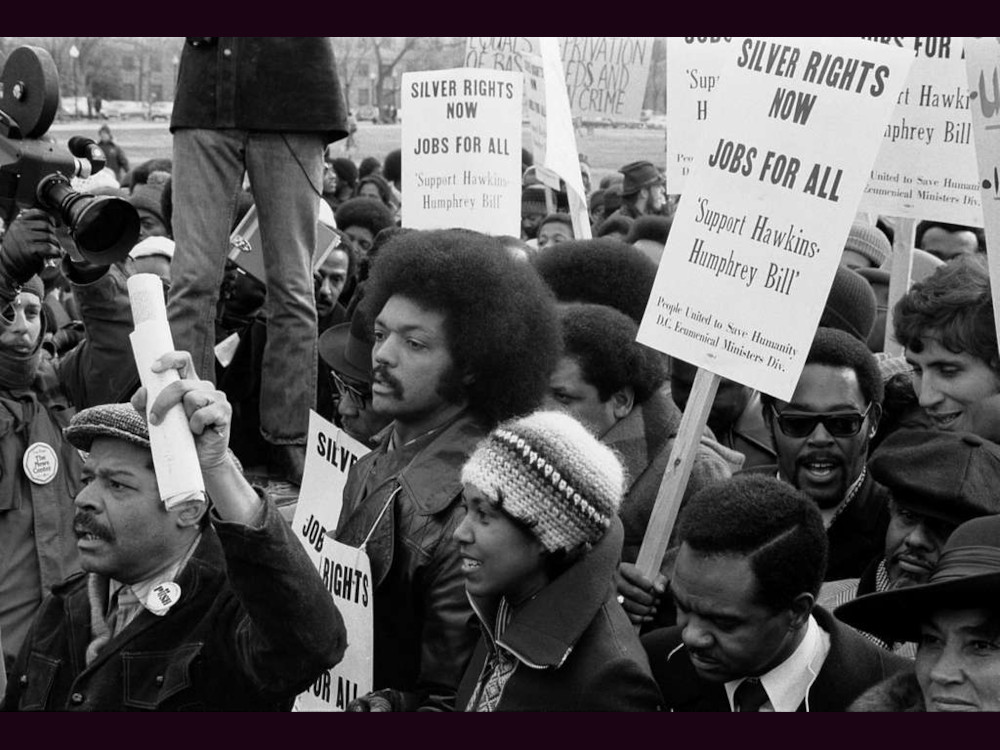
Image: Jesse Jackson at a rally on 15 January 1975. Image Credit: Gary Stockbridge, Get Archive
Jesse Jackson is such an important figure in America. He’s human, so complex; not all good, not all bad, but a complex mixture. Let’s value the memory of one who spoke and acted so strongly, with passion and conviction, for justice.
I heard him speak at a conference in Atlanta in 1987: he was riveting in person, with characteristic black rhetoric that alternately soared, hammered, whispered, and roared. Such an experience! He was a candidate for the Presidency in the year after I had arrived in the USA (and I followed the local politics very carefully—a good relief from hours spent poring over Ancient Greek texts!). He stood again the year after I left and was very nearly the Democratic nominee. His legacy is enormous.