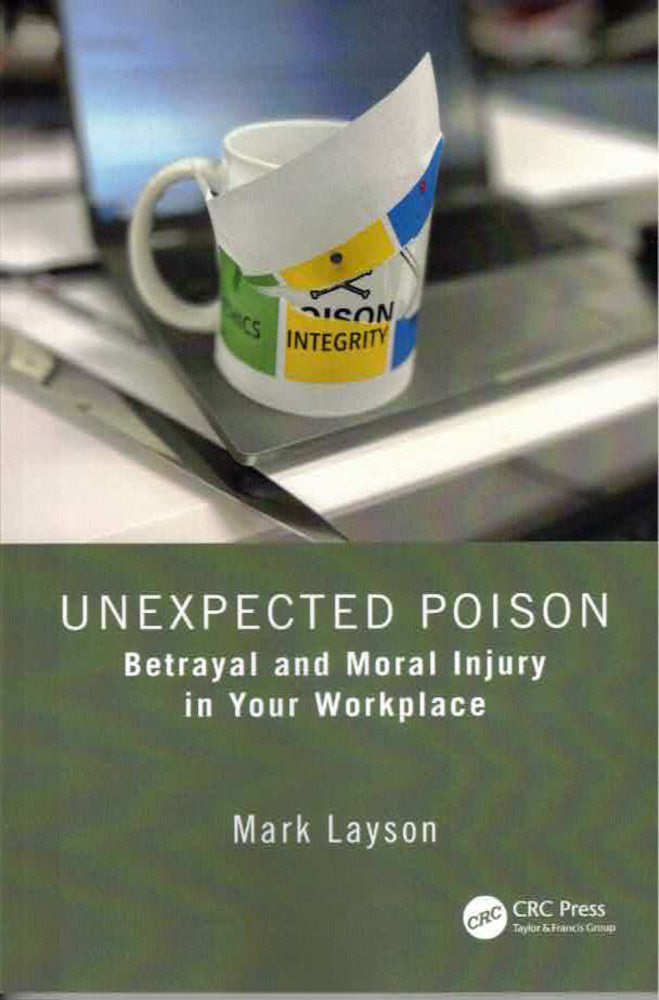

Book Review Unexpected Poison: Betrayal and Moral Injury in the Workplace,
If you have left a workplace suffering a deep sense of failure or injustice, you might have suffered a moral injury. Dr Mark Layson, who has been a police officer on the beat, then an Anglican minister, and now Director of the NSW/ACT Disaster Recovery Chaplaincy Network, has poured years of conversations and research into Unexpected Poison: Betrayal and Moral Injury in the Workplace, aimed to help frontline workers exposed to physical or psychological hazards in their workplace.
The higher the ethical claims of an organisation, the greater the downside when the standards of organisational safety and fairness are betrayed.
Layson turns to Led Zeppelin’s Stairway to Heaven lyric, “you know sometimes words have two meanings,” to give two definitions of moral injury devised by researchers, before explaining that we can meld them
Moral injury has a context:
a. The betrayal of what is right
b. By someone in legitimate authority
c in a high-stakes situation.
Moral injury has content: “lasting psychological, biological, spiritual, behavioural, and social impact of perpetrating, failing to prevent, ot bearing witness to acts that transgress deeply held moral beliefs and expectations.”
Speaking personally, having been made redundant twice, though painful, I have not experienced them as moral injury.
Layson lays out the content moral injury as similar to PTSD: “the morally contentious content of a person’s work is the causal factor of distress. Much like trauma exposure, morally contentious work is the stock and trade of the first responder. Morally contentious decisions include whether to kill an underaged combatant, whether to return a child on a court order to a drug addict step-parent, or whether to inflict a painful medical treatment on a patient for whom it is unlikely to improve their viability.”
The risk of focusing only on the content of moral injury is that it may leave the organisation off the hook.
The reality of moral injury comes through strongly in the case studies Layson includes in Unexpected Poison.
To illustrate one mechanism of betrayal in the workplace, DARVO (Deny, Attack, Reverse Victim, Offender), Layson turns to cycling.
“Lance Armstrong was a former champion cyclist. He won an unprecedented seven Tour de France titles, defeated cancer, and founded the enormous cancer charity Livestrong. In 2003, Armstrong was on top of the world, with a loyal cadre of friends and celebrities to defend him. That year, his former soigneur, Emma O’Reilly, provided information to journalists about Armstrong’s illegal use of performance-enhancing drugs.
“Armstrong labelled O’Reilly an alcoholic and a prostitute to denigrate her character. One of the journalists she spoke to was sued by an official of the international governing body of cycling and labelled a ‘little troll’ by Armstrong. Two things are noteworthy. Firstly, most people, including myself, stayed on the Armstrong bandwagon for longer than they should have. And secondly, it was a zero-sum game for Armstrong. Armstrong didn’t just have to win; his accusers had to hurt for their revelations.”
Another Layson example is “Peter Fox, a Detective Chief Inspector of police [who] acted as a whistleblower against church abuse and was the subject of controversy as a result of his stand. Fox wrote of his treatment by some of his colleagues in the police and the battle against the church in his region. Both institutions had a desire to defend their interests rather than pursue justice.”
Perhaps Layson’s best, or most useful, chapter is titled Saving Ourselves, Defending Virtue. He describes a descent from Naivety, to Subtle Withdrawal, to Cynicism, to Resentment, to becoming what one once hated. He suggests the antidote to descent is ascent, a Tolstoyian personal moral revolution taking our moral fate into our own hands.
Spiritual transformation is a key part of ‘post-traumatic growth’: “This is particularly relevant in workplaces of service or mission, such as healthcare, chaplaincy, or first response. When people are betrayed in these environments, it is not just their professional selves that are wounded but their spiritual cores as well. Yet this core can also be where seeds of renewal are nurtured. A recommitment to values, to service, to community, to transcendence is possible, often times stronger because of the fall.”
Unexpected Poison: Betrayal and Moral Injury in Your Workplace, Mark Layson, CRC Press/Taylor and Francis Group, 2026. $97.75 paperback, on Amazon