
An Obadiah Slope column
Obadiah lives in a narrow street. Maybe that is why this story caught his eye: How many cars parked in your street for a church meeting are too many? That issue has blown up in the States with a court ruling against a group of Jews, Alex Littlefield reports for the oddly titled Juicy Ecumenism blog of the Institute for Religion and Democracy.
“Daniel Grand, an Orthodox Jew, lives in University Heights, Ohio. His faith requires communal prayer with a minyan of at least ten men on the Sabbath. He invited a small group of neighbors to gather for these services in his home.
“A neighbour complained. City officials issued a cease-and-desist letter. The letter stated that Grand’s home could not serve as a place of religious assembly in a residential zoning district without a special-use permit. It threatened code enforcement if he continued.
“Grand cancelled the next service and submitted a permit application. Neighbours filed opposition letters that expressed open hostility to Jewish practice. One writer stated he did not want the neighbourhood ‘labeled as Jewish.’ The city held a public hearing marked by similar opposition.
“After Grand withdrew the application, Mayor Michael Dylan Brennan declared at the Planning Commission meeting that the cease-and-desist order remained in full force. He told those present: ‘If you observe such activities, and I hope you do not, but if you do, you may report them to the city, and the city will enforce its laws…’ A police lieutenant directed patrol units to conduct frequent drive-bys of the home. The city prosecutor initiated a housing code investigation. An inspector searched the residence with consent from Grand’s wife and found no violations.”
Leaving aside the anti-semitic stuff for the moment (yes, that is hard, but try) , please conduct a thought experiment with Obadiah. How would ten cars parked in your street work out. It would overload the admittedly narrow street that Obadiah lives in. where a lot of houses don’t have driveways.
Obadiah wonders, though, if Daniel’ Grand’s fellowship could carpool. Or one or two take the public transport. That would work well in the Jewish part of Melbourne, if he lived there, which has some rather nice trams.
How big would a religious gathering have to be to break your local bylaws?
Oikos, a group that supports home churches, suggests parking is critical “Most municipalities have laws that do not permit the conduct of regular public meetings or businesses in private premises without certain stringent requirements being in place. Usually, these laws are not enforced unless there are complaints by neighbours. For home churches, the obvious complaints could come from insensitive parking of cars or noise.”
###
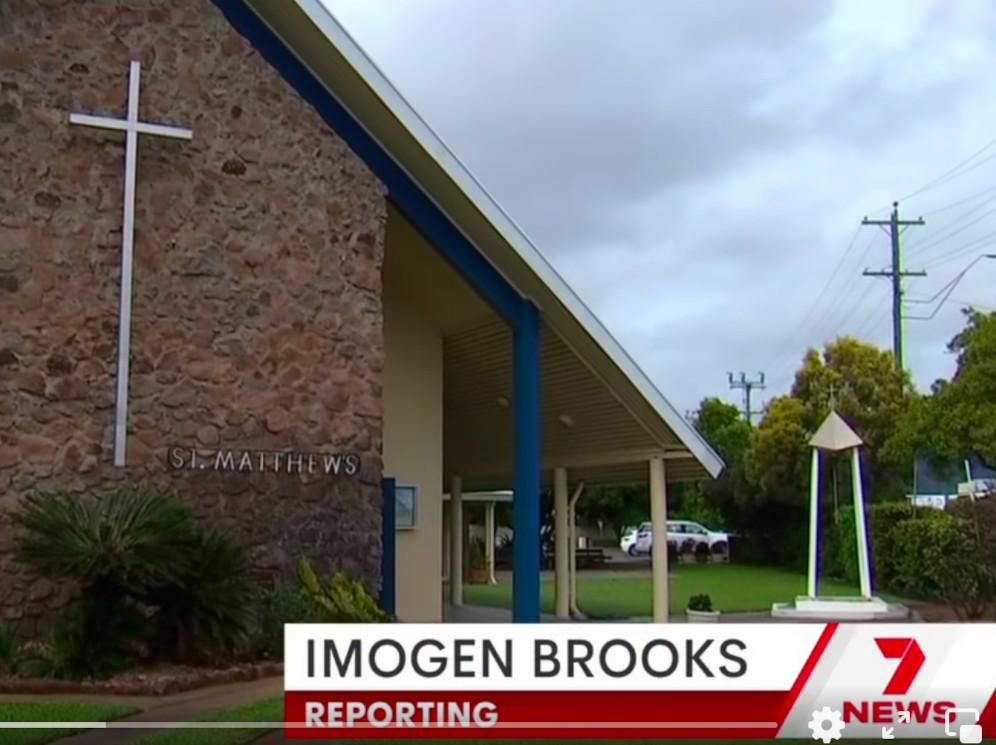
Church receivership hits home: St Matthew’s Anglican church in Mundingburra, a suburb of Townsville, has been listed for sale, an outcome of the North Queensland diocese being placed in receivership, the result of child abuse in the past.
Some eleven properties will be sold. The Other Cheek understands that the payments are redress payments, which means there are a large number of abuse survivors involved, as redress payments are capped. The abuse mostly relates to children’s homes. The ABC reported the diocese is expected to have $11m owing by 2028.
###
Monogamy blues: An overture (Presbyterian talk for a motion) that ministers in the progressive Presbyterian Church USA be required to be monogamous is before their General Assembly (Presbyterian talk for a church parliament). It is getting quite a reaction. The PCUSA LGBTQIA lobby group says it targets them according to a Religious News Service report.
“The board and staff of More Light Presbyterians released a statement last month, saying the proposal on monogamy targets queer communities.
“It centers a single model of relationship as the only faithful expression of Christian life, ignoring both the breadth of biblical witness and the lived realities of many faithful people,” the statement says. “Scripture speaks richly about covenant, mutuality, justice, and love but does not prescribe one uniform relational structure across all contexts.”
More Light Presbyterians argues that poloyamory should be accepted by the church.
The New York Post, in a follow-up story, reports a claim that the overture is racist. “The Advocacy Committee on LGBTQIA+ Equity also argued that the monogamy rule reinforced White privilege. The group claimed the mandate imposes ‘a narrow, culturally specific understanding of family’ that ‘privileges a dominant cultural framework over the lived realities of communities of color and global Christians.’
###
In a sponsored feature in the Financial Review YWCA explain their role as a housing provider “… for many women and gender diverse people, the system is failing at a far more basic level – safety and security – and the impact is economic.
In many new developments, basic gender-responsive design features are not always considered.”
They give an example – a peephole in the front door so women can see who is visiting them.
That’s a fair point. And Obadiah can see that social housing will meet the needs of women and other marginalised groups. And he agrees with YWCA that “When women and gender-diverse people lack stable housing, those costs are absorbed by the health system, the justice system, homelessness services, and child protection, the most expensive points of government intervention.”
But Obadiah is finding it hard to work out how gender diverse housing is different in any other way.
Maybe, just maybe there’s a clue here in another comment by YWCA’s Michelle Phillips, their group chief executive officer.”Housing pathways for women and gender diverse people are shaped by structural factors often overlooked; from lower lifetime earnings and unpaid care responsibilities to higher likelihood of domestic and family violence.”
There’s a case for social housing to be robust – there are many vulnerable people groups who might benefit from that. And for security camera too, because Obadiah knows they can be preyed upon.
And YWCA is right to make the point that providing social housing can save large amounts of money in other services.
“Church Receivership Hits Home”: the documents on the ADNQ website make it clear the Diocese is working closely with the receivers to restructure for a sustainable future and have the funding to meet (capped) redress obligations to survivors of historical sexual abuse. I have not seen in the documents any mention of claims through the courts. If there are any that may well exceed costs under the redress scheme. The courts would determine justice on a case-by-case basis. In addition costs may be awarded against the Diocese.
No doubt the ADNQ has taken expert advice in all aspects of their restructure plan. ADNQ is facing some harsh realities all at once but intending to continue and meet obligations.
I hope that the congregation of St Matthew’s Anglican church in Mundingburra can continue to meet and pray. As for the Diocese going bust, I’d suggest that to be a win for all those who suffered abuse whilst the Diocese looked on.
It is usually not the local congregations fault, but they end up bearing a burden imposed on them by the leader groups of the Diocese.
I speak as someone who is seeking compensation against an Anglican school – but who has nothing against Anglicans or followers of any faith, as individuals.
Obadiah, this is Daniel Grand. We othrodox Jews under Jewish law can not drive on the Sabbath and Jewish holidays. That’s what makes this even more disturbing – there would be no cars. Just people who lived a couple of blocks around my house who would walk on foot.
A very good point, thanks for coming over here and making it.