
In the lead-up to the 250th anniversary of the USA (semiquincentennial), Peter Bentley provides a selection of articles from his series looking at the USA through American film and television.
Given the ubiquitous environment, it was a thorny issue to work out where to start with this topic. When one thinks of classic American cinema, the western looms large and the number of westerns produced is even larger. It is illustrative of the importance of the mythic influence of the west and its impact on the American image, whether humans wearing a black or white hat, or environmental as in the iconic image of Monument Valley.
While many westerns focus on the towns, stagecoach journeys and railroads (and connected robberies), the gunslinger, and related fights, particularly in the bar, there is also the significant portrayal of the Indian people. It is insufficient to say this has been a complicated relationship given the extent of the wars and conflict during the expansion of the West. Many westerns, particularly of the B-grade variety had a simple cowboys versus Indians approach, no doubt fostering the focus of the early acting games of American boys (and I admit Australian boys) and viewpoints. I have memories of being entertained with the series F-Troop (1965-1967), marvelling at the slapstick incompetence of many of the soldiers at Ford Courage in this ‘wild west’ setting. This series is in the comedic tradition of Gilligan’s Island, rather than Hogan’s Heroes, though there are similarities in character types with the latter. I may have a more critical approach to all of these shows now.
I will defer making further comment about the portrayal of Indians, partly because there are many better placed to do so, and I provide some comment in the chapter on the Indian Nations.
An early and influential Western series was The Howdy Doody Show (1947-1960). Particularly significant for its pioneering orientation as a children’s show, it featured a nod to Western icon Buffalo Bill, with the host Buffalo Bob, and the marionette Howdy Doody, both dressed as cowboys. The National Cowboy and Western Heritage Museum in Oklahoma City has recognised the influence of the show, particularly in the wider development of merchandise and promotional products.
The nostalgic television series Happy Days (set in the 1950s) featured an iconic episode with Ron Howard’s character connecting with the Howdy Doody show through Richie’s entry in the look-a-like context, motivated by his desire to take a photo of Clarabell the Clown without make-up for the school newspaper.
The multi-directed How the West Was Won (1962) is a good entry point for film as the themed sections provide an understanding of the different issues of starting out, including the forms of travel, and the trials and tribulations of living in the West. The themes are: The Rivers (1839), The Plains(1851), The Civil War (1861-1865), The Railroad (1868), The Outlaws (1889). John Ford directed the fascinating anti-war/pro-war Civil War segment.
This could be followed by the Sergio Leone film Once Upon a Time in the West (1968) and it is a surprising pleasure for the opportunity to see Henry Fonda in a very well-tailored baddie role.
When one considers directors, John Ford is the preeminent Western director, and yet none of his Western films were recognised among his four Academy Awards for Best Director. Ford’s films brought stardom or showcased significant actors in the field, notably John Wayne in Stagecoach (1939) with an iconic introduction through a twirling rifle, a modern twist to the dashing sword. Wayne became intrinsically connected to the western and a household name, and symbol of American values and male culture.
John Wayne’s stellar roles in She Wore a Yellow Ribbon (1949) and The Searchers (1956) are also memorable for their connection with and consideration of the people of Indian nations. I remember seeing new prints at the Sydney film festival on the large screen in the beautiful State Theatre, and marvelled, finally understanding that this was the only way to appreciate the stunning scenery, and the depth and colour enhanced by the cinematographer Winton C. Hoch, particularly in She Wore a Yellow Ribbon.
Apart from John Wayne, I want to highlight my favourite actor James Stewart who starred in significant westerns in his overall career. From the early Destry Rides Again (1939) where James Stewart is well placed to be the man who does not ‘shoot first and ask questions later’, to The Man Who Shot Liberty Valance (1962). The latter film looks at the development of legends, through the irony of the title and the foundation of screen legends. James Stewart, in one of his most memorable Western roles, joins with John Wayne.
Some westerns conjoin with other genres, including musicals like Paint Your Wagon (1968), and others are simply farces, allowing then established comedians to appear, an example being Bob Hope in The Paleface (1948). I do not think Hollywood would contemplate making this film today.
Other westerns link to major events, notably the period after the civil war, and the Indian wars, with Clint Eastwood ensuring that The Outlaw Josey Wales (1976) would become a classic. The film stands out for its nuanced consideration and memorable characters. It is helpful to contrast this film with the classic western Shane (1952) that has maintained a certain lyrical quality about it and a level of sentimentality. Eastwood’s Josey Wales is left with little expectation and desire, apart from death and a conflicted moral compass.
Clint Eastwood has put his stamp on a style of western over many years, and could be regarded as a more successful western proponent than John Ford, because Eastwood has acted as well as directed. Even when he did not direct, Eastwood’s strong image ensured dominance of the film’s style. Eastwood was introduced to a wider American audience through the western television series Rawhide (1959-1965). Ironically when he moved into Westerns, his still most famous Westerns are not actually American, being in the ‘spaghetti western’ tradition; films made by European directors, particularly in Italy. Starting with A Fistful of Dollars (1964), and For a Few Dollars More (1965), and The Good, the Bad and the Ugly (1966), Sergio Leone helped to direct Clint Eastwood toward super stardom in this foundational trilogy. Even though Clint’s characters had names, there was an evident theme of ‘The Man with No Name’ that has become associated with these early films, and has continued in often homage styled films. The music from Ennio Morricone is memorable for all time.
Though Eastwood’s character in Hang ‘Em High (1968) had a name, he returns unrecognised and unknown when he returns to the area of his hanging to seek justice. High Plains Drifter (1973) had ‘The Stranger’. These Eastwood characters were on the side of ‘good’ but had a dark or even evil side as in the case of High Plains Drifter. Enigmatic and versatile writer Ernest Tidyman provided the screenplay for High Plains Drifter continuing his exploration of moral ambiguity. Tidyman not only provided for the setting of the end to come for the town, but the end of humanity, symbolised by the painting of the whole town red and the overwriting of the entry sign to the town Lago with the word Hell in red.
John Wayne apparently did not like the interpretation of the western in High Plains Drifter believing it did not portray the people and the issues of the west. It is no wonder that Wayne reacted so strongly to Sacheen Littlefeather’s non acceptance and Indian activist speech when she appeared in the place of Marlon Brando at the 1973 Academy Awards who had been awarded Best Actor for his role in The Godfather. This was an illustration of the importance of the image of the west that had been cultivated by film and a perception that critiques were sacrilegious.
And yet revisionism has abounded in the films themselves.
While displaying significant violence Pale Rider (1985) turns this aspect around in a lateral way with the titular character, the ‘preacher’ played by Eastwood. There is an element of the righteous prophet, or a modern-day Marvel character in his physical engagements.
The significance of the ‘rider’ in Pale Rider is undeniable. As the preacher he is the harbinger of death to those he designates as crossers of the line. Viewers today may miss the religious foundation, but for those reared in 1970s and the influence of books like Hal Lindsey’s The Late Great Planet Earth, the apocalyptic connection would have been clear.
“I looked, and there before me was a pale horse! Its rider was named Death, and Hades was following close behind him. They were given power over a fourth of the earth to kill by sword, famine and plague, and by the wild beasts of the earth.” (Revelation 6: 8 NASB1995)
One of my favourite westerns is another Clint Eastwood vehicle, completed a few years later at a time when people thought the days of the western had ended, Unforgiven (1994) is a masterpiece of storytelling and a moral fable as well. Well-deserving of the Academy Awards for Best Film and Director and Best Supporting Actor for Gene Hackman as Little Bill, this film combines the lyrical imagery of Shane with the savage brutality of Hang ‘Em High.
Eastwood has also been prominent in the development of the modern western, including Honkytonk Man (1982) and the earlier Coogan’s Bluff (1968) with Clint Eastwood starring as the ‘fish out of water’ ‘country and western’ officer on assignment in the big city. This film led to the television adaptation McLoud (1970-1977) with Dennis Weaver as Deputy Marshall Sam McLoud. I remember watching the episode ‘Night of the Shark’ (Season 6 Episode 7) that featured McLoud in Sydney investigating mob (or Mafia) links. The theme was best summed up by McLoud’s NYPD ‘boss’ telling the Australian police commander “it’s a little difficult to explain McCloud to a foreigner, unamerican, non-American. It’s a little difficult for me to understand him myself.”
After McLoud is attacked in his hotel room, the visiting (undercover) Australian detective who interrupts the incident, asks McLoud to explain why he hurled a perfect stranger off his balcony and McLoud retorts “Well what do Australians throw off their balconies, friends?”
There are the usual pictorially prominent scenes with locations at the Sydney Opera House and Sydney Harbour Bridge, and of course an opportunity to jump on a horse during the Australia Day parade and chase down a villain, ending up on the field during a soccer match between rival teams Sydney and Melbourne. Of course, the closing scene has to be in a pub (hotel), and a beer joke ensues at the expense of McLoud’s NYPD boss.
Clint Eastwood’s western roots are solid as evidenced by his last film at the time of writing Cry Macho (2021), though this is more in the ‘cowboy’ film genre than the traditional western. Helpfully Eastwood has consolidated his acting into age-appropriate roles.
There has been a continuing tradition of remaking or reimaging classic westerns. The remake of 3.10 to Yuma (2007; original 1957) gave Russell Crowe an opportunity to provide a more sophisticated western character than his early entry into the Hollywood arena with The Quick and the Dead (1995).
Modern westerns have also continued to be produced; with I would argue the finest modern western being the Oscar winning Best Film No Country for Old Men (2007). Based on the Cormac McCarthy book, with an excellent cast led by Tommy Lee Jones as the American weary Sherriff, this morality tale connects the western eras. It also helps to placate those of us who have always hoped for a film version of McCarthy’s Blood Meridian, the most visually descriptive book I have read, though as other readers may perceive, perhaps the most unfilmable.
Lately Jane Campion secured an Academy Award for Best Director for The Power of the Dog (2021). Set in the early twentieth century, the film provides strong identity focussed roles, stunning scenery with related cinematography and a mystifying story that may have been better suited to a short film. The reference in the title to Psalm 22, Verse 20, is a fascinating excursion, though to me illustrated a more confused example of exegesis than serious theological consideration.
And lastly Yellowstone (2018-2023), a modern-day Shakespearean chronicle, that could also be viewed as the relocation of Dynasty to a free state ranch in present-day Montana. With stunning cinematography, excellent horse acting, and remarkably consistent screenwriting from the creator Taylor Sheridan, and a mostly good cast. The series is anchored by Kevin Costner as John Dutton the modern anti progressive western hero. English actress Kelly Reilly as daughter-in-waiting Beth Dutton has a stunningly strong turn from the English crime show Above Suspicion.
Yellowstone’s prequels 1883, and 1923 highlight the endeavours and struggles of the Dutton family in the past and help to justify the more means-based approach to conflict resolution in the modern era as well as setting up for what will be the eventual and ultimately peaceful resolution. The Yellowstone franchise provides a contemporary way of highlighting the west and its importance in upholding the American way of (western) life.
Note: at present this article is part of a collection hopefully to be published as a book before the American quincentennial.
Peter Bentley pkbentleyarchive.com
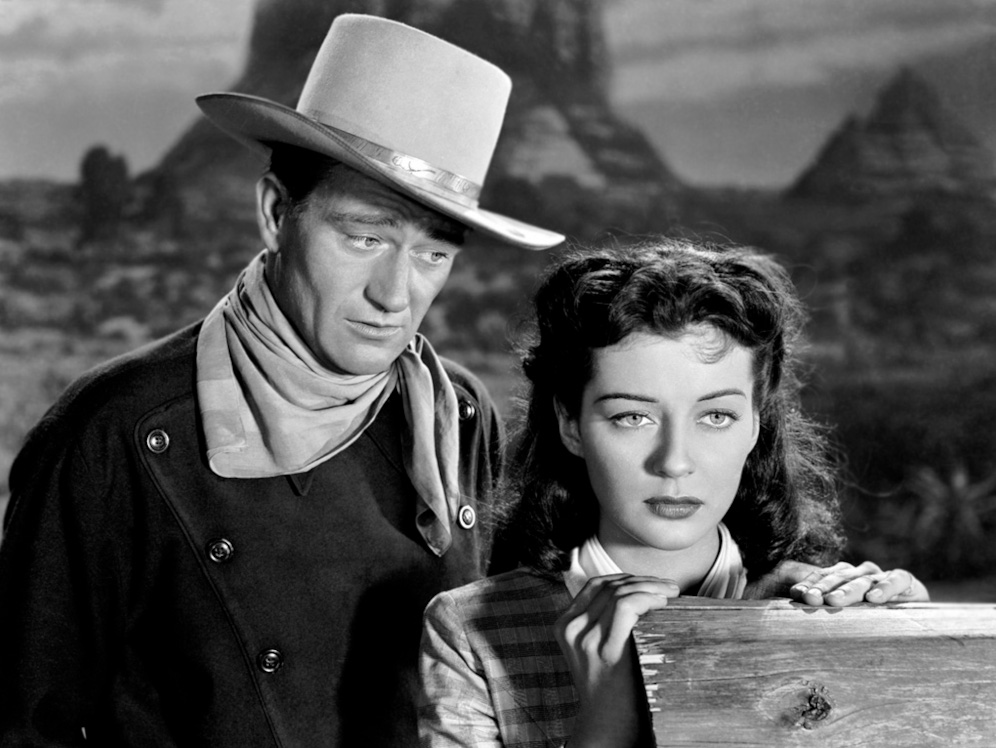
Image: John Wayne & Gail Russell in “Angel and the Badman”, 1947. Image Credit: Flickr