
Joseph Holmes via Religion Unplugged
(REVIEW) Christopher Nolan’s “The Odyssey” has drowned out its critics in a sea of money and critical acclaim. The film has generated mountains of controversy before it came out for its casting choices, historical anachronisms and “defy the gods” marketing.
But none of that stopped the film from being one of the most profitable and best-reviewed movies of the year, clearing $264.1 million worldwide and getting a 95% score from critics and a 97% from audiences on Rotten Tomatoes.
This is no surprise. Nolan is a master filmmaker and he is at the height of his powers. He tells the story distinctly from a post-secular lens: One that suggests we should act as if the gods are real whether or not they are.
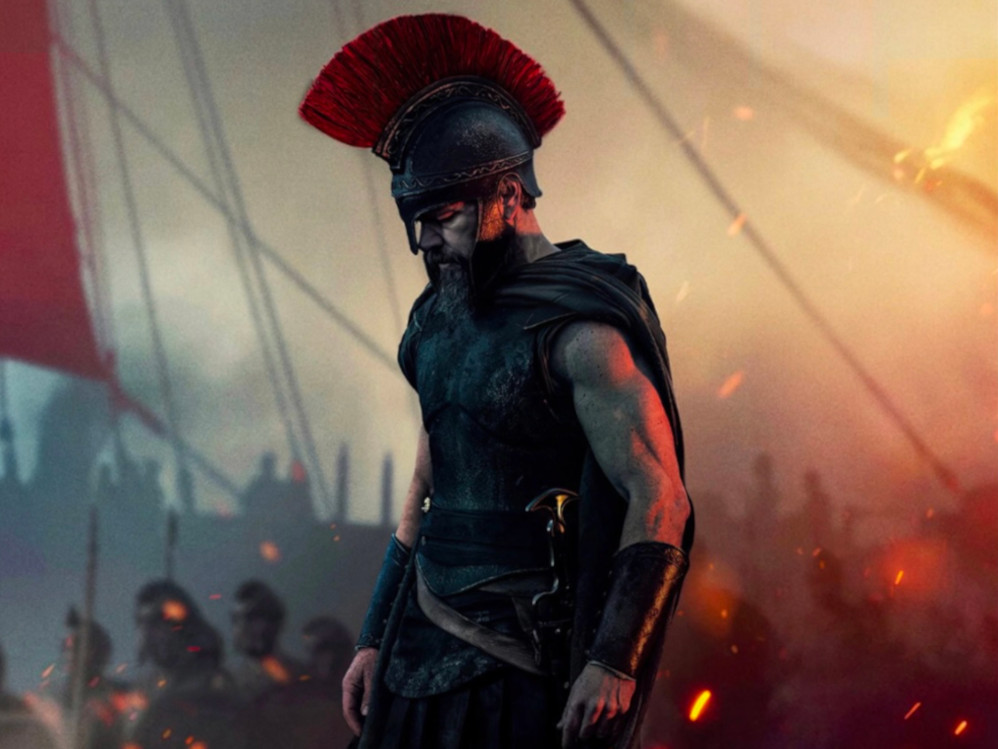
Adapting the original Greek epic by Homer, “The Odyssey” follows Odysseus (Matt Damon), king of Ithaca, who embarks on a perilous journey to return home after the Trojan War. Crossing the Mediterranean Sea with his fellow soldiers, they soon find themselves battling not only the elements but an array of deadly obstacles and mythical creatures along the way.
Meanwhile, his wife Penelope (Ann Hathaway) and his son Telemachus hope for his return while fending off a gang of suitors, who mean to kill Telemachus and marry Penelope for the throne.
Nolan’s “Odyssey” is an undeniably unique telling of a mythological epic. “Clash of the Titans” treated its world like a fantasy and showed every God and miraculous encounter by its heroes. “Troy” completely ripped out the gods and treated its story like a materialist sword-and-sandals epic.
But Nolan does for epic myths what he did for superheroes with “Batman Begins” and sci-fi with “Interstellar.” That is, he takes the mythic and strips it down and grounds it just enough to make the mythic more plausible and therefore powerful.
When it works, it’s glorious. Nolan shows Odysseus talking to Athena in a way that blends the mythic and the personal. But other scenes don’t all work. When we jump from a seemingly normal sea journey to a random encounter with a giant Cyclops, the effect is more jarring than scary or awe-inspiring.
Very few gods are actually portrayed in person in “The Odyssey.” Instead, we have religious interpretations of ambiguous events. We see plenty of mythological monsters, like the Cyclops and the witch Circe who transforms men into beasts.
But those could be false memories. And most of the time people just attribute ordinary events, like storms and lightning, to gods and bad events, like being unable to return home for years, to curses by the gods. Nolan even opens the film by calling this “a time of apparent magic.” The only god who appears is Athena, talking to Odysseus when he appears to be talking to himself.
This leads some like Christian film critic Brett McKracken to conclude that the supernatural in Nolan’s film is really just psychological: “It’s human agency — not divine power — driving the outcome.”
But the content of Odysseus and Athena’s conversations – and what results from them – suggests the opposite. Odysseus complains to Athena, “Why don’t the gods talk to us in ways we can understand?”
She retorts: “Who doesn’t understand thunder, or fire, or a good harvest?”
Throughout the story, Odysseus attempts to defy the will of the gods. But each time, his hubris is thwarted. And in the end, he reveals that his own defiance of Zeus’s law is responsible for the breaking apart of the civilization and the home loves.
A core theme of “The Odyssey” is that the disintegration of society is caused by repeated violations of divine law by commission or omission. Characters in the story explain that “Zeus’s Law” — the law of the world’s supreme god — is that you should be kind to strangers and welcome them because one of them might be a god.
Nolan expressed that this idea is the core of his film.
“That’s so important to the way that society had to hold together because in this world, as soon as you leave the house, you’re at the mercy of strangers. If you’re going out on a journey for more than a day or two, you’re turning up and saying, ‘Feed me, clothe me, help me.’ And so there has to be this glue, this binding principle of ‘I will treat you as if you were a god in disguise, as if I might be judged by the gods for the way I treat you,’” he said.
But focusing too much on Nolan’s continuity with Greek values is slightly deceptive. Many have noted that Nolan’s “The Odyssey” conflates aspects of Homer’s religion with Christianity and modernity. This is not Robert Eggers’ “The Northman.” which tries to recreate Norse worldview without a modern lens.
As culture critic Rob Henderson notes, “In the poem, the Greeks rape, rob, enslave, and pillage without displaying anything like modern guilt.”
He added: “Yet such individuals lived in societies that existed before Christian morality reshaped the Western understanding of guilt, mercy, and the value of every human life. The moral injury that afflicts Nolan’s Odysseus belongs more naturally to the AD world than the BC one.”
But Greek literature Scholar Spencer Klavan argues this isn’t necessarily a flaw. After all, “every generation has drawn something different” out of Odysseus.
“Nolan’s man of sorrows is more convinced than Homer’s that winning the war by fraud was a definitively catastrophic sin against the gods. On this point Nolan’s Odysseus is more like Dante’s — an offender against heaven — and certainly more like Tennyson’s — the restless lord of a civilization in decline,” Klavan said.
What “Odyssey” actually reflects is a distinctly Western “post-atheism” approach to religion. Gone are the days of “New Atheism” when the most popular secular approach to religion was that we were better off without it.
Now, the most prominent public intellectuals like psychologist Jordan Peterson and sociologists like Jonathan Haidt and Ryan Burge argue religion is necessary to hold society and communities together. Haidt admits that he agrees humans have a “God-shaped hole” even if he doesn’t think there’s a god who can fill it. Peterson argues that even if you don’t know if God exists, you should act as if He does.
There’s actually a lot of Peterson reflected in Nolan’s movie. In “We Who Wrestle with God,” Peterson blurs the line between prayer and intuition, between insight and divine revelation. He does this not to drag God down, but to reinterpret our secular experiences as religious.
Nolan does the same. He blurs the line between Odysseus’ internal monologue and Athena’s dialogue not to explain away Athena, but to make us reinterpret our own inner voices.
Nolan’s “Odyssey” is ultimately about a man who thinks he’s smarter than the gods and his fathers, learning instead in the end that they are smarter than him and always have been. It is a faith-based film, but using gods nobody believes in anymore. Because of that, these gods can represent gods or traditions as a metaphor for any divinely ordained pro-social tradition you happen to believe in. In the end, it suggests that if you need to believe in the gods and their laws to hold the world together, then doesn’t that suggest they are real after all?
“The Odyssey” is now playing in theatres.
Joseph Holmes is an award-nominated filmmaker and culture critic living in New York. He is co-host of the podcast “The Overthinkers” and its companion website theoverthinkersjournal.world, where he discusses art, culture and faith with his fellow overthinkers. His other work and contact info can be found at josephholmesstudios.com.
Image: The Odyssey. Image Credit: vividculturemagazine