
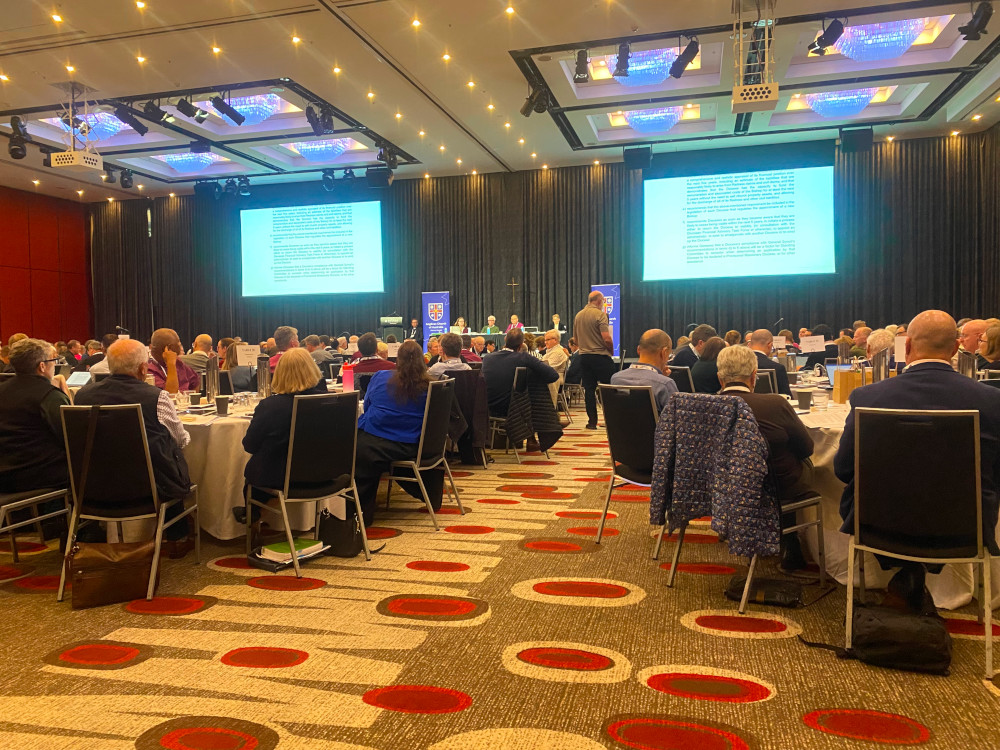
What happens when a diocese (church region) is not viable? The Australian Anglican General Synod meeting in Melbourne has spent several sessions seeking a solution.
The long-running and vexed issue of some rural and regional dioceses (regions) of the Anglican Church of Australia no longer being viable, due in part to the shift in population to the coast, globalisation and redress debts rising from sexual abuse cases, has been a feature of several General Synods dating back more than a decade. Many delegates described it as getting worse each time it has been debated. Some dioceses have been described as one or two redress cases away from running out of money. There has been no suggestion of avoiding paying these debts.
However, this synod’s debate has transcended the evangelical/progressive divide with delegates of all flavours contributing positively to the complex discussion.
The Standing Committee of the General Synod had been tasked with finding a way to help struggling dioceses over the past four years, with no simple solution being found. Instead, a series of bills amending the Anglican Church Constitution proposed solutions, some radical, for when a diocese can no longer pay its way. They put forward a series of four proposed constitutional amendments from the Standing Committee of General Synod seeking to improve cooperation between dioceses.
One solution might mean merging a diocese with another, or changing which dioceses make up a province. A pair of bills to make this easier passed. It will allow provinces to be modified and dioceses to be merged or created by the Standing Committee of the General Synod rather than have the Synod make the change – which could take up to eight years- and will go to each diocese to decide whether to accept it. Safeguards include that affected dioceses would have to agree to changes. All the Metropolitans (the Archbishops in the mainland capitals) would have to agree as part of a two-thirds majority of the Standing Committee.
Requiring all five Metropolitans to have to agree to changes in provinces or dioceses is a safeguard against one wing or faction of the church seeking to gain advantage. (“Provinces” in the Anglican Church of Australia are the mainland states which each contain several dioceses, with the Northern Territory as part of Queensland. Tasmania is “extra- provincial.”)
The bills passed. The main effect of the change is to make changing or merging dioceses and altering provinces much quicker and therefore easier.
A bill proposing to allow emergency changes for the administration of a diocese was withdrawn. It was not getting the sort of support required – a 75 per cent vote in the houses of clergy, laity and bishops – to pass as a constitutional amendment.
A proposal allowing a bishop to serve multiple dioceses, coming to the aid of a diocese in trouble, caused the liveliest debate of the synod so far. The motion for a constitutional change finally failed to pass – but a way to share bishops was found in a deft maneuver after much debate.
The proposal for a constitutional change was that the Bishop of one diocese (first diocese) could be elected to serve as bishop of another (second diocese), with the consent of the diocesan committee of the first diocese, all the diocesan bishops in its province, and the Primate.
This is a controversial change for Anglicans committed to the ancient principle of one bishop, one diocese. Peter Sherlock (Melbourne) described this practice as “absolutely critical “and “a principle at the heart of our Anglican reformation.”
Speakers in favour, including Bishop Paul Barker and Fiona McLean, lay, both from Melbourne, emphasised that the multiple-diocese proposal is for temporary situations. Garry Weatherill, Bishop of Ballarat (and significantly formerly of the small Willochra diocese in SA), and others raised the issue of paralysis – in an Anglican diocese, no legislation can be passed without a Bishop.
Bishop Michael Stead from Sydney pointed out that an annual viability report shows about a quarter of the dioceses are on the watchlist for unviability. He stated, “Within five years, we will not be able to support the current 23 dioceses.”
The vote to accept in principle (like a first reading in parliament) was by houses, passed in laity 67-35, Clergy 62- 39; the Bishops had a narrow yes margin that was not reported after the Bishops struggled with electronic voting. This meant that the motion was unlikely to pass as a Constitutional change, which requires a 75 per cent vote.
After a meal break, a way forward was found. A motion on “Financial self-assessment by dioceses” had a significant amendment added: “Recognising that at this time it has not been established that the constitution prevents a bishop of a diocese being elected as a bishop of another diocese.”
And “Recognises the desirability that those in episcopal orders be able to assist and support a diocese without a bishop functioning as a Provisional Diocesan Bishop as an interim appointment.”
This reflected the mind of General Synod, suggesting that they think a bishop can or should be shared between dioceses.
The mover of this motion, Arthur Copeman of Newcastle, explained that the Standing Committee had been struggling to find a mechanism for helping struggling dioceses. One key problem was risk – of merging dioceses taking on the redress debts of another. Copeman explained that the statutory assessments of North Queensland were already being covered by the national church; in this way the redress debts of North Queensland were affecting every diocese.
The motion made three recommendations to dioceses:
1. When a diocese has a vacancy for a Bishop, the diocese needs to assess whether they can pay for a bishop over the next five years without selling property and taking redress debts into account.
2. That dioceses put that process into their episcopal election rules.
3. That dioceses need to keep track of where they are heading financially.