
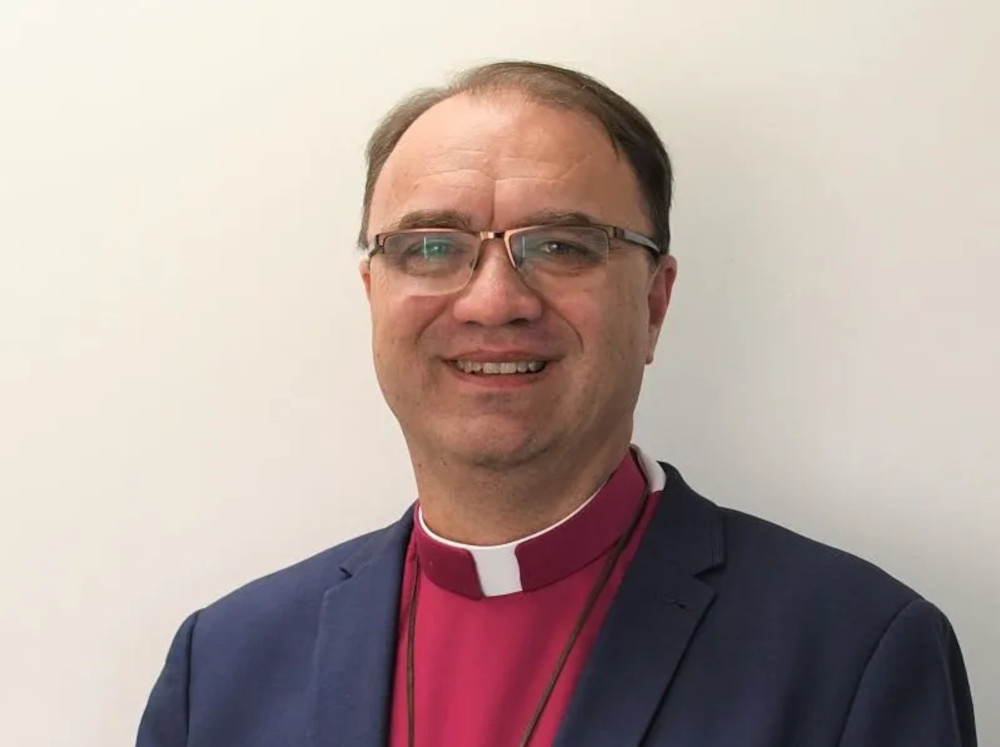
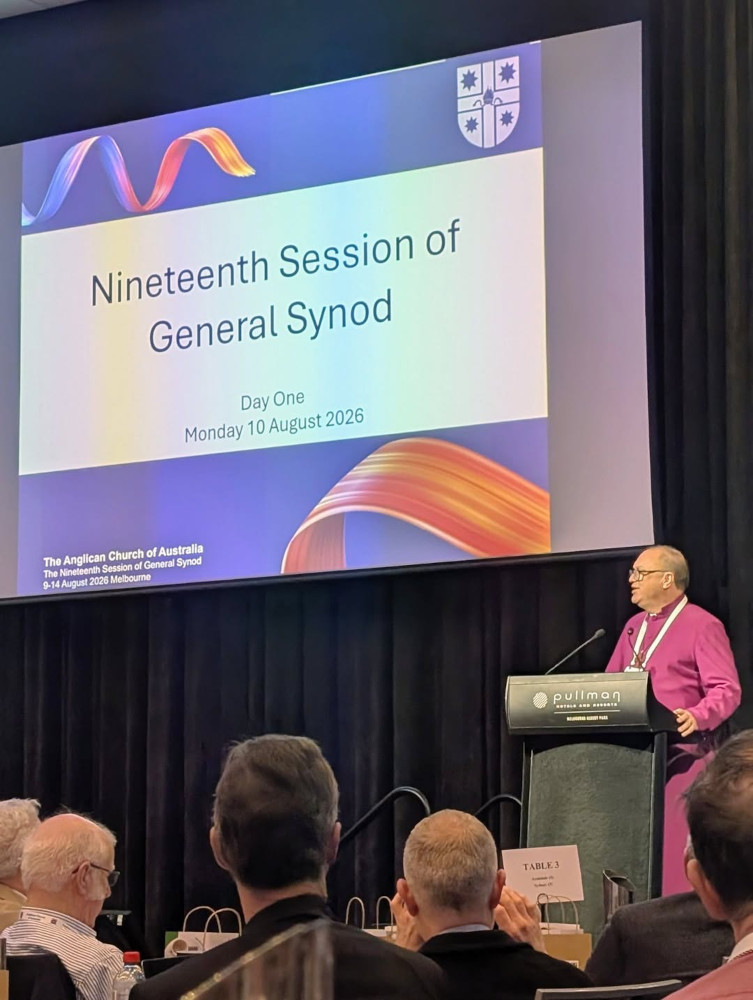
An excerpt from the Presidential Address by Bishop Mark Short to the 19th Anglican General Synod
Describing the growth of distrust in our society, particularly post Covid, Bishop Short turns to the rise of anti-semitism as a prime example.
The current Royal Commission into antisemitism and social cohesion has highlighted the exclusion and hostility experienced by our Jewish neighbours and colleagues in the lead-up to and in the aftermath of the December 14th, 2025 terrorist attack at Bondi.
This is worthy of particular reflection on the part of Christians, not least because of our own tragic history of complicity in this area. Several years ago, I spent a sobering afternoon reading translations of mediaeval Hebrew poetry. So many of them being laments, composed on the occasion of pogroms initiated by those claiming to act in the name of Christ.
As I reflected on the events of December 2025 and October 2023, I felt that pogrom-like character. How much more so the community that was on the receiving end of such atrocity. More broadly, in the level of online reference and public debate, there is a tendency to see those who differ from us in some regard as a potential threat rather than a potential partner. Increasingly, we find it easier to ascribe motives and intentions to others on the basis of their religious, political and cultural identities rather than as a result of patient conversation. Perhaps downstream from these developments, we have seen growing uncertainty at the political level. The clearest manifestation of this has been the declining share of votes going to the two traditional political blocs and the rise of independents and political parties on both the left and the right.
Beyond and beneath these developments, there are more fundamental questions being asked at a national or indeed an existential level. What does it mean to be Australian? What are the tacit assumptions and frameworks of meeting that finders together notwithstanding our disagreements? Are we a multicultural or monocultural nation? If it is the latter, who gets to decide what constitutes that culture?
In recent years, two books, Julianne Schultz’s The idea of Australia and Tony Abbott’s Australia: A History have explored these questions through an overview of our national story. And notwithstanding their different politics and their different narrative styles, they both engage with Noel Pearson’s framework for understanding Australia in terms of our ancient indigenous heritage, our British legal and cultural foundations, and our post-war immigrant flavouring.
Both also regard the result of the referendum on the Voice to Parliament in October 2023, 2023 as profoundly revelatory. For Schultz, because it showed our inability to reconcile our egalitarian aspirations with anxieties around race. For Abbott, because it represented the triumph of a liberal emphasis on the rights and equality of individuals over against privilege afforded on the basis of group identity.
So let’s begin with hope. Uncertainty is not merely a problem to be solved. It can also be an invitation to rediscover the source of our confidence. Christians have never located their home in social cohesion or economic prosperity; all their possibilities are located in the faithfulness of God. …
So what are the defining features of Christian hope? First of all, it is personal. In 1 Peter 1:3, believers are assured that the God and Father of our Lord Jesus Christ has given us a new birth into a living hope through the resurrection of Jesus Christ from the dead. Christian hope is also communal. In passages such as 1 Thessalonians 1:2–3, the fledgling church is commended for your work of faith and labour of love and steadfastness of hope in our Lord Jesus Christ. Hope is something they manifest together. And finally, and ultimately, Christian hope is cosmic. It looks forward not just to the salvation of individuals or the redemption of the people, but to the liberation of creation itself when Christ returns, as in Romans 8. …
Hence, when we come to consider the relationship between the gospel and Noel Pearson’s three aspects of our national identity, our indigenous heritage, our British foundations, our immigrant flavourings, we must resist any attempt to co-op the gospel as if it were merely another ideology to be deployed to advance the interests of one group at the expense of the others, nor should the gospel be regarded as somehow depending for its progress on the ascendancy of one strand over the others. Instead, we should ask ourselves, how has, how is, and how might God be at work through the gospel in the three aspects of our national life?
Here, for example, we might point to the faithfulness of God in Christ, who has revealed to us his presence in the vastness of this land, his love and its fruitfulness and his purpose in its cycles of death and renewed life for thousands of years. We might also remember and celebrate the faithfulness of servants like James and Angelina Noble, Aboriginal Christian leaders who in the first part of the 20th century travelled across Northern Australia to share Christ and to bring shameful acts of dispossession and murder to light. You might also rejoice that an ancient and living culture has become the means through which the good news is embodied and communicated in fresh ways.
Next, let’s consider that second strand, our British legal and cultural foundations. Here we might point to the rich heritage of the Catholic faith renewed in the English Reformation through which God continues to nurture our discipleship as the scriptures are read and as we gather together in all of worship. …
Finally, in considering that through a third strand, our post-war immigrant flavourings, we might point to the many leaders and churches God has raised up in the last 50 years from those who come to our shores and how the Anglican Church of Australia would be a much smaller and less interesting group of people without their presence and contribution. Most of all, we might and should give thanks that the word of God across these three strands has never been in competition, but always complementary because we worship a God of abundance whose grace is never a zero-sum game. Hence the absolute folly of enshrining one culture or one expression of culture as normative, since culture is as dynamic as the God who is constantly at work in and through and above it for his glory.
Main Image: Mark Short. Image Credit: Diocese of Canberra and Goulburn
Insert image: Bishop Mark Short addresses General Synod. Image Credit: Archbishop Jeremy Greaves Facebook