
My early years as a Christian included a couple of nervous breakdowns, one of them quite severe. A desire to please God, to be rid of sin, and a failure to see that sanctification is God’s work, not mine, sent me into a very dark place. It lasted nearly a whole year. And to my mind, it was still a lonely experience.
It all came back, in a nice way, on Saturday. And I saw my past in a different light.
This is a story of going to a history lecture series and finding a friend, or rather, a fellow traveller. The lectures were an Emmanuel College intensive – this small liberal arts college runs several a year. This one was on Revivals, and we met in the Sydney offices of the Presbyterian Church in Surry Hills just up from Central Station.
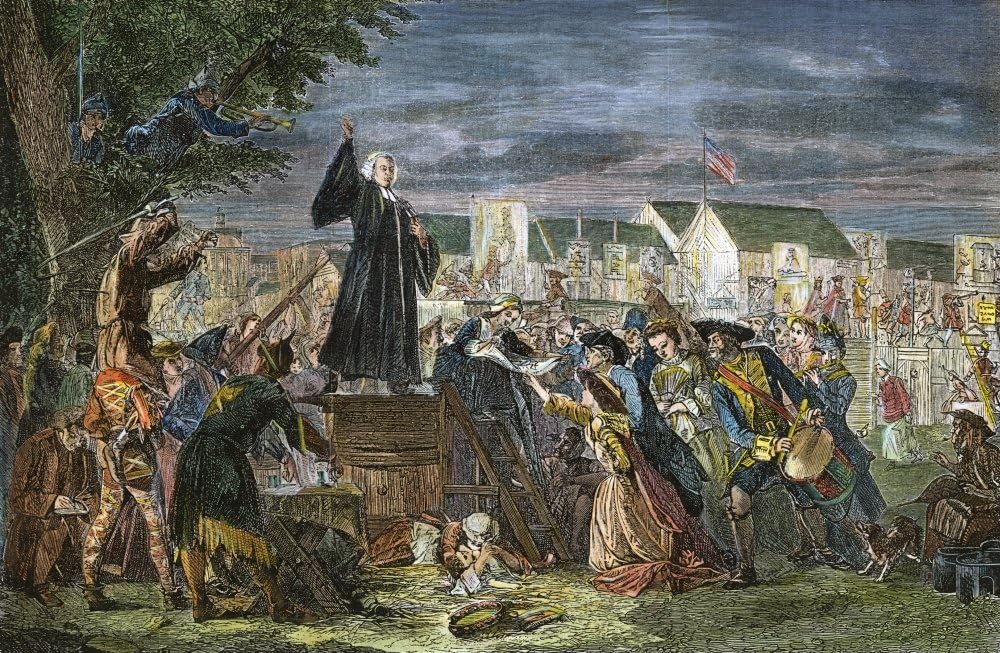
My fellow travelling friend is or was George Whitefield (1714-1770), whom the lecturer, Tom Eglinton, described as “easily the most heard preacher in history up to that point.”
Whitefield’s path to faith, and to becoming a famous preacher, was stormy. He had a very bad year, too. He was a student at Oxford, and had joined the Wesleys in the Holy Club, a group of young men who knew they wanted to be Holy but had not come to life in Jesus.
Eglinton pointed us to one of Whitefield’s descriptions of the year 1735: “God only knows,” he says, “how many nights I have lain upon my bed groaning under the weight I felt, and bidding Satan depart from me in the name of Jesus. Whole days and weeks how I spent lying prostrate on the ground, and begging freedom from those proud, hellish thoughts that used to crowd in upon and distract my soul. But God made Satan drive out Satan. For these thoughts created such a self-abhorrence within me, that I never ceased wrestling with God till He blessed me with a victory over them. Self-love, self-will, pride and envy buffeted me in their turns, that I was resolved either to die or conquer. I wanted to see sin as it was, but feared, at the same time, lest the sight of it should terrify me to death. Having nobody to show me a better way, I thought to get peace and purity by outward austerities, acts of charity, observance of times and seasons, fasting, and prayer.”
Here’s Eglinton on what happened next: “At the same time as experiencing his inward struggles with pride and self-love, he also decided that he needed to fight his sensual appetite, he says, and decided to battle his flesh as well. He stopped eating fruit. He gave the money that he used to spend on fruit to the poor. He then purposefully ate the worst available food.
“Even though there was plenty of good food available at the college, he picked the worst of it. He pasted twice a week. He didn’t powder his hair because that’s a luxury. And he wore crude basic clothing, woollen gloves, a patched gown and dirty shoes. He was even persuaded by a book and his own spiralling thoughts to give himself over to quiet his apartment. He stopped journaling, he stopped praying, and he stopped participating in the assessments for his studies. This escalated over a five- or six-week period. Eventually the climax occurred when Whitefield spent several hours praying out under a tree during a storm one night and then did the same the following night, which led him in his thoughts to believe that he must go further in killing his flesh, to even give up meeting with the Holy Club.
“When Whitefield didn’t turn up to a few meetings in a row, Charles Wesley, as a good friend, hunted him down and encouraged him to go and see his brother John Wesley, who advised Whitefield to ‘resume all of his externals though not to depend on them in the least,’ – all the external displays of his religion. You would think that this might have solved the problem. Just keep going, meeting with him, keep your praying up, keep your reading the Bible, and your soul will come good. But no, Lent came up shortly after this, and Whitefield followed the Methodists into fasting for six weeks, except he outdid them all.
“They ate no meat except on the weekends. He ate nothing except for sage tea with no sugar and coarse bread every day except for Sunday. He also took to walking outside in the cold mornings until one of his hands turned black. By the time Passion Week came around, after six weeks of brutal discipline in his body, Whitefield’s body just gave in. He was then laid up in bed for seven weeks and during this time experienced what he seems to say is his conversion. …. He says, ‘The blessed spirit was all this time purifying my soul. All my former gross and notorious and even my hard sins also were now set home upon me of which I wrote down some remembrance immediately and confessed them before God…’
“About the end of the seven weeks, and after I’d been groaning under an unspeakable pressure both of body and mind for above a 12 month, over a year, God was pleased to set me free in the following hour. One day, perceiving an uncommon drought and a disagreeable clanginess in my mouth and using things to allay my thirst but in name, it was suggested to me that when Jesus Christ cried out ‘I thirst,’ his sufferings were near an end, upon which I cast myself down on the bed crying out, ‘I thirst, I thirst.’ Soon after this I found and felt in myself that I was delivered from the burden that had so heavily oppressed me. The spirit of mourning was taken from me, and I knew what it was truly to rejoice in God my saviour and for some time could not avoid singing Psalms wherever I was, but my joy gradually became more settled and blessed be God has abode and increased in my soul, saving a few casual commissions ever since.”
I had found a fellow traveller.
And there were more. As the lecture series continued, Charles Wesley’s similar struggle three years later, sick with pleurisy, revealed a second fellow traveller, and in a lecture by Alex Lopez, Jonathan Edwards’ conversion from fear and doubt was explained. So I walked back to Central Station with three fellow travellers, who knew anguish and pain before joy.
Image: George Whitefield preaching To The People In Moorfields, London, England, in 1742