
Charles Brammall
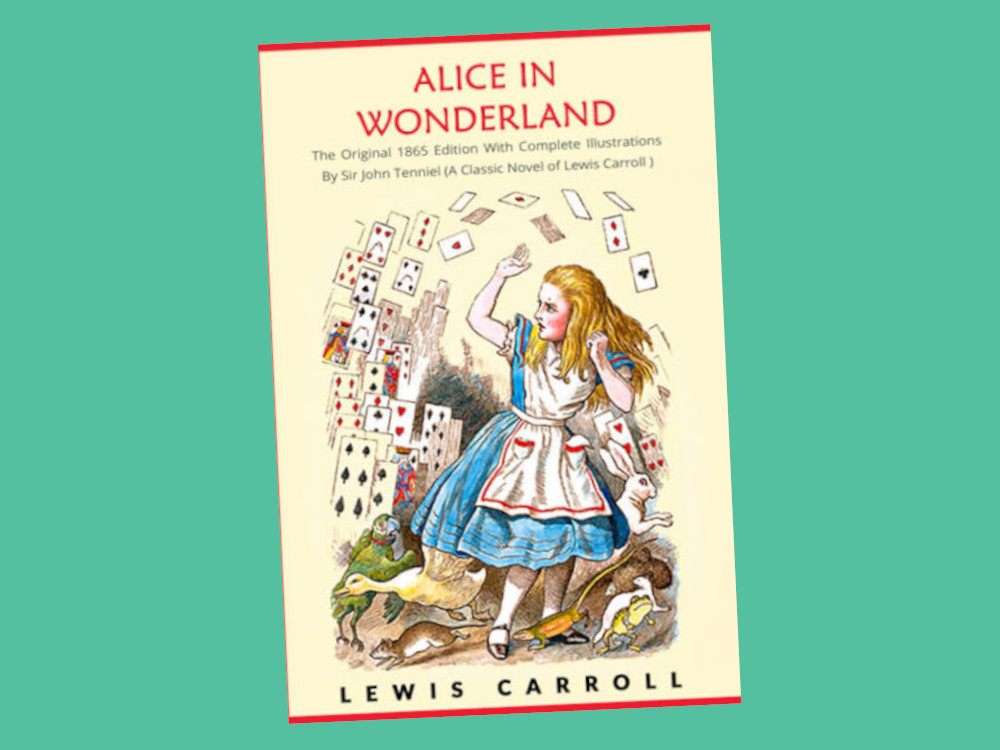
Alice, who had quite given up trying to keep her thoughts in straight lines (for they persisted in curtsying to one another and wandering off mid-sentence), found herself once more in Professor Lewis Carroll’s (Charles Lutwidge Dodgson’s) Oxford Don-like study. True to form were its dark wood panelling, Chesterfields, smoking jackets, and floor-to-ceiling books. The good man was carefully arranging teacups according to a principle he called moral geometry.
“Everything must have its place,” he said, placing a saucer at a most unreasonable angle, “even chaos. Especially chaos. Otherwise it becomes… untidy.”
Alice, who had seen chaos before and found it quite tidy in its own way, did not argue. She had learned that arguing with a mathematician was like trying to nail jelly to a sermon.
A Faith Most Orderly, and Therefore Slightly Dangerous
“Before we begin,” said the avuncular Lewis, producing his pocket Bible with the air of a conjuror revealing the only trick that matters, “you must understand that I am, inconveniently for some, a Conservative Evangelical Christian. For me, Jesus’ death is the crux.”
Alice nodded, as one does when confronted with a fact that refuses to be otherwise.
“I was born on Jan 27, 1832.”He continued, as if dates were moral objects, “the same year the Source of Mississippi River was discovered, Mendelssohn‘s ‘Hebrides’ premiered in London, and Manet was born. Nicolaus Otto, Louisa May Alcott and Gustave Eiffel were also born; and Goethe and Walter Scott died.
“As for me, father was a parson, and mother a woman of admirable patience. I was raised on scripture, discipline, and the alarming conviction that one ought to behave well even when no one is watching— which, I assure you, is most of the time.”
He explained, with quiet satisfaction, that he belonged to that earnest species known as Evangelical Anglicans— those who take prayer seriously, scripture seriously, the physical resurrection of Jesus the key to our eternal hope, and themselves just seriously enough to be dangerous if not occasionally ridiculous. He prayed, read, reflected, and carried his Bible as though it were both compass and conscience.
“And yet,” Alice said, peering at a teacup that seemed to be judging her, “you wrote nonsense.”
“Precisely,” he replied. “Faith without imagination becomes brittle. Imagination without faith becomes unhinged. I preferred a sort of holy hinge.”
His Family, Dates, and the Peculiar Absence of a Wife
Alice, who had begun to suspect that biographies were simply stories that insisted on dates, asked about his life.
“I never married,” said the good Doctor, with a calmness that suggested he had arranged the matter with himself long ago and found it satisfactory. “No wife, no children: though I have borrowed many, in the form of nieces, nephews, and various small persons who tolerate my storytelling.”
Our academic recited his life as if it were a timetable: matriculated at Christ Church in 1850; graduated in mathematics in 1854; lectured, puzzled, photographed; published Alice’s Adventures in Wonderland in 1865; died, with excellent timing, on January 14, 1898.
“I enjoy walking, rowing, logic, photography, and children’s company,” he added. “Not necessarily in that order, though I do try to keep them from colliding.”
“And your personality?” Alice asked.
“Meticulous, whimsical, shy, morally scrupulous, occasionally absurd,” he said. “I am fond of order, though my imagination refuses to obey it. My sins are small, I think- my conscience large, and my sense of humour— regrettably- persistent.”
Of Writers, Rebukes, and Encouragements Served with Tea
“Did no one correct you?” Alice asked. “All this nonsense must have alarmed somebody.”
“Oh, constantly,” said the Intellect, brightening. “Though always politely, which is far more effective.”
He spoke of G. K. Chesterton, who admired his curious talent for making absurdity behave itself morally. “Chesterton believed that nonsense, properly handled, tells the truth sideways— which is often the only way truth consents to be told.”
There was Charlotte Mary Yonge, who approved of moral instruction tucked neatly into narrative, like medicine in jam. “She reminded me that children are not merely amused— they are formed.”
He spoke with affection of the ghostly influence of Robert Southey (Ed.- my 4 x great grandfather, author of Goldilocks, Poet Laureate to Mad King George III, dear friends with fellow Lakes Romantic Poets Wordsworth and Coleridge, and brother-in-law to the latter). Southey urged him to develop diligence, virtue, and the alarming notion that literature ought to improve its readers.
“And then,” the quaint gentleman said, with a curious glance toward the future, “there is Daphne du Maurier, who has not yet been born, but will one day approve of my ability to let chaos roam freely while keeping it on a moral leash. A remarkable trick, as chaos bites.”
Alice considered this. “So you were encouraged… and rebuked?”
“Gently corrected,” he said. “Encouraged to keep moral clarity; warned not to let whimsy eclipse virtue; reminded that imagination must serve truth, not escape it. A most agreeable arrangement.”
The Great Misunderstanding About Drugs (Which Is Not Entirely Mistaken)
At this point, a bottle labelled Drink Me slid obligingly across the table, as though summoned by curiosity itself.
Alice looked at it suspiciously. “This,” she said, “is rather like a modern drug.”
Lewis raised an eyebrow. “So I am told by persons who have the advantage of living in the future and the disadvantage of explaining everything chemically.”
He gestured, and the room obliged by becoming educational.
The Drink Me potion shrank her – just as LSD alters serotonin pathways, distorting scale, perception, and proportion until the world becomes vast and one becomes small, or vice versa, depending on one’s philosophical inclinations.
The Eat Me cake expanded her alarmingly – like DMT, with its overwhelming immersion, ego dissolution, and the sensation that reality has grown too large for its own narrative.
The Caterpillar’s mushroom adjusted her size with unnerving precision—psilocybin, loosening identity, softening the boundaries of self, and encouraging the sort of introspection that asks inconvenient questions like “Who am I?”
The Cheshire Cat (the wall upon which it sat and inspired Carroll through his study window at Christ Church, Oxford, I have witnessed), appearing and disappearing: with theatrical indifferences – ketamine, fragmenting perception, detaching presence from substance, leaving one with the grin but misplacing the cat.
And the Mad Hatter’s tea party, looping endlessly with impeccable illogic – cannabis, warping time, conversation, and memory until one suspects that six o’clock has ambitions of eternity.
Alice blinked. “But you didn’t know these things?”
“My dear child,” said her eminent friend, “I knew children, dreams, logic, and the peculiar elasticity of the human mind. The brain requires no chemical encouragement to behave strangely— it manages quite well on its own.”
Moral of the story, which refuses to sit still
Our author leaned forward, lowering his voice as though confiding in the furniture.
“For the modern evangelical,” he said, “there are lessons from me, though they may wriggle:
Order exists, even when unseen.
Curiosity must be governed by conscience.
Humility is essential, for one is frequently wrong.
Discipline and imagination are not enemies, but allies.
And moral formation may occur quite effectively under the disguise of nonsense.”
Alice nodded, though she suspected she would forget half of it by tea.
“And your heresy?” she asked boldly.
“None of note,” he replied. “Though I have occasionally been guilty of excessive whimsy, which some consider doctrinally suspicious.”
“And sin?”
“Impatience, perhaps,” he said. “And a tendency to over-explain, which you may have noticed.
Alice had.
Carroll: “And poor self awareness perhaps?”
A conclusion which Is not one at all
The room began to dissolve— not unpleasantly, but with the air of a thought concluding itself. The teacups stopped arguing. The Cheshire Cat misplaced itself entirely. Somewhere, Chesterton laughed, du Maurier nodded approvingly, and the future politely refrained from interfering further.
Our erudite friend closed his notebook. “You see,” he said, “I did not require drugs to imagine Wonderland. I required only attention- to the mind, to children, to logic, to God, and to the delightful possibility that nonsense may tell the truth more faithfully than seriousness ever dares.”
Alice considered this very carefully.
Then, being a sensible girl, she decided it was completely unreasonable— and therefore almost certainly true.
Brilliant and very entertaining! Thanks!