
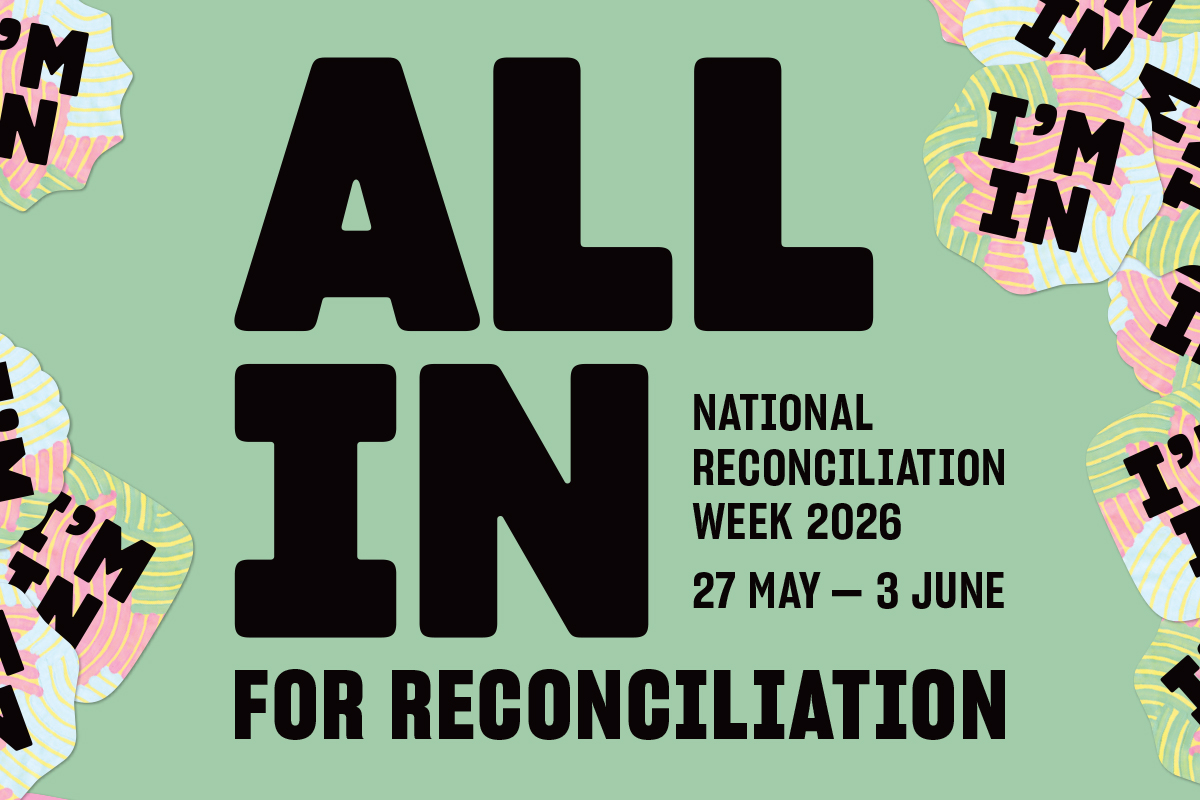
NATIONAL RECONCILIATION WEEK · 27/5 – 3/6 2026 · “ALL IN”
Written by Larissa Minniecon, ABM Truth-telling and Reconciliation Missioner
After 29 years of asking, a First Nations Anglican voice calls the church to step off the sidelines and finally do the work.
Reconciliation is not a spectator sport. It never has been.
And yet, here we are – again.
Every year, for twenty-nine years, First Nations Australians have gathered under the banner of National Reconciliation Week to renew a call that should not need to be made again. This year’s theme – All In – is a direct and urgent call: commit wholeheartedly to reconciliation, every single day, or accept that you are complicit in its failure. There is no middle ground. There is no comfortable seat in the stands.
I write this not only as an Australian. I write this as a First Nations Christian believer addressing the Anglican Church – the institution that claims the reconciling love of Jesus Christ as its very foundation. And I write this with a weariness that I should not still feel in 2026.
When are we coming off the sidelines? When does action replace intention?
Is it not our mandate – as the Anglican Church – to make reconciliation the core of our actions? Then why, after 29 years, are we still asking?
The Mandate Is Already Written
The Church does not need a new theology of reconciliation. It already has one, written across every book of Scripture. The five pillars of reconciliation that guide our national movement are not secular inventions – they are God’s (and therefore – necessarily – the Church’s) priorities. Consider what we, as First Nations people, are asking for:
FIVE PILLARS · FIVE SCRIPTURAL MANDATES
Right Relationship
Micah 6:8 · Romans 12:10
Equality & Equity
Galatians 3:28 · Acts 10:34–35
Historical Acceptance
Nehemiah 1:6–7 · Psalm 51:3–4
Institutional Integrity
Isaiah 1:17 · Luke 11:46
Unity
Psalm 133:1 · Colossians 3:14
How many Bible verses does the church need to move it to genuine action? How long will the Church be deaf to Gospel imperatives it proclaims in words? How many times must First Nations believers stand at the altar of their own faith community and plead a case that Scripture has already decided?
The Word is not ambiguous. Walk justly. Love mercifully.
Honour one another above yourselves. There is neither Jew nor Gentile. God shows no favouritism. Do not burden others with loads you will not lift yourself. These are not suggestions. They are commands.
The Cost Was Already Paid — By Our People
Reconciliation was not a radical invention. It was a recommendation – one of many – that emerged from the Bringing Them Home Report of 1997, the landmark national inquiry into the forced removal of Aboriginal and Torres Strait Islander children from their families. That report laid bare a wound that the nation – and the Church – helped inflict.
Children were taken.
Mothers were traumatised.
Fathers never saw their children again.
The grief, the loss, the intergenerational trauma cost our people an entire generation and more. The Stolen Generation is not a historical abstraction. It is living memory. It is the grandmother who cannot speak of it. It is the uncle who was never found. It is the silence at family gatherings where names should be spoken.
Responding to the Stolen Generation is a national responsibility. But it is also – explicitly – a church responsibility. The Church was present at the removal. The Church ran the missions. The Church signed the documents. It cannot now stand at a distance and observe the healing work as though it were a bystander.
“All diocese and parishes to pray and work for the healing of the nation and in order to facilitate re-connections, to collaborate with the Federal Government and Indigenous people to make all archives and other records accessible.” General Synod motion- Stolen Generation, 26 July 2001 · Moved by the Revd D. Langham, Seconded by Bishop A. Malcolm
Twenty-five years ago, Aunty Rev Canon Di Langham stood before the General Synod and moved a motion that was both pastoral and prophetic. It was a motion for healing. It was a motion for access. It was a motion for collaboration. It passed. And yet – here we are. Still asking.
Do Not Ask Us What to Do
There is a particular exhaustion that comes from being asked, repeatedly, to provide the answer to a question that has already been answered. The Church does not get to turn to First Nations people in 2026 and ask, “Well, what should we do?” That question, in this moment, is an abandonment – not an inquiry.
We have given the answer every year. We gave it through the Bringing Them Home Report. We gave it through General Synod motions. We give it every Reconciliation Week. The answer has not changed, because the action has not followed.
Do the work, Church. Open the archives. Give First Nations people and their families access to the records, the documents, the names – the evidence of their own histories held in diocesan filing cabinets and parish registers. Collaborate with First Nations communities as equal partners, not as charity. Commit resources – real resources, not goodwill statements – to the slow, costly, holy work of restoration.
Restoration is not a programme. It is not a Reconciliation Sunday or a Welcome/Acknowledgement to Country at the beginning of a service. It is the ongoing, daily, costly commitment to right what was wronged – the justice and hope work that Jesus Christ our Lord taught and embodied. It is the work of Nehemiah, who did not simply grieve the broken walls – he picked up stone and mortar.
It is the work of Zacchaeus, who did not simply feel remorse – he gave back four times over.
All In. Every Day.
National Reconciliation Week 2026 calls every Australian – every institution, every community, every church – to be All In. Not in theory. Not in ambition. But in practice. In policy. In the opening of archives. In the funding of healing programmes. In the genuine, humble, sustained partnership with First Nations peoples that this moment demands.
The sidelines are not a neutral position. To stand and watch is a choice. And twenty-nine years of watching is long enough.
Do the work. We have shown you how. We are still here, still asking – and still believing, as people of faith, that the Church can yet become what it was always called to be.
Written by Larissa Minniecon, ABM Truth-telling and Reconciliation Missioner
Endorsed by:
The Rev’d Cameron Burr, Chair of the National Aboriginal and Torres Strait Islander Anglican Council (NATSIAC)
and
Rev’d Canon Aunty Di Langham, Secretary to NATSIAC and the first Director of Reconciliation with Newcastle Anglican Diocese.