
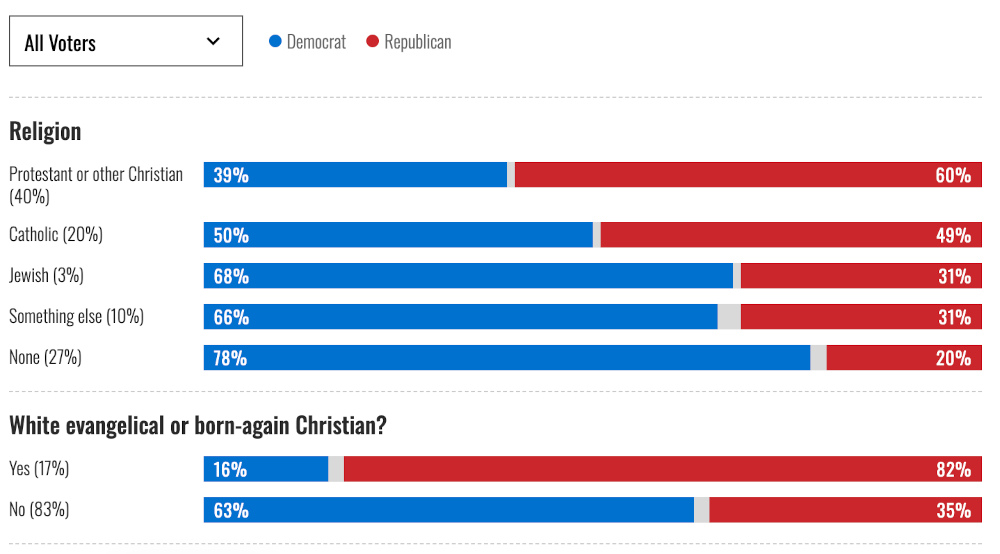
The share of white Evangelicals voting in the US 2026 elections plummeted to 17% of voters, down from 24% in 2022 and 23% in 2024, according to the Washington Stand published by the conservative Christian group, the Family Research Council. Coupled with this year’s turnout at the midterms (123.5 million votes cast) compared to the 2024 presidential election (154.3 million), it is likely only about half of the evangelicals who boosted President Trump’s return to the White House turned out to vote this year.
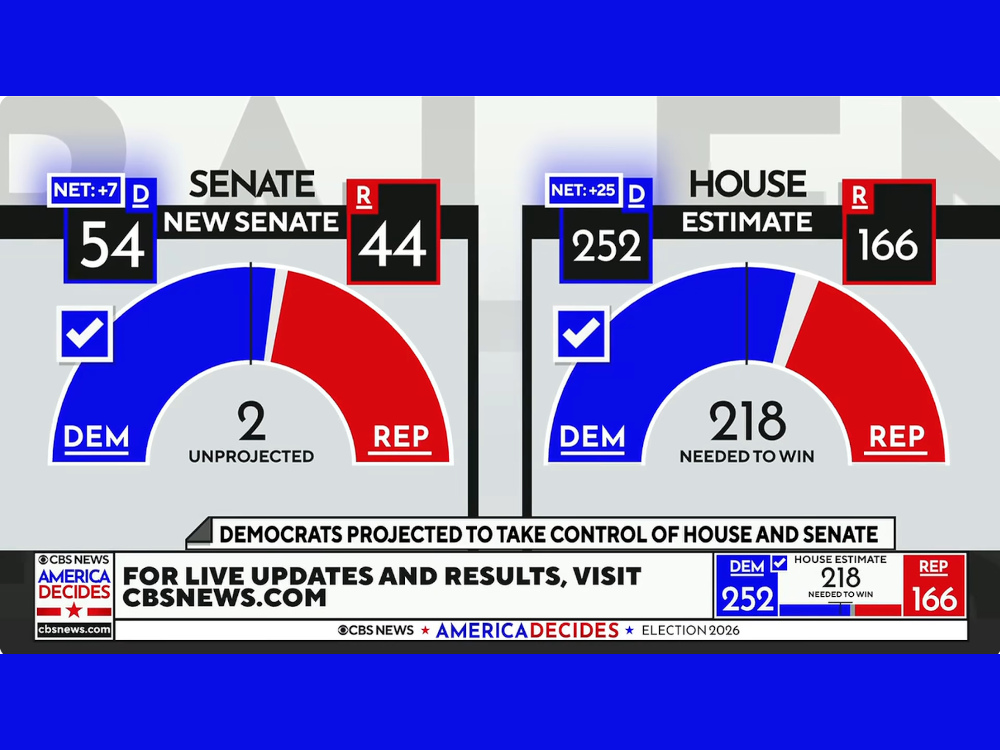
The blue tsunami that swept the Democrats to power with about a 15 per cent average swing was boosted by the absence of white evangelicals. Of the white evangelicals who did turn out, 82 per cent voted Republican, according to exit polls – the same percentage as last time, only with far fewer votes. Here is NBC’s summary:
Just prior to the election, Pew Research’s Gregory Smith told a Council on Foreign Relations webinar, “among white Evangelical registered voters, the share of them who say they approve of the way the president is handling his job today is twenty points lower than at the beginning of his second term.”
Religious News Service reported that Catholics, who made up about 20% of midterm voters, shifted from majority red in 2024 to a near-even split this year between Republicans and Democrats, according to both [NBC and CNN] exit polls.
“The American Catholic vote, once a decisive source of support for Donald Trump, has become one of the clearest indicators of the political discontent confronting his presidency,” the Catholic News Site Zenit commented. “In the November 3 midterm elections, Catholics divided almost evenly between Democrats and Republicans, marking a dramatic reversal from the 2024 presidential contest.”
As the Evangelical vote fell, the “religious nones” vote rose fromn 24 to 27 per cent of the voter trn out.
Zenit noted that Latinos and white Catholics did not vote the same way. “White Catholics remained firmly Republican, with 56% supporting the party’s candidates. Among white Catholics without a university degree, that figure rose to 63%. Hispanic Catholics, by contrast, voted Democratic by 65%, while African American voters did so by 87%. The wider Hispanic electorate also moved towards the Democrats, whose share of the Latino vote rose from 51% in 2024 to 64% in these midterms.”
These shifts – the stay-at-home evangelicals and the left tilt of the Catholic vote – provided valuable votes to the emerging Democratic wave. In aggregate, perhaps more than half of the swing could be attributed to these by religious voters – in this case, non-voters.
“Exit polls showed nonreligious voters were instrumental in securing key Senate victories for Democrats whose faith was central to their campaign,” the left-of-centre Catholic news site National Catholic Reporter recounted. “CNN found that megachurch pastor Adam Hamilton lost both Protestants (37%) and Catholics (47%) in the Kansas Senate race, but he won support from 82% of religious nones. In Texas, James Talarico won the support of 58% of Catholics and 77% of nones.” But it is the change numbers of these voters that may have been decisive.
However, religion was not a key factor, according to some experts ‘I don’t particularly think it was a religious election,’ political scientist and researcher Ryan Burge told RNS. ‘I think it was pretty much an economic election, an inflation election, a dissatisfaction with Trump election.’”
On the other hand, the election was notable for the election of a number of centre-left or progressive Christian candidates, with senators-elect Talaricio and Hamilton leading a pack. The Other Cheek’s first take on the results: Progressive Christians surf a blue wave in US elections