
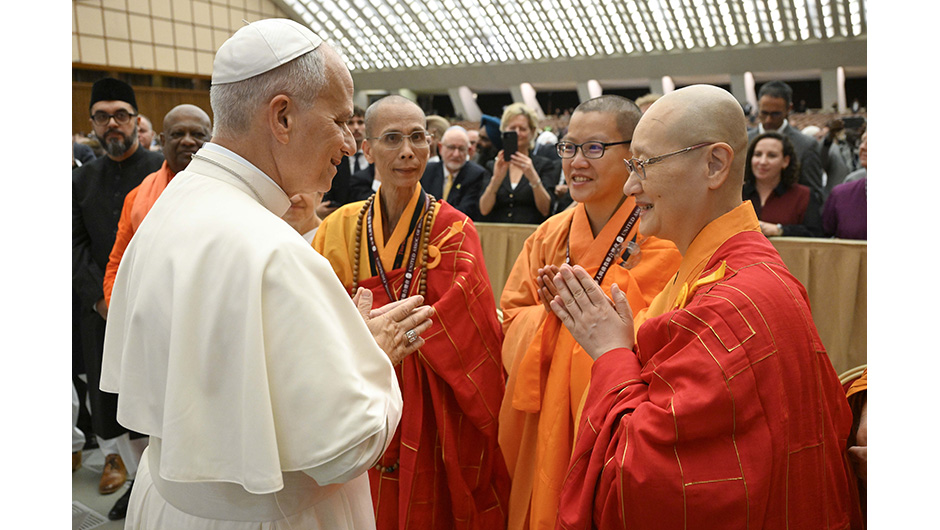
A careful reading of Pope Leo’s statement’s confirms that Jesus is the unique and sole saviour of humanity.
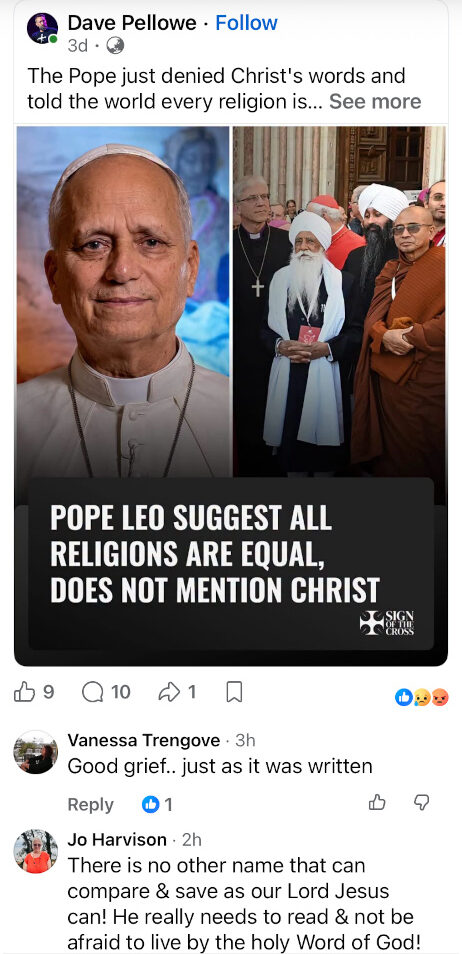
The accusation. Claims are doing the rounds on social media that Pope Leo XIV sees all religions as equal. Here’s an Australian example posted by conservative commentator David Pellowe, on November 2. Pellowe is a significant Christian voice best known for the annual Church and State conference.
“The Pope just denied Christ’s words and told the world every religion is equal.
“He did not mention Christ.
“Not once.
“The man who sits in the chair of Peter stood with Sikh leaders, Buddhist monks and others and treated their paths as equal to the gospel. He offered no distinction. No exclusive claim. No warning. No cross.
“Jesus said: “I am the way, the Truth, and the life. No one comes to the Father except through me.”
“That is not a suggestion. That is the foundation of Christianity.
“If every religion is equal, then Christ is optional.
“If Christ is optional, the cross is meaningless.
“If the cross is meaningless, the gospel is just another opinion.
“For years the Vatican has blurred the lines. Interfaith events. Soft language. The steady drift that treats the unique, exclusive claims of Jesus as one voice among many. Now it is out in the open. All religions equal. Christ not even mentioned.
“Australia’s churches do not need more of this.
“Parents do not need their children told that every path leads to the same place.
“A nation facing radical Islam, moral collapse and cultural confusion does not need its most famous Christian leader declaring that truth is relative.
“There is only one Name under heaven by which we must be saved — MESSIAH JESUS!
“What are your thoughts?”
What the Pope said:
The Facebook Illustration is lifted from Sign of the Cross, a conservative Catholic page which links to a Lifesite news story. That references a speech by Pope Leo “video message of his Holiness Pope Leo XIV to the participants in the international meeting ‘Unarmed and disarming peace“‘ This is an address about International Peace, to 5000 people which included secular and religious leaders, including the Chief rabbi of Rome and the Grand Imam of the Istiqlal Mosque in Jakarta, Indonesia and Rector of the International Buddhist Education Center in Myanmar. “Unfortunately, as I wrote in Magnifica Humanitas, ‘an almost blind faith was placed in the ability of the markets to generate prosperity, democracy and stability. In reality, rather than automatically generating unity and peace, globalization has provoked fundamentalist, identity-based and nationalistic reactions” (no. 201).
Against this backdrop, there has been “troubling revival of war as an instrument of international politics” (ibid., 190). As the Catechism of the Catholic Church states, “the accumulation of arms strikes many as a paradoxically suitable way of deterring potential adversaries from war. They see it as the most effective means of ensuring peace among nations”
The meeting was held at Assisi and the Pope said “Let us turn to God, the giver of peace, that he may touch the hearts of those who seek war and terrorism. Let us not forget that prayer is never in vain.
“Indeed, prayer is a school of dialogue with God, with people and with all creatures. Let us think of Saint Francis, whose death we have commemorated on his eight-hundredth anniversary. The world needs dialogue. The path of Assisi calls religious leaders to foster a climate of dialogue amongst the faithful and within society, so that the language of arrogance may give way to the language of peace, negotiation and understanding. This will help to ‘gradually [lead] humanity away from the cycle of violence’ [again quoting his encyclical Magnifica Humanitas].”
A general statement that human beings should all pray is thin ground to accuse Pope Leo of saying all religions are equal. But there are other papal speeches which actually on the topic of other religions, which might have been what Pellowe was remembering.
On October 28, 2025 3,000 people attended a speech by Pope Leo to mark the 60th anniversary of Nostra Aetate, the Second Vatican Council’s declaration on relations with Judaism, Islam and other world religions. Catholic News Service’s Cindy Wooden reported “At the beginning of the event, more than 80 representatives of Christianity, Judaism, Islam, Hinduism, Jainism, Sikhism, Buddhism, Zoroastrianism, Confucianism, Taoism, Shintoism and African Traditional Religions filed into the hall behind a Sri Lankan Buddhist dance troupe and accompanied by children from an Italian choir.”
Pope Leo’s full speech is here: https://www.vatican.va/content/leo-xiv/en/speeches/2025/october/documents/20251028-nostra-aetate.html
The Pope had warm words from the 400 delegates to a Nostra Aetate conference:
“If the Nostra Aetate Declaration has nourished the ties between us, I am convinced that its message remains highly relevant today. Let us, then, take a moment to reflect on some of its most significant teachings.
“First, Nostra Aetate reminds us that humanity is drawing closer together, and that it is the task of the Church to promote unity and love among men and women, and among nations (cf. n.1).
“Second, it points to what we all share in common. We belong to one human family — one in origin and one also in our final goal. Moreover, every person seeks answers to the great riddles of the human condition (cf. n.1).
“Third, religions everywhere try to respond to the restlessness of the human heart. Each, in its own way, offers teachings, ways of life and sacred rites that help guide their followers toward peace and meaning (cf. n.2).
“Fourth, the Catholic Church rejects nothing that is true and holy in these religions, which “reflect a ray of that truth which enlightens all people” (n. 2). She regards them with sincere reverence and invites her sons and daughters, through dialogue and collaboration, to recognize, preserve and promote what is spiritually, morally and culturally good in all peoples.
The Pope made special mention of the anti-Semetic intent at the heart of this document.
Dave Pellowe and others are correct that this speech makes no mention of Christ. Which raises the question: has Pope Leo assereted that Chris is the Saviour?
Perhaps the most significant statement of his papacy came in October last year when the Vatican issued, with Papal approval, Mater Populi Fidelis declaring that Jesus, not Mary, the sole redeemer.
Paragraph 24: “The biblical statement about Christ’s exclusive mediation is conclusive. Christ is the only Mediator, “for there is one God, and there is one mediator between God and men, the man Christ Jesus, who gave himself as a ransom for all” (1 Tim 2:5-6). The Church has clarified this unique place of Christ in light of the fact that he is the eternal and infinite Son of God, hypostatically united with the humanity he assumed. This is exclusive to Christ’s humanity, and the consequences that derive from it can only be properly applied to him. In this precise sense, the Incarnate Word’s role is exclusive and unique.”
Paragraph 47: “7. Our salvation is solely the work of the saving grace of Christ and of no one else. Saint Augustine affirmed that “this reign of death is only destroyed in any man by the Savior’s grace,”[101] and he explained this point clearly in light of the redemption of the unjust man: “Who would want to die for an unjust man, for an ungodly man, save Christ alone, he who was so just as to be able to justify even the unjust? So, my brethren, we had no meritorious works, but only demerits. Although the works of men were of such a sort, his mercy did not forsake them and… instead of the punishment that was owed, he gave them the grace they did not deserve… [He did this] to redeem us, not with gold or silver, but at the price of the shedding of his blood.”[102] Thus, when Saint Thomas Aquinas asks whether anyone can merit for another, he answers that “no one can merit for another his first grace, save Christ alone.”[103] No other human being can merit it in the strict sense (de condigno), and on this point, there can be no doubt: “no one can be just unless the merits of the Passion of our Lord Jesus Christ are imparted to him.”[104] Likewise, Mary’s fullness of grace exists because she received it freely, before any action on her own part, “in view of the merits of Jesus Christ, the Savior of the human race.”[105] Only the merits of Jesus Christ, who gave himself up to the end, are applied to us for our justification — which, since it “ends in the eternal good of divine participation, is a greater work than the creation of heaven and earth.”[106]“
Discussion: Protestant frustration with the catholic Church is because we may use different modes and styles of communication. Sure, a protestant might say, why can’t the Poper declare the uniqueness of Christ when he has representatives from other religions in the Vatican? He does sometimes – take this speech on 9 May 2025 for example “Address of the Holy Father to representatives of other churches and ecclesial communities and other religions.“
Then there is the Catholic tendency to use words like justification and evangelization and sacramental in different ways to Protestants. Oh that the catholics would get hold of a good Protestant dictionary!
But we have to read carefully, and allow for these different communication styles. When we wish to examine a particular issue, especially on a subject like how someone regards other religions, let’s examine a piece of writing about that topic. Picking a comment or phrase out of a speech or essay about another topic is not the way to get a full picture of what a writer or religious leader thinks, especially if they have actually addressed the topic fully elsewhere. Lets seek out the vbest sources of information and then make a judgment call if necessary. And some, but not all, differences will lessen.