

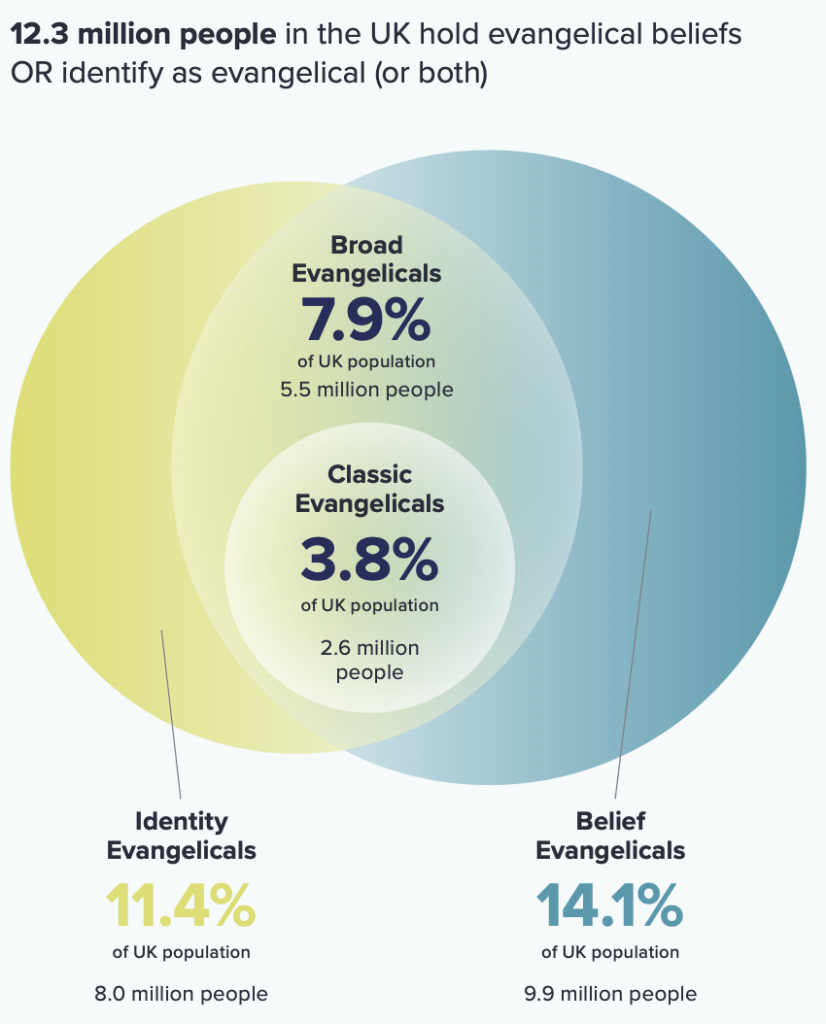
12.3 million people in the UK hold evangelical beliefs OR identify as evangelical (or both) out of a population of 70 million, according to a survey commissioned by the Evangelical Alliance. The findings contradict some common assumptions; the survey found evangelicals are younger, more ethnically diverse, and more likely to be male than the wider population.
“Evangelical belief was measured using four statements based on the Bebbington Quadrilateral, a widely accepted framework for defining evangelical Christianity,” the Understanding UK Evangelicals analysis reports. “Respondents indicated their agreement with each statement on a scale from strongly agree to strongly disagree. This enabled us to identify those who agree with all four statements – a group of Belief Evangelicals.
“From this we identified five groups within the broader evangelical population, from those who simply identify with the label to those who hold the tightest combination of evangelical identity, belief, and Protestant church tradition. We anticipated significant overlap between these two groups and that those who identify as evangelical would be highly likely to hold the beliefs, and vice versa. What we found was a core group who meet both tests, but also a much larger population who meet only one. Altogether, 17.6% of the UK population (around 12.3 million people) are Somewhat Evangelical on at least one of these two measures.”
The Bebbington Quadrilateral defines four core emphases of evangelicalism: Bible, cross, conversion, and activism. It came from historian David Bebbington’s 1989 book Evangelicalism in Modern Britain: A History from the 1730s to the 1980s.
Adults were asked if they agreed with the four statements of evangelical belief; the percentages are those who either agreed or strongly agreed.
• Biblicism – The Bible is the inspired and authoritative word of God: 26 per cent
• Crucicentrism – Jesus Christ died in our place to save us from our sins: 28 per cent
• Conversionism – Belief in the need for personal conversion through faith in Christ: 20 per cent
• Activism – The importance of putting faith into action through evangelism and good works: 20 per cent
14.1 per cent agreed or strongly agreed with all four.
The researchers divided those with evangelical belief into five groups, ranging from all who shared the four evangelical beliefs – which might include Catholics – to a tighter group which they call classic evangelicals.
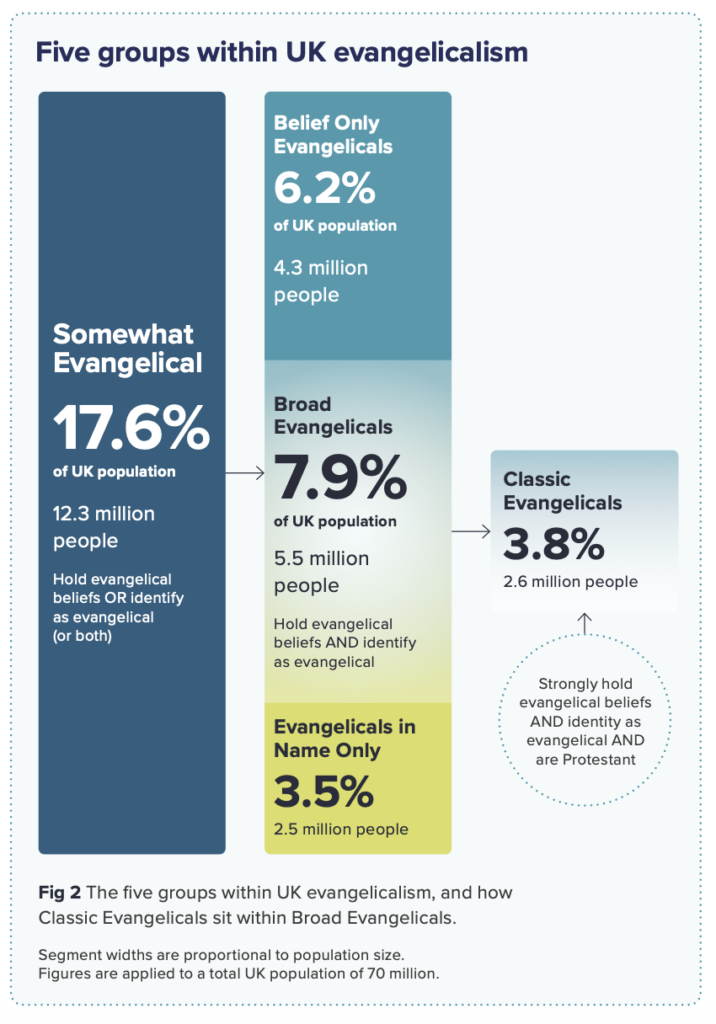
Here’s how the resaerchers defined those groups:
Somewhat Evangelical (17.6%)
Those who agree or strongly agree with all four belief statements OR identify as evangelical (whether or not they would use the term). No denominational or practising limitation – the widest category of evangelicals. Identity evangelicals are those who considered themselves an evangelical, and whether they would be comfortable using the term to describe themselves
Broad Evangelicals (7.9%)
Those who agree or strongly agree with all four belief statements AND identify as evangelical (whether or not they would use the term).
Classic Evangelicals (3.8%)
Those who strongly agree with all four belief statements AND identify as an evangelical (whether or not they would use the term), AND are Protestant Christians (excluding Roman Catholic and Eastern Orthodox traditions).
Evangelicals in Name Only – EINOs (3.5%)
Those who identify as evangelical but do NOT agree with all four core evangelical belief statements.
Belief Only Evangelicals (6.2%)
Those who agree or strongly agree with all four evangelical beliefs but do NOT identify as evangelical at all.
Practising Christians (7.2%)
Those who attend church, in person or online, at least once a month, and pray and read the Bible independently at least once a week.
Classic evangelicals
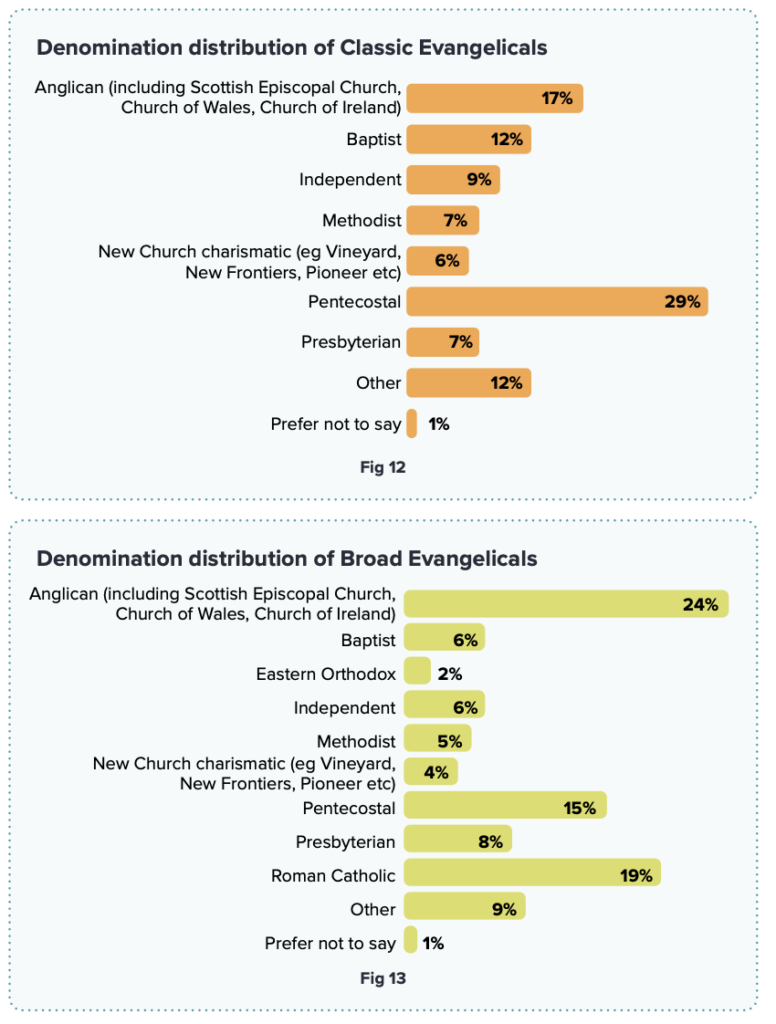
Australian groups such as Baptists and evangelical Anglicans resemble the group in the UK survey called classic evangelicals. The researchers state “Classic Evangelicals strongly agree with all four belief statements AND identify as an evangelical (whether or not they would use the term) AND are Protestant Christians (excluding Roman Catholic and Eastern Orthodox traditions). Historically, evangelicalism has been considered a group within Protestant Christianity which is why we have restricted this group to only Protestants. 3.8% of respondents can be described as Classic Evangelicals – equivalent to 2.6m of the UK population. This group is younger than the general population and much more ethnically diverse.
“It is highly likely that an individual from this group is also a practising Christian: we found that over 77% of Classic Evangelicals were also practising Christians, suggesting that this group makes up a significant part of active evangelical churches up and down the UK.
“Classic Evangelicals skew notably younger than the UK population as a whole. 43% are under the age of 35, with another significant grouping (nearly 20%) aged 35 to 44.
“Classic Evangelicals are also ethnically diverse. Over a third come from an ethnic minority background – nearly double the proportion of the general population. The majority of this group are Black, Black British, Caribbean or African, who alone make up nearly 28% of all Classic Evangelicals in the UK.
This group trends significantly male: more than 61% of Classic Evangelicals are men.
Broad evangelicals
“This wider definition of evangelicals – those who identify as evangelical and hold the core beliefs, regardless of denomination – accounts for 7.9% of the UK population, or around 5.5m people. By most measures, this group can be defined as evangelical; they are simply less certain in their belief, and, unlike Classic Evangelicals, do not necessarily belong to a Protestant denomination.
Broad Evangelicals follow a similar demographic pattern to Classic Evangelicals, though the trends are somewhat less pronounced. About 58% of this group are practising Christians, notably lower than the 77% recorded among Classic Evangelicals.
“Like Classic Evangelicals, Broad Evangelicals skew younger, though less markedly: 41% are under the age of 35.
“The pattern of ethnic diversity holds here as well, with nearly 30% of this group from an ethnic minority background.”
Growth
The report is optimistic about church growth. “The number of evangelicals has grown significantly from the 2 million estimated by Tearfund’s 2007 survey of UK churchgoing1. Using the narrowest definition there are now an estimated 2.6 million evangelical Christians in the UK.
“Looking at the number of practising Christians in the UK – those who regularly attend church, pray and read their Bibles – 64% are evangelicals in terms of both how they identify and their beliefs.
“Adults under 35 are the age group most likely to identify as evangelical and to hold evangelical beliefs. Approximately a third of the most committed evangelicals come from ethnically diverse backgrounds, while an estimated 60% of evangelicals are male.
“This is incredibly encouraging news. At a time of widely reported decline in religion, the statistics tell a different story. Evangelical Christianity is thriving among young people, ethnic minority populations and men. The UK church is growing, and this looks set to continue, given the demographics.”
Image Credit: The digital artist / Pixabay