
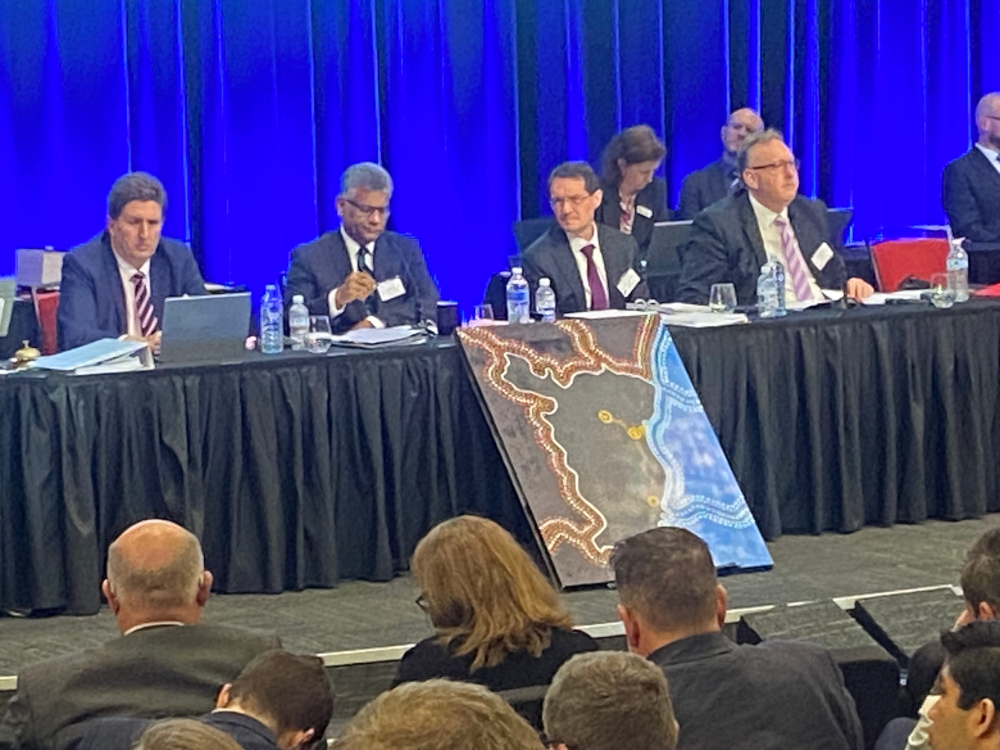
Sydney Anglican Synod 2026 might be known as the “conversion synod. This meeting of the church parliament-like gathering has heard Archbishop Kanishka Raffel recount a myriad of conversion stories in his presidential speech (read some of them here: Archbishop Kanishka Raffel tells stories to the Sydney Synod: they are worth telling again) but also resolved to ask Ministers running local churches to do a new thing. They are to “record the names of those who professed faith in Christ during a year in order that the church might rejoice with the angels in heaven.” The number of people saved, in two groups under and over 18 years old, would be passed on to the diocesan registrar, and a group monitoring the diocese’s (Sydney Anglican) goal of at least 5 per cent each year.
Moving the motion to record conversions, Craig Roberts, who heads Youthworks and chairs the committee, monitoring the 5-year 5 per cent goal: “If the Lord blesses our work, we will grow by 27% over these five years. If that momentum continues, we’ll grow by two thirds over 10 years and by 2040 we will have doubled in size. That potential excites me. Not because we want an empire, but because that would mean more people are falling in love with Jesus, entrusting their lives to him, saved from the eternity without him and then telling their friends about him.”
But Sydney wants to measure conversion growth. “The moneyball stat is measuring conversion growth. Not church growth because the church down the road fell apart and 50 people turned up to your place on Sunday. Not growth because believers have moved into your suburb from another church, but church growth because the lost are being saved before our very eyes.”
Roberts was careful to emphasise, “Hear this very carefully and clearly.. This is not an audit of pastor faithfulness. This is not a scorecard of rector or ministry team competence. This is us in the light of the declining church attendance observed between 2013 and 2022, asking what is the Lord doing?
Mike Hastie, Lead Pastor at Toongabbie Anglican Church, spoke seconding the motion on why a better measure of growth is needed: “Overall attendance is a good indicator of growth, but it is a lagging measure. That is, the factors that undergird whether a church is growing in attendance or declining are often related to things that happened in the months and years prior to that, which makes finding the relationships quite complex. …
“As has already been said, one of the challenges in calculating this conversion growth [for this year’s report] is the method we’ve used, which is quite blunt. We’ve used confirmations and adult baptisms as an approximation for conversions, noting that we’re presumably mostly using youth numbers in those confirmations and dividing it by adult attendees.
“We’re seeking to improve this by including a simple adult and under 18 step for total professions of faith and that will change things for my church a bit. Take for example, a man I will call Pete. Pete was baptised as a child. In understanding his story ,over the many years he has lived, he has never understood the grace of Jesus. Last year he came to understand the grace of Jesus and his life has been changed dramatically. We don’t do double dunking and so his conversion doesn’t appear in our stats. He’s very clearly professing faith in Jesus. There is a woman also that I will call Jen. She comes from a Hindu family and for her, the public act of baptism carries seriously complicated implications, yet she too has very clearly confessed faith in Jesus Christ and the transformation in her life testifies to God’s work in her. Pete and Jen matter. I know their real names. Our church thanks God for them. We pray for them and I want to see them established as disciple making disciples of Jesus.”
Daen Sandy Grant from St Andrews Cathedral suggested that the word “goal” for the 5 per cent growth target should be something like “prayerful aspiration.”
Erin Riley from St James Menagale asked about “people who fall into a third category who are not professing faith for the first time or being baptised but are instead returning to the church after a period wandering in the wilderness. I speak as one such person who had a lengthy period away from Christ, but that does not make my previous profession any more true or honest and nor does it in any way undermine the profound gift of coming back to Christ.” The seconder pointed towards NCLS data as capturing people like Erin Riley.
Andrew Schmidt, the minister of St Jude’s Randwick, asked a similar question: “What is the intention in regard to a person, a child who is the sort of always believed sort of person that they’re brought up in church. I could just foresee some difficulties answering that question. We don’t want to be double counting people…” The seconder suggested ministers’ focus should be on those who come to faith under their own ministry.
Raj Gupta, Minister of Carlingford and North Rocks, asked how he could assess when a child came to faith. Roberts responded, “I haven’t got a black and white answer for you, Raj. Every family, every child is different. I guess something that Reverend Hastie said a few minutes ago is what we are looking for is not just one lay down misere number, but we’re trying to get a sense of missional heat, evangelistic heat across our churches.”
Mikw Doyle, Minister of Berala, moved an amendment to delete the requirement on rectors to record conversions. “The only reliable thing about clergy-reported data is that it is reliably unreliable. The report itself demonstrates the problem. There are 259 parishes. 50 didn’t submit their data in time for the report, and of the 209 they did, only about half reported baptisms and confirmations. Why on earth do we think that adding another statistic to report will make clergy reliably report what clergy already don’t reliably? And it is a statistic that is subjective, personally advantageous to the person reporting it and impossible to verify. It is bad data. The NCLS nearcomers figure is a much better measure, independently collected, professionally designed and statistically meaningful.”
Doyle also had a theological objection: “Our desire for good outcomes leads us to act as though we produce those outcomes. Our desire to measure leads us to make judgments that only God can make. Our desire for a culture of evangelism becomes a culture obsessed with the conversion moment. And our desire to count numbers leads us to forget that people matter, people that God loves, people that Christ died for, people that God calls into his family, people who hear the voice of our saviour and answer him in God’s time. … Rectors should not be asked to maintain a book of life. It is not consistent with our theology. Writing names in the book of life belongs to the God who saves. Let us not turn this into another rector reported KPI.”
Prasanth Columbage, minister of St Stephens Wliioughby, opposed Doyle’s amendment but also spoke from the heart. “I’m clergy; I’m a rector in a lower north shore church. Let me do my peacocking for a moment. The last two years we’ve experienced 5% conversion growth, eight for the first year, 12 this year, except only four of them attend church regularly now. And I’ve learned a lot from that experience, from the thrill of someone praying a prayer of confession and then from the disappointment, frustration and anger, dare I say, of them then perhaps walking away from that moment.
“I’ve learned a lot of things. First of all, I learned that Jesus knew what he was talking about. When you cast the seed, it lands in different soil and only one of them ends up going the distance. This is not claiming that people will go the distance. It’s just marking a point in the line. Secondly, I learn my heart needs to be fixed. I need to not so easily be swayed by short term wins. I need to be patient because the Lord is patient with me. I need to be patient with his people because I’ve also learned that sometimes they go and then they come back. Praise God for that.”
Pointing to the book of Acts and the numbers of conversions recorded in it, Toby Neal, minister of Vine Church, Surry Hills, spoke against the Doyle amendment: “For many years, I resisted recording the names of those whom God has saved because I’m a Sydney Anglican and we like to be theologically precise. Who am I to say who is written in the Lamb’s Book of Life? I don’t have access to that. I can’t see it. And so I resisted it for many, many years. But a couple of years we started writing down the names of those who had professed faith in Jesus. Now not all who professed faith in Jesus persevered to the end, but a profession is something we should rejoice in. It’s something that we can identify and write down and notice, like we are not being asked to assess whether their faith is genuine. God knows those who are his; we’re being asked not for salvations, but for professions.”
“Every staff meeting we ask the question, ‘Who’s professed faith in Jesus in the last week?” That forces me to account for my last week of work. The last ten weeks, I haven’t had an answer to that question, and I felt guilty. And so on Sunday I’m like, “I’m not going to show up without an answer.” And so I went and spoke to a man that I knew has been exploring faith, and I asked him where he’s at.
“Last year a lady came to me after a sermon in tears and I was worried she’s going to be angry at me, but she said, ‘I’m so cuffed to the heart. I think my mum’s going to hell.’ And she was in tears. And I said, ‘Where are you at? Have you become a Christian yet?’ She said, ‘I’m not sure.’ I said, ‘Would you like to become a Christian?’ She said, ‘Yeah, I’d love to become a Christian.’ I explained it to her. I said, ‘You want to pray now?’ I led her in prayer and she put her trust in Jesus.”
Dave Jensen from Evangelism and New Churches called for “gospel optimism.”
“It’s very easy to point back to Billy Graham’s arrival [in 1959] and go, ‘Well, that was a different time.’ And it was. 90% of Sydney and Wollongong claimed to be Christians at that time. An enormous number of the 2.2 million people who lived in our city said that they were Christians, and many of those were baptised and confirmed like my own father and professed faith at Billy Graham. But today, very, very different. However, gospel optimism allows you to view reality differently. For example, did you know that whilst we are not 90% of the nation, 90% of the city being Christian, we’re at 45%.
“45% of our city and Wollongong claim the name of Christ, claim to be Christian. Do you know what number that is? 2.8 million people. To get your mind around that, that is far more than the people who claimed Christ in 1959. That’s more than the people who lived in Sydney and Wollongong in 1959. It’s not the same. Of course it’s not. The difference is gospel optimism that we believe in a God who can and does save people. We know he does, and the worst of the worst. If you don’t believe me, look around. [gestures to the Synod].
The unamended motion passed on the voices.
Image: Sydney Synod2026