
In an online essay, historian Michael Gladwin captures the post-war impact of the extraordinary cohort of chaplains who left comfortable parishes for the front line of World War One, profoundly shaping the way Australia commemorates Anzac Day and a lot more.
Brothers in Alms: Australian Anglican Army Chaplains and the Impact of the First World War, 1919–1939, is published in the Cambridge University Press Journal of Anglican Studies and is open access online.
Gladwin quotes Chaplain Gerard Tucker from 1917 “I cannot see the synod of Melbourne sitting spell-bound while the unknown Tucker puts forth the lessons he and hundreds of others have learnt while on service. I can, though, see the same synod paying the greatest heed to the well-known Canon So-and-so, should it have been his privilege to have seen the things that we have seen. But alas, Canon So-and-so stayed at home.”
Before becoming a chaplain, the Anglo-Catholic Tucker had enlisted as a private in the medical Corps, finding ” his closest friends were a seller of newspapers in Toorak Road, a porter at Flinders Street railway station, a builder and a farmhand from Gippsland.” A long-cherished ambition to set up a brotherhood was finally realised after the 1929 stock market crash, when he founded the Brotherhood of St Laurence with three young protégés.
“Their rule consisted of frugal living, celibacy, communal life and active community involvement,” Gladwin writes. “During this time, Tucker also befriended Ernest Burgmann. Burgmann, an outspoken priest and later Bishop of Canberra and Goulburn (1934–60), denounced police brutality at Tighes Hill, Newcastle (where police and several protestors were injured in fighting that broke out over the eviction of a returned servicemen and his family), gaining wide community support in 1932.
The Brotherhood moved to inner-city Melbourne at the invitation of veteran chaplain Archbishop Frederick Head MC, in 1933, where it commenced an influential ministry that expanded and continues to this day, pursuing Tucker’s original charter. The location of the new mission in Fitzroy, in the heart of Depression-ravaged Melbourne, was one where lone police officers did not walk even in daylight, but where religious and clergy moved around safely by day or night (because they did not represent the law or landlords). By the early 1930s around one-third of the unemployed in Melbourne had not seen work for three years. Under Tucker’s leadership, the Brotherhood campaigned for the abolition of slums and established hostels for homeless and unemployed men and boys, housing schemes, a community retirement village and hospital, a club for elderly pensioners, a seaside holiday house for poor families and an opportunity shop.”
In evangelical Sydney, Dean Albert Talbot, who had ignored a bullet wound at Lone Pine to continue ministering to the men at Gallipoli, was part of the generation of Chaplains who Gladwin recounts as returning with a passion for social justice. “Upon his return to Sydney, Talbot helped co-found the Industrial Christian Fellowship in 1923 with trade unionist Albert Willis. By this means Talbot sought to bring Christian values to bear on Labour politics. Talbot refused a ‘Yes’ vote for the conscription referenda and opposed government policy during the general strike of transport and mining workers, which divided NSW in 1917, pleading with fellow clergymen not to align the Church unthinkingly with the interests of capital. For these efforts, and for his cooperation with Roman Catholic priest Maurice O’Reilly during the 1917 strike, Talbot attracted bitter antagonism from conservatives among both Anglicans and Presbyterians. The Church Record expressed its surprise at such an attitude ‘from one of the heroes of Gallipoli.’”
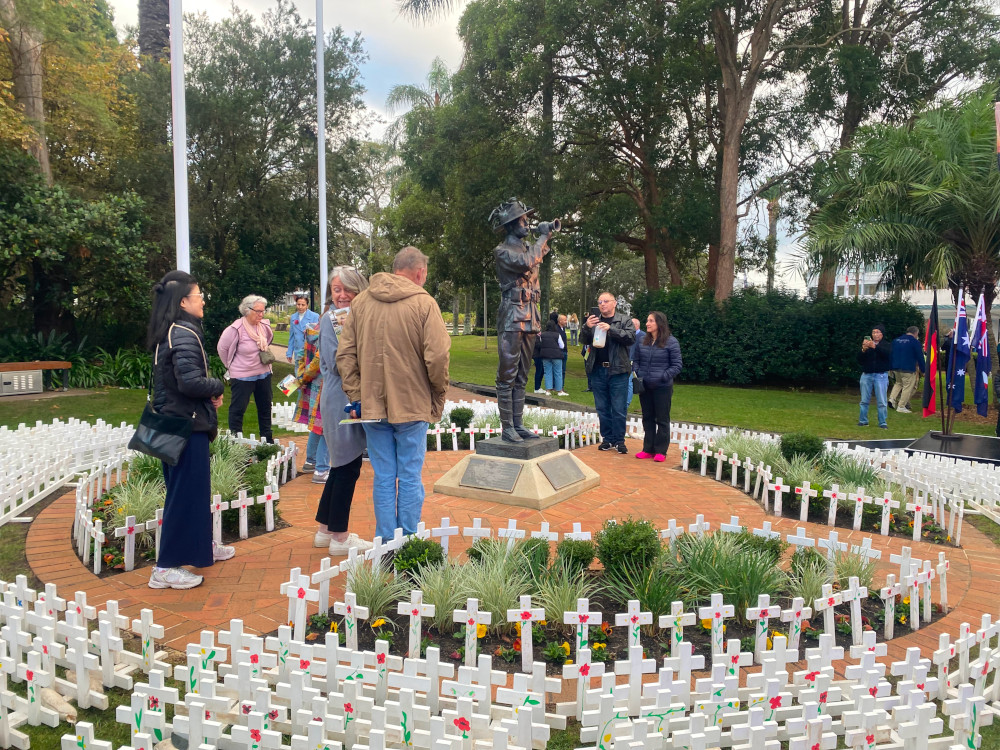
Talbot also connects to a major theme of the Gladwin essay, the Anglican influence on the shaping of Anzac Day, in leading Sydney’s first commemoration and setting up a liturgical pattern working with Archbishop John Wright, beginning “the traditions of wreath laying, silence, hymn singing and the dawn service in Sydney…The pattern ensured that Anglican liturgy, language and symbolism would shape both remembrance occasions and the more formal war memorial unveiling ceremonies that would mushroom around Australia during and after the 1920s.”
Gladwin’s essay gives a picture of a very different Anglican Church in Australia – the yet-to-be-federated Church of England dioceses of the interwar years, when a blossoming Anglo-Catholic sensibility shaped how many served Christ, and how returning chaplains offered a link to ordinary Australians.
Image: the dawn Service lives on with Hymns and Liturgy, Burwood NSW, 2026