
An Obadiah Slope Column
Listening to the ABC PEP (Planet Extra Podcast) takes the Christian virtue of perseverance, as it often runs three hours. But perseverence yields real gems.
The latest is “correspondence” from Dr Andrew Judd from Ridley College, offering a gentle corrective to co-host Prof David Smith from USyd’s US Studies Centre.
David Smith reads a response from Judd to a Smith comment about Christian nationalist leader Doug Wilson.
“So this correspondence is from Dr Andrew Judd from Ridley College in Melbourne. He’s an Anglican minister, and I know he is not the only Anglican minister who listens to PEP. So shout-out to all the Anglican ministers out there. He was picking me up on something I said about Doug Wilson, who is the founding pastor of the church network that Pete Hegseth belongs to.
“And he says, ‘one more qualification, if I may. You’re right that Doug Wilson is an outspoken postmillennialist, which is indeed unusual in North American Christianity. It’s not part of his church’s required doctrinal basis, but it is common in that network.
‘However, I don’t think post-millennialism alone is the most important thing to understand about Hegseth’s church network. The other belief system associated with Wilson is Christian nationalism, which is related, but not the same thing. It’s one thing to believe that the world is going to become a better place before Jesus returns, post-millennialism. It’s another thing to believe that the church’s job is to actively create a theocracy to help that along, Christian nationalism.”
Smith comments: “Now, I’m glad that Dr Judd has made this qualification for us, partly because the term Christian nationalism, I think, has been quite distorted actually by one of my own tribe, by, well, two of my own tribe.
“These social scientists, Andrew Whitehead, and I forget the name of the other one, but anything that you see about Christian nationalism in the media is basically quoting them and their understanding of Christian nationalism. And they have stripped it of a lot of its actual Christian content.
“They instead conceptualise it as basically just another version of reactionary politics where Christianity is really a marker of white conservative identity rather than anything else. I think it’s very important to remember that there actually is a theological version of Christian nationalism, and this is what Dr. Judd is talking about.
Smith further quotes Judd: “In contrast, almost all other Christian denominations have a fairly well-developed political theology that places hard limits on what we want to achieve in politics.
“For example, the doctrine of the common good, which says that when Christians get involved in social reform, it should be for something other people can get behind for non-theological reasons, something love your neighbour.
“Many also have quite firmly held doctrines of the separation of church and state, which is essential for theological reasons because of the emphasis on freedom of conscience in Protestant traditions. The high percentage of dissenting denominations, like Baptists who went to America to escape the state-backed liturgy of Anglicans like me should have inoculated the US against this mistake, but alas. Christian nationalism is very fringe globally, even in conservative theological circles.”
Smith reads another quote from Judd: “I was surprised that when I was in Boston for the Evangelical Theological Society meeting last November, that Stephen Wolfe was in attendance because Christian nationalists tend to test their ideas on X, not academic theological conferences. But it is emerging as a kind of chaplain for hire to MAGA ideology.”
Co-Host Chas Liccardello interjects, “Ouch.”
“Seeking political power this way sits uncomfortably in the intellectual history of Christianity, see our religion’s founder’s personal encounters with the Roman Empire.
“For example, theologians and preachers* I know in the US have been caught off guard by its emergence in their flocks, discipled by social media figures rather than their pastors.”
Smith adds, “So I think he is making a very important point. It is important to remember Christian nationalism is still fringe, at least if we’re talking about it in this real way of genuinely theocratic beliefs about hastening along God’s advancing kingdom. And that runs counter to a lot of what we have been seeing from this kind of social sciencey version of it, which is saying, well, according to survey research, we’re seeing more and more people basically identifying as Christian nationalists as a kind of marker of white reactionary politics. It’s not that. So thank you very much for that, Andy Judd.”
###
Journalism is a great recycler. The ‘churches for sale’ story has turned into the sort of story to fill a slow news day. Easy to write, and you can get pretty pictures.
Example “20 beautiful country churches for sale all around Australia” in Country Style magazine. A sample: “If you’re looking for a church in a tiny country town of WA with plenty of renovation potential, this is it. Located in the Wheatbelt town of Dumbleyung, this old brick church was built in 1925 and is ready for its next chapter. The property is listed for $120,000+”
Just a quick flick through Domain.com.au and realestate.com.au will bring up the pictures and text, and away you go. The story writes itself. Every few months it seems.
In real estate land, “conversion” applied to churches means a reno job to fit a house in. Not the saving of a soul, unless soul is what a pretty building has.
And even the niche sites get into it, commercialrealestate.com.au swings in with 6 churches to convert into your business dream for sale right now in Australia. Warning: religious puns ahead!
“Capitalising on their history and architecture, often featuring high ceilings and glass-stained windows, investing in a repurposed church could be just the divine calling your next chapter needs.
“Whatever its next incarnation – from unique stays to luxe homes, creative hubs to co-working spaces, yoga halls to wedding venues, libraries to bookstores – the list of worthy resurrections is infinite.”
And a bit like a pokie machine, random ads can have churches lining up.

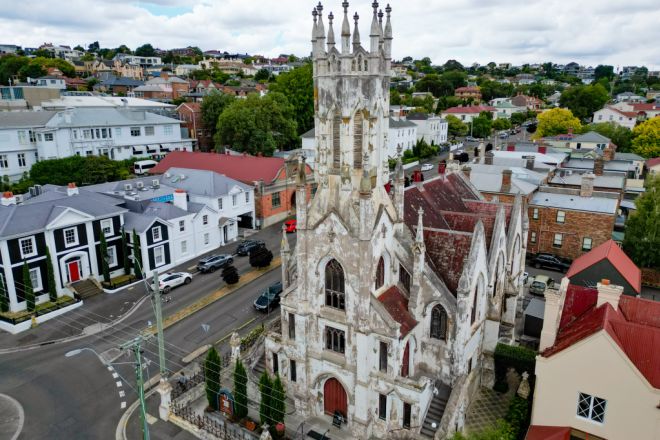
Although it has been sold many times since it was a church, our main picture shows the shabby white church in Launceston, which has been offices, a showroom and a house still looks like a church. IOt was originally named after Scottish minister Thomas Chalmers, so The Other Cheek thinks this started as Presbyterian.
###
The Global Methodist Church, which, like its namesake, the Global Anglican Communion, was founded in protest at its mother church accepting gay marriage, is planting a church in Australia. Apparently, in Blacktown, NSW. Obadiah would like to know more.
* Corrected from the original transcription of breaches