
Charles Brammall
Many years ago my young family and I had a farm stay holiday on Hugh Fraser’s Mohair Goat farm near Inverell. Hugh and his wife were lovely, and he kindly gifted me with a high quality Leatherman in a beautiful sheath, which I treasure to this day.
Hugh’s dad Malcolm (he of the missing trousers, and the almost unheard of shift in his politics post his Prime Ministership), was near the centre of probably the most shocking and controversial political event in Australia’s history.
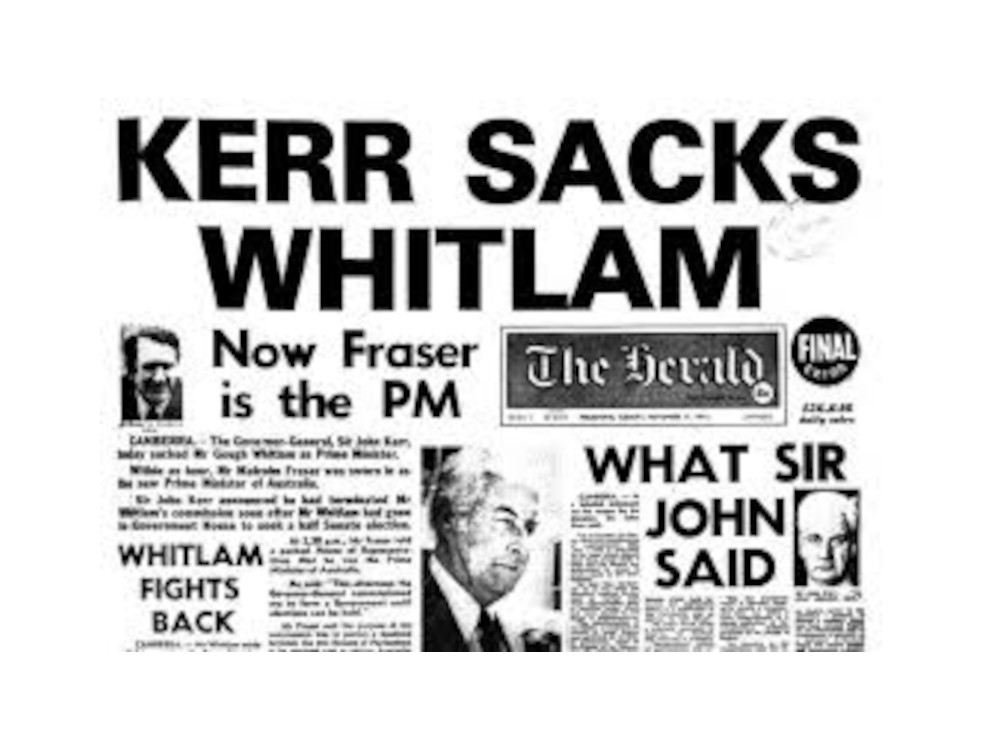
On the afternoon of 11 November 1975, a stunned crowd surged towards the steps of Parliament House in Canberra. Rumours had spread through the capital with astonishing speed. Australia’s PM had just been dismissed by the Governor-General. Journos scrambled for position, television cameras rolled, and thousands waited in disbelief for Gough Whitlam to appear.
He did not disappoint. Tall, imposing and slowly spoken; visibly angry, Gough strode onto the steps and delivered what many regard as the greatest political speech in Australian history. Its closing words have echoed through Australian public life ever since:
“Well may we say ‘God save the Queen’, because nothing will save the Governor-General.”
The crowd erupted. Whether you admired or opposed Whitlam, almost everyone recognised they were witnessing history.
More than fifty years later, the Dismissal remains the nation’s greatest constitutional controversy. It has generated libraries of scholarship, divided historians and lawyers, and inspired multiple documentaries, dramas, and books. It become a permanent reference point whenever Australians debate democracy, constitutional convention or political power.
The irony of Whitlam’s famous sentence is often overlooked. He quoted a traditional Christian prayer, while denouncing the Queen’s representative. Even in one of Australia’s defining secular political moments, the language of Christianity shaped the nation’s instinctive vocabulary.
That unexpected connection points towards another, infinitely greater confrontation over authority nearly two thousand years earlier: the arrest, trial and crucifixion of Jesus Christ. And His resurrection, and ascension to international, all powerful, eternal glory.
The comparison must never be forced- Whitlam was a gifted but fallible politician. But Christians confess Jesus as the sinless Son of God. Yet both stories ask remarkably similar questions. Who possesses legitimate authority? Can legal decisions still be morally wrong? When institutions preserve themselves, what happens to justice? And can apparent defeat become genuine victory?
A nation ready for change:
Before Labor won office in December 1972, Australia had experienced twenty-three consecutive years of Coalition government. The nation was changing rapidly. Immigration had transformed its population, Universities were expanding, and Television was reshaping culture. Younger Australians increasingly questioned inherited authority. And Whitlam recognised these changes before most of his contemporaries.
Paul Kelly, political historian and journalist, argued last year that Whitlam sought not simply to change governments, but to redefine the relationship between citizens and the Commonwealth.
Historian Frank Bongiorno similarly described Whitlam in the same year as “one of the principal architects of modern Australia”. Judith Brett, political historian, suggested in 2019 that few Australian leaders have possessed such a coherent intellectual vision for national renewal. And it is almost impossible to deny that Whitlam’s ambition was breathtaking.
Within three short years, his government abolished university tuition fees (I was a very grateful recipient of this very short window), introduced Medibank, and expanded legal aid. It recognised the People’s Republic of China, ended military conscription, and completed Australia’s withdrawal from Vietnam. Then it dramatically increased arts funding, strengthened environmental protection, and advanced Indigenous land rights (viz Paul Kelly’s moving song “From Little Things Big Things Grow” about Indigenous Elder Vincent Linguari).
Many reforms were controversial at the time. But most later became accepted by governments of both political persuasions. Even political opponents acknowledged Whitlam’s extraordinary capacity. His government demonstrated that a PM could reshape Australia’s institutions rather than merely administer them.
Brilliance and blind spots
Almost everyone who worked with Whitlam commented on his formidable intellect. In 2025 Jenny Hocking, Whitlam biographer, described a man whose memory was astonishing, and whose command of history, literature and constitutional law intimidated colleagues. Cabinet ministers recalled him quoting Shakespeare without hesitation, reciting Latin poetry from memory, and correcting officials without consulting papers.
His brilliance became part of his political identity. Yet intelligence alone rarely guarantees successful leadership. Judith Brett argues that Whitlam occasionally assumed reason would overcome political opposition. Paul Kelly similarly observes that he sometimes mistook intellectual victory for political victory. Winning an argument in Cabinet did not necessarily secure support in Parliament, or confidence among anxious voters.
Modern leadership studies distinguish between transformational and transactional leaders. Whitlam excelled at transformation. He imagined a different Australia and persuaded millions to imagine it with him. But he proved less comfortable with patient negotiation, compromise, and administrative discipline that sustained reform over the longer term. Like many great reformers, his greatest strengths occasionally became his greatest weaknesses.
Margaret – Far more than a PM’s wife
No account of Whitlam’s career is complete without referring to his beloved wife Margaret. Earlier generations often portrayed her as Australia’s glamorous First Lady. But recent scholarship paints a far richer picture.
Jenny Hocking argues that Margaret was Gough’s intellectual equal and closest adviser. Judith Brett likewise portrays their marriage as an unusually equal political partnership for its generation. Ideas were debated in bed and across the dinner table long before they reached Cabinet.
Margaret possessed her own formidable presence. She campaigned independently, spoke publicly on national issues, and became one of Australia’s most admired public figures. Her warmth often balanced Gough’s larger than life and imposing intellectual style.
Together they raised four children: Nicholas, Antony and Stephen; then later Catherine. Politics inevitably demanded sacrifices from the entire family, yet friends consistently recalled a household where ideas, books and vigorous discussion filled everyday life. And their marriage lasted more than seventy years.
When dementia gradually overtook Gough in his final years, Margaret became his principal carer. Australians who had once watched the commanding reformer dominate Parliament now saw a quieter story unfold— an affectionate and tender spouse faithfully and lovingly accompanying the man with whom she had shared an extraordinary life.
Why was Whitlam dismissed?
Popular debate often reduces the Dismissal to slogans. Some describe it as a “constitutional coup”. Others insist Gough brought disaster upon himself. Most contemporary historians reject both extremes. They point instead to several converging crises.
Australia faced severe inflation, rising unemployment, and international economic instability following the 1973 oil shock. The controversial Loans Affair damaged the government’s (and particularly Gough’s) reputation for administrative competence. Meanwhile, political polarisation intensified as unions, business groups and state governments increasingly confronted one another.
The constitutional crisis became the final catalyst. The Coalition-controlled Senate refused to pass Supply Bills, preventing the government from obtaining the money necessary to continue governing. Whitlam believed his government remained legitimate because it retained the confidence of the House of Representatives.
Opposition Leader Fraser believed that denying Supply would force Whitlam either to resign or seek an election. Both claimed that constitutional principle supported their position.
Law, convention and judgement
The modern debate owes much to constitutional lawyer Anne Twomey’s 2025 work. She insists that Australians must distinguish three separate questions:
First, did Kerr possess the legal authority to dismiss Whitlam?
Second, did constitutional convention justify exercising that authority?
Third, was dismissing Whitlam politically wise?
Those questions are related, but not identical. Most constitutional scholars accept that reserve powers existed. George Winterton, constitutional scholar, argued in 2025 that reserve powers formed part of Australia’s constitutional inheritance from Westminster. In 2018, Brian Galligan, constitutional scholar, likewise accepted their existence, while questioning when they should be exercised.
The greater disagreement concerns convention. Australia’s Constitution says remarkably little about how reserve powers should operate in practice. Instead, much depends upon trust, restraint and unwritten understandings. when those conventions collapsed in 1975, the written Constitution alone proved insufficient to resolve the crisis.
Kerr and Fraser:
Sir John believed he faced an impossible dilemma: in announcing his decision, he declared that a Prime Minister unable to secure Supply “cannot govern.” Therefore, he believed he had a constitutional duty to commission another PM capable of obtaining Supply and advising an election.
Malcolm Fraser accepted that commission. Kerr later argued that Australia required “stable government” and that only a general election could resolve the constitutional deadlock. His supporters viewed the Dismissal as an unpleasant necessity rather than a political triumph.
Whitlam vehemently disagreed. To him, Kerr had destroyed one of the fundamental conventions of responsible government, by dismissing a Prime Minister who still commanded the confidence of the elected chamber. And argument has never disappeared.
The palace letters:
For decades historians wondered how much Buckingham Palace knew about Kerr’s thinking before the Dismissal. That question changed dramatically in 2025 because of Jenny Hocking, Whitlam biographer. After a lengthy legal campaign, Hocking secured the release of the Palace Letters between Kerr and Sir Martin Charteris, the Queen’s Private Secretary. And the letters transformed historical understanding.
They demonstrated extensive communication between Kerr and the Palace before the Dismissal. But they did not show that the Queen directed Kerr’s decision. Nevertheless, they revealed a far closer exchange than many historians had previously realised.
But not everyone interprets the evidence identically. Hocking argues that the correspondence reveals Kerr increasingly preparing himself for dismissal, while deliberately keeping Whitlam unaware of that possibility. Twomey reaches a more cautious conclusion. She accepts the importance of the letters, but argues that they stop short of demonstrating royal involvement in Kerr’s final decision.
Meanwhile, in 2025, Sir David Smith, Kerr’s former Official Secretary, continued to defend the Governor-General’s conduct, maintaining that he acted within both the law and constitutional necessity. Ironically, the release of fresh evidence has made the Dismissal simultaneously clearer and more complicated.
As often happens in history, the closer scholars examine the evidence, the more nuanced the story becomes.
To be continued…
Part 2 will explore why the death of Jesus Christ both resembles— and profoundly differs from— Whitlam’s fall. Also why he is still regarded as one of Australia’s greatest Prime Ministers despite the Dismissal, his relationship with Christianity and the churches, and the philosophical and ethical lessons of 1975.