
Charles Brammall
As Chaplain at a Roman Catholic Aged Care facility, I was often asked by loved ones to perform the Last Rites over a dying (or even deceased) relative. This was to ensure they didn’t die (or go to Purgatory) with unconfessed sin.
What to do?
It reminded me of the concept of “Sin-eating”, a folkloric ritual primarily recorded along the Anglo-Welsh borders from the 17th to the early 20th centuries. I am also half way through a fairly silly, allegedly scary movie, “Description”, about modern day US “Sin-eaters”. It’s not JUST a thing of thing of the past. My wife’s grandmother in fact, was a “spiritist”.
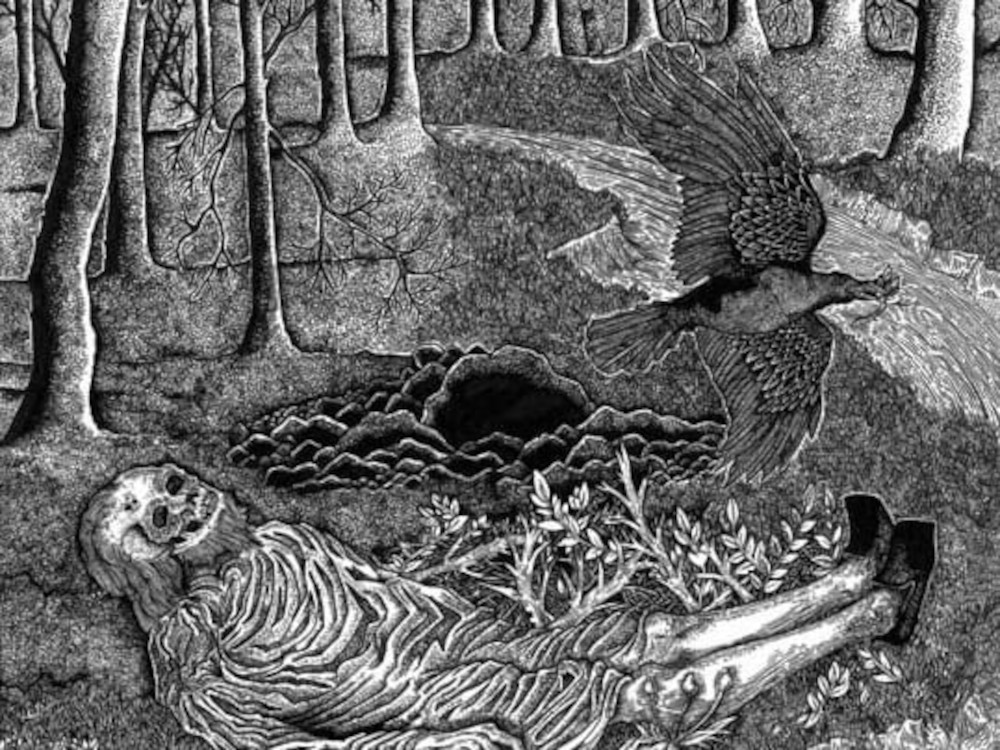
“Sin-eating” involves a social outcast consuming a symbolic meal of bread and ale or beer placed upon or passed over the breast of a corpse. By consuming this food, the sin-eater theoretically ingested and absorbed the unconfessed sins of the deceased. This allowed the departed soul to bypass prolonged suffering in Purgatory or wander as a restless ghost. It worked a little like this:
[Deceased Corpse] —>
(Sins absorbed into Bread/Ale) –>
[Sin-Eater Consumes] —>
Soul Freed
(Pariah State)
18th century folklore and recent scholarship
The foundational documentation of sin-eating rests on the 17th century manuscripts of antiquarian John Aubrey. In his Remaines of Gentilisme and Judaisme (c. 1686–88), he described a sin-eater in Herefordshire as a “long, leane, ugly, lamentable rhascal” (sic) who sat over the corpse. In exchange for a groat, a crust of bread, and a bowl of beer, the performer would utter a formulaic incantation:
“I give easement and rest to thee, dear man. Come not down the lanes or in our meadows.”
Recent academic interpretations
Recent scholarship has moved past viewing sin-eating as a primitive “pagan” survival, reframing it as a complex post-Reformation mechanism:
- The Reformation Transposition: Landmark studies by folklorist Dr Helen Frisby (including her work At the dark edge of life and death: Sin-eating rituals in Britain, published in early 2026), argue that sin-eating emerged abruptly in the 1640s. It was not a pagan relic, but a “transposition” of the banned Catholic Requiem Mass into domestic folk custom.
- When the Protestant Reformation officially stripped away Purgatory and intercessory prayers for the dead, families experienced severe spiritual anxiety. Sin-eating stepped into this vacuum to restore a felt “economy of relationships” between the living and the dead.
- Social Marginalisation:
- Jacqueline Simpson and E. Sidney Hartland have illustrated that the sin-eater functioned as a communal pharmakos (scapegoat). As documented by C19 antiquarian Matthew Moggridge at a meeting of the Cambrian Archaeological Association, the sin-eater was fiercely detested, viewed as a pariah, and regarded as “one irredeemably lost” because they chose to spiritually bloat themselves on collective moral rot for a meager fee.
- It reminds me (tangentially) of Phil 3:19- “Their end is destruction; their god is their stomach; their glory is in their shame; and they are focused on earthly things.”
Theological analogues
OT Sacrificial System:
The mechanics of sin-eating closely mimic, yet fundamentally distort, the sacrificial architecture outlined in Hebrew Scripture:
1. The Scapegoat (Azazel)
The clearest OT analogue is the Day of Atonement (Yom Kippur) ritual, found in Lev 16:21-22:
“And Aaron will lay both his hands on the head of the live goat, and confess over him all the sins of the children of Israel… putting them upon the head of the goat, and will send it away by the hand of an appropriate man, into the wilderness. And the goat will carry upon it all their sins, into an uninhabited land.”
The folk sin-eater mirrors the scapegoat. They act as a physical receptacle for sins, and then vanish from the community’s sight into a state of exile.
2. The Priest Eating the Sin Offering (Chattat):
In Lev 10:17, Moses rebukes the priests for failing to eat the purification offering (chattat):
“Why didn’t you eat the sin offering in the sanctuary area? For it is especially holy, and He has assigned it to you to take away the guilt of the community and make atonement for them before the Lord.”
In God’s law, holy priests consumed the sacrificial meat to neutralise guilt within God’s sanctuary. The folk tradition perverts this dynamic. A PROFANE outcast, rather than a holy PRIEST, consumes a ordinary meal to absorb- rather than extinguish— the moral pollution.
Jesus’ death, resurrection, and ascension and sin eaters
In orthodox Christian theology, the entire system of human or animal transference is finished, and its need undone, by the work of Messiah Jesus. This makes human sin-eaters spiritually redundant;
In His death, Jesus absorbs, BECOMES, and eradicates all sin.
In His Resurrection and Ascension to glorious reign He defeats death’s enthroned king (sin, Satan, and judgement), and dispenses His cosmic claim: direct justification.
1. The Substitutionary Death
Messiah functions as the ultimate sin-bearer, fulfilling both the chattat and the Azazel scapegoat, 2 Cor 5:21- “He made the One Who did not KNOW sin to BE sin for us, so that in Him we might become the righteousness of God.”
Unlike the folk sin-eater, who merely stacks more sins onto their own COMPROMISED soul— Jesus is a FLAWLESS sacrifice. His death does not just STORE moral pollution; it destroys its legal power, ABSORBING God’s just and deserved vituperativeness, MEANT for human rebellion against Him.
2. The Power of Jesus’ Resurrection
His return to life shifts the entire dynamic from transference, to transformation. A traditional sin-eater left the corpse’s family with a grim transaction: sins were moved, but they still existed on earth inside the pariah. Jesus’ bodily resurrection serves is God’s proof that the receipt of sin has been paid in full, and canceled, Rom 4:25-
He “was delivered up for our offences, and was raised again for our justification.” The resurrection means death can no longer HOLD the chosen person of God, bypassing, indeed rendering blasphemous, the need for folk-magical interventions over a corpse.
3. The Ascension as Cosmic Enthronement
Jesus’ Ascension completes the work by positioning Him as the sole Eternal, International, Omnipotent, High Priest. The only pure High Priest. God says in Heb 9:24 that Jesus did not enter a physical sanctuary made by human hands, but “into heaven itself, now to appear in the presence of God FOR US.”
By ascending to the right hand of the Father, Jesus CONTINUOUSLY applies His OWN blood as a DIRECT cleansing agent for the believer. This renders all earthly human intermediaries obsolete, indeed, attempted usurpations of God’s role (as Adam attempted to do in paradise). It is in fact the definition of sin itself- declaring autonomy over God.
But the ascended Jesus also transforms the ritual MEAL entirely: in the Lord’s Supper (indeed, John Woodhouse mounts a convincing argument from 1 Cor 9-11, that in EVERY meal believers share together), believers do not feed an outcast to unload their SINS; they feed on Jesus victory to receive His LIFE.
Shakespeare’s sinner-eater hints?
The Bard unsurprisingly doesn’t use the TERM “sin-eater”- That would anachronistic, as the expression only explicitly appeared in writing during the 1640s via John Aubrey. But Shakespeare’s plays frequently leverage the underlying cultural anxieties regarding unconfessed death, missing last rites, and the heavy spiritual weight of ancestral sin:
1. Hamlet and Unconfessed Death
The core engine of the work turns on the horror of dying without absolution— the exact fear that gave rise to sin-eating. The Ghost of Hamlet’s father laments:
“Cut off even in the blossoms of my sin, Unhousel’d, disappointed, unaneal’d,
No reckoning made, but sent to my account
With all my imperfections on my head.” (Act 1, Scene 5)
“Unhousel’d” means without receiving the Eucharist, and “unaneal’d”, without extreme unction (last rites). Hamlet Snr is forced to suffer in a purgatorial fire because his sins were never purged or absorbed, illustrating the exact cultural panic that drove rural borderers to hire folk sin-eaters.
2. Henry V and the Weight of Royal Sin:
In V, the King experiences deep anxiety over carrying his father’s sins (the usurpation of Richard II’s throne). Before the Battle of Agincourt, he prays:
“Not today, O Lord,
O, not today, think not upon the fault
My father made in compassing the crown!
I Richard’s body have interred new…
And on them have bestow’d contrite tears, Doing implied penance…”
(Act 4, Scene 1)
Henry attempts to find structural, ritual workarounds to “absorb” and pay for a dead man’s unconfessed guilt, directly mirroring the impulse of folk sin-eating.
3. King Lear and the Scapegoat Pariah:
In Lear, Edgar’s disguise as “Poor Tom”— an ugly, half-naked, desperate beggar who eats “the swimming frog, the toad, the tadpole” (Act 3, Scene 4)—strongly channels the social image of the borderline pariah. While not explicitly a sin-eater, Poor Tom represents the ultimate societal long drop toilet: the visual image of an outcast who ingests filth and carries the spiritual madness and moral degradation of an entire decaying kingdom on his back.
For a closer look at this topic, it is instructive to look at John Aubrey’s original letters, or explore how Welsh communities eventually abandoned the practice in C19.
Prayers:
Dear Jesus,
thank You that You are alive and with the Father.
Thank You that Your blood is enough to cleanse me from sin.
Thank You that I do not need another person to stand between me and You.
Thank You that You give me Your life, not because I deserve it, but because You love me.
praise You for Your victory, Your grace and Your wonderful gift of life.
Amen.
Dear Father,
please draw my loved ones to Jesus- especially my Jewish, Muslim, Hindi, Roman Catholic, Anglican and other loved ones- who feel they must earn Your favour through good works, religious acts or human intermediaries.
Please help them see the beauty of Jesus’ finished work.
Show them that He alone is enough, that His blood cleanses them, and that His life is freely given.
Give me grace to speak about this gently, humbly and lovingly, never looking down on them, or being hypocritical, self righteous, or arrogant.
Amen.
Dear Father,
I confess that I often try to carry my own sins, fix myself, or depend on other people instead of trusting Jesus.
I forget that Jesus has already died for me, risen for me, and brought me to You.
Forgive me for trusting myself instead of His grace.
Thank You that Jesus is enough.
Help me rest in Him, feed on His life, and share His love with others.
Amen
Image: Sin Eater. Image Credit: Sin Eater /Tumblr