
In the lead-up to the 250th anniversary of the USA (semiquincentennial), Peter Bentley provides a selection of articles from his series looking at the USA through American film and television.
War has been a defining feature of the history of the USA. After all, the USA was birthed in war, and since its inception, it has been embroiled in or connected to nearly every major war in the world.
There is, as one would expect, a wealth of written material about the establishment of the United States through a war that would help to define its ontological state. The War of Independence, or rather as it is also known, The Revolutionary War, was a complicated affair with periods of earlier conflict between the British forces and Americans before the major conflict started in earnest from 1775. There was also the sometimes-intriguing involvement of other nations and/or soldiers supporting the colonists (as the Americans were known) or the loyalists, as the British were known. This resulted in conflicts appearing in areas other than the USA mainland itself, a feature not unique to this time period when considering the alliances and connections that were established for mutual benefit.
Of special mention is the French connection, with the French providing significant funding (as material gifts and loans) to the Americans, a factor that would come back into play following the development of post-revolutionary France and the ensuing war between Great Britain (and other countries) and France from 1793, with the USA concentrating on neutrality, notwithstanding its short conflict with France. 1
After nearly seven full, impactful, and often frozen years, the war concluded with the American victory at Yorktown in 1781, though there were continuing conflicts and finally the formal Treaty of Paris in 1783. 2
Intimately related to the war of independence was the adoption by the ongoing provisional government of the 13 American colonies (the Second Continental Congress) of The Declaration of Independence on the 4th of July 1776. The 4th of July is, of course, now the preeminent holiday for everything American and naturally features as a key celebratory event in many films. Surprisingly, though, there appears to be a smaller body of substantial films and television series that capture the importance of the actual war of independence and the 4th of July itself. Perhaps after the 250th anniversary, there will at least be a good number of documentaries.
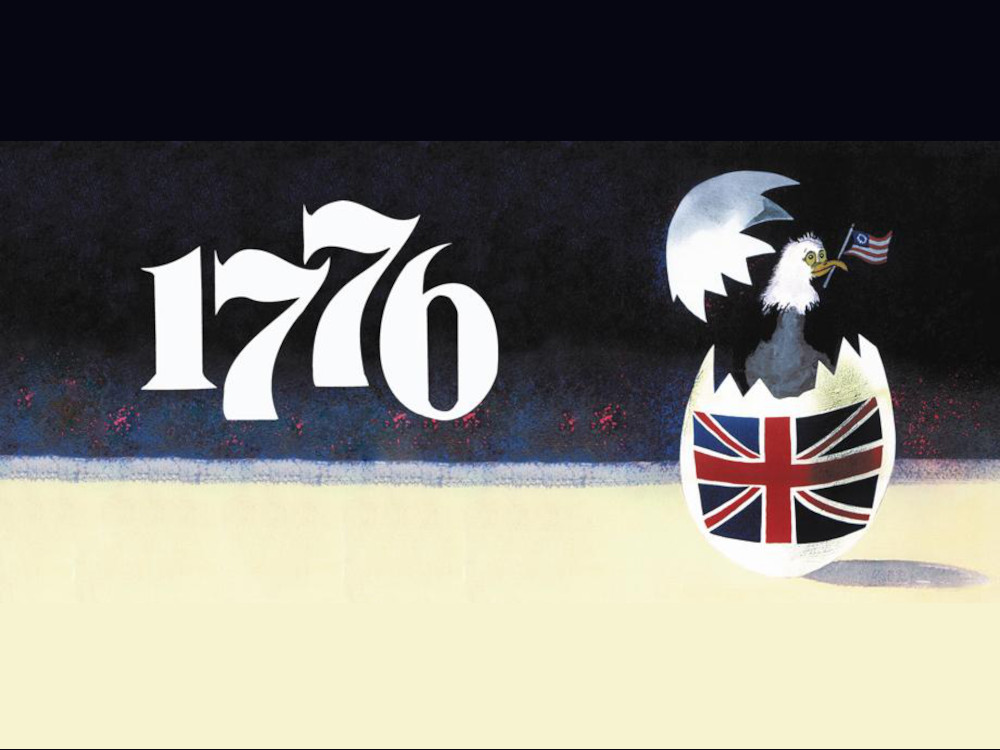
1776 (1972) needs to be highlighted because of its foundation as a work of historical consideration and its significant popularity at the time. One is reminded of the popular, exceptional, and surpassingly modern musical Hamilton, which is naturally focused on Alexander Hamilton. 1776 stands out for its early prominence in the development of modern historical musicals. A more spoken word-based musical, 1776, uses a broad range of material (with liberty and embellishment) from the founding fathers and members of the Continental Congress that approved the Declaration of Independence. With wonderful portrayals of Benjamin Franklin, John Adams (and the brief appearances of Abigail Adams), and Richard Henry Lee in particular, this is an entertaining work of engagement and a treatise as well. It is a more political treatment than Hamilton, and in the spirit of Monty Python and Shakespeare, coarser, reflecting more the language of the era. As a satire on the continuing political machinations of America, it remains a contemporary experience. Apart from the preoccupation with the weather, there are other amusing elements, including the regular deprecation of John Adams, almost in the form of the celebrity roasting popularised by Dean Martin.
William Daniels dominates in an effective way as John Adams. When I first saw the film, I wondered why I recognised his voice more than his person, and after checking further, I found that Daniels provided the voice of K.I.T.T. in the original Knight Rider (1982-1986). Daniels has some provocative lines that have stood the test of time, including, “I have come to the conclusion that one useless man is called a disgrace; that two are called a law firm, and that three or more become a Congress!” One has to laugh at the formation of a committee to keep secrets called ‘the secrets committee’.
The Patriot (2000) may seem an odd choice for the title, as it was helmed by someone seen as an ‘Australian’ actor, Mel Gibson, playing Benjamin Martin. The term patriot was also synonymous with the colonists, and given that Gibson was born in the USA and has mostly had his substantial career in the USA, it is quite appropriate. The film is not so much a straight historical account as a nod to maintaining the Hollywood tradition of the personalised story of good versus evil. The theme is based on ‘righteous’ revenge, with the main evil character (naturally an Englishman) destined to receive a good comeuppance in a suitable time. The film reminded me of Shenandoah, a film I highlight in reflecting on the Civil War.
Gabriel is one of Benjamin Martin’s sons in the film, and he is played by Australian actor, the late Heath Ledger, who went on to fame for his (posthumous) Academy Award-winning role for the portrayal of the Joker in The Dark Knight (2008). Ledger is notably more restrained and uses far less makeup in The Patriot.
The Crossing (2000) brought Jeff Daniels an opportunity to play arguably the most significant historical figure in American History. There is a prime historical metaphor as well, between Julius Caesar’s crossing of the Rubicon and Washington’s crossing of the Delaware. Daniels brings a respectful level to the role and highlights his ability in historical character development. The film confirms the idealism of the USA by illustrating the necessity of the highest level of commitment to the cause of independence, and at the same time, clearly outlining what will be the eventual outcome.
There have been many other films that have a theme of independence, not connected to the actual historical events, but that use that notion as a foundation for reasserting and highlighting the spirit of American independence. Notably among these is Independence Day (1996), though whether aliens are analogous to the English is a discussion for another time in the light of the complex special relationship that has now long been the hallmark of the American and United Kingdom geopolitical foundation.
In continuing to consider the theme of independence, it is helpful to note that there was another significant wider war after 1783. This war could lay claim to being the first forgotten war, namely the War of 1812.
In a way, the war of independence was continued in this war, as the USA, as its own country, was the instigator of war as a nation.
In an interesting and succinct summary of the war on the USS Constitution Museum website, one could substitute the names of America and Canada for different countries in certain wars of the last hundred years, revealing a consistent theme in the history of war: the failure to consider the past, while at the same time overestimating one’s own ability. After three years of confounding battles, both sides agreed it was time for peace.
“Most Americans assumed that the conquest of Canada would be, in the words of former president Thomas Jefferson, “a mere matter of marching.” The United States enjoyed a huge population advantage over Canada—7.7 million to 500,000—and it was widely believed in America that U.S. troops would be welcomed as liberators. But events did not play out as Americans expected. Waging war at the end of extended supply lines over the vast distances of the North American wilderness was no easy task. The British and their allies from indigenous nations in North America proved a formidable foe.” 3
After this war, the United States moved forward more grounded and founded, growing in its own image of independence. The continued readiness to expand into other areas resulted in ‘more wars of independence’, including the many American Indian Wars, the Texas War (of Independence) in 1836, and what could be seen as a mini civil war, the Utah War (1857 – 1858).
1 Milestones in the History of U.S. Foreign Relations – Office of the Historian
2 Overview of the American Revolutionary War | American Battlefield Trust
Note: at present, this article is part of a collection, hopefully to be published as a book before the American quincentennial.
Peter Bentley
pkbentleyarchive.com
Image: Logo for the musical 1776. Image Credit: Music Theatre International