Charles Brammall
An important new development has emerged in Boyd studies this year. 2026 has brought unusually revealing curatorial research into Boyd’s religious imagination, although there is no new scholarly study (that I have found) establishing whether he personally professed orthodox Christian faith.
Two major exhibitions have made it possible to examine his religious work in a fresh context: The National Gallery of Australia’s (NGA’s) first complete presentation of his twenty Life of St Francis tapestries, and Bundanon’s major Man on Fire: Visions of Nebuchadnezzar exhibition.
And the distinction is crucial. This is new evidence about how Boyd used Christianity in his art, but certainly not proof that he did or did not believe the gospel.
The boy who watched:
Arthur’s grandmother, Emma Minnie Boyd, told him Bible stories. And they stayed soundly with him. But so did the terrifying spectacle of his father’s epileptic seizures.
His father, Merric Boyd, had adopted Christian Science, a religious movement quite different from orthodox evangelical Christianity. Arthur grew up watching a man he loved undergo frightening episodes that he could neither prevent nor fully understand. Later, those memories resurfaced in paintings in which human beings become grotesque, animalistic creatures.
Boyd explained his compulsion to revisit such memories to biographer Barry Pearce in words reported as: “I had to paint these things to un-see the trauma.”
That is, painting, for Arthur, was not necessarily a way of decorating the world. It could be an attempt to undo what the world had done to him.
And then comes the extraordinary turn. His Nebuchadnezzar series was not simply a painter’s rendition of a biblical story. The Old Testament (OT) king, humiliated and reduced to a beast, became a meeting point for several nightmares: the Vietnam War, reports of Buddhist self-immolation, and Boyd’s childhood memories of his father’s seizures:
A proud king brought low by God became in Boyd’s hands, an image of human beings stripped of their pretensions. The disturbing question asked by the work is not merely whether judgement exists. It is what we become when power, violence or suffering strips away the civilised surface.
One can recognise the biblical story, but one cannot reduce the painting to a sermon.
The saint who misbehaved:
Then there is Francis of Assisi, the medieval saint who renounced wealth, embraced poverty and sought kinship with creation.
Boyd returned to Francis repeatedly. His Life of St Francis works, developed principally during the 1960s and early 1970s, explore poverty, compassion, and nature. They investigate family conflict and spiritual change.
Yet Boyd’s Francis was not necessarily the Francis one might expect to find in a conventional church calendar. Boyd was attracted to the saint’s humanity, his rejection of materialism and his engagement with the natural world, while resisting what he saw as religious proselytising and the imposition of religious authority.
Here the story acquires a deliciously awkward complication. Francis’s life was defined by his devotion to Christ. Boyd, however, could admire the saint’s compassion without simply endorsing the doctrinal framework in which generations of Christians had understood him.
And Arthur did not always behave like an obedient illustrator. He invented or substantially reimagined episodes in Francis’s life. The medieval scholar Thomas Boase, whose biography Boyd was illustrating, became sufficiently perplexed to request an explanatory list identifying the figures and incidents in the pictures. The NGA records this unusual episode:
Imagine commissioning illustrations for a biography of a saint and receiving pictures that leave the scholar asking what, precisely, he is looking at.
Boyd was not merely recording what Christians traditionally believed had happened. He was wrestling with what holiness might look like when filtered through his own imagination, doubts and experiences.
But the latest world’s best practice research changes the emphasis.
The NGA’s 2026 exhibition, Arthur Boyd: Tapestries, has brought all twenty of his monumental Life of St Francis tapestries together for the first time. The gallery’s accompanying scholarly material examines how Boyd reworked the saint’s life, including his substitution of dreams for some traditional accounts of Francis’s visions.
This is a substantial development in understanding the work, though not a newly discovered confession of faith.
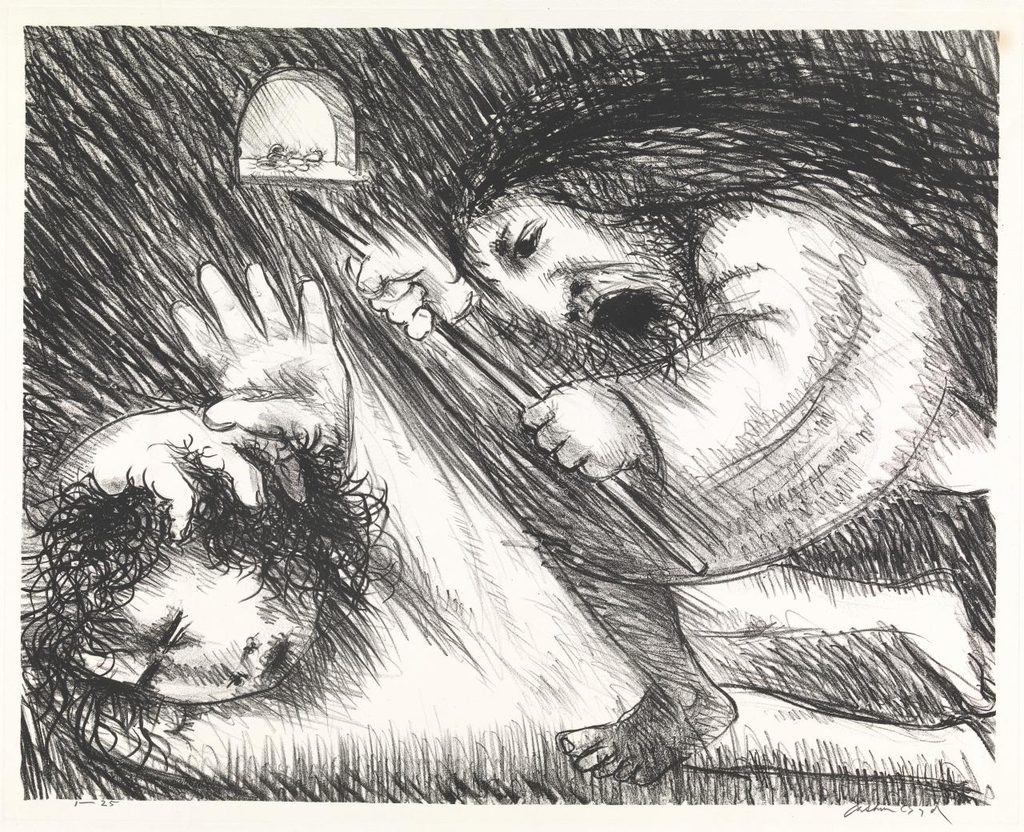
The curatorial research connects Boyd’s Francis with his own complicated family history. His father’s difficult relationship with the world, and the separation of father and son in Francis’s story, become intertwined.
In one of the exhibition’s striking interpretations, Boyd’s imagined scenes of family breakdown illuminate the saint’s movement towards a different life.
The tapestries also contain imagery that is more explicitly Christian than a simple celebration of nature or kindness. The exhibition labels interpret flames in works such as The Vision of the Church on Fire as a metaphor for the intensity with which Christ lives in Francis and St Clare, and for the power of Christianity to sustain believers.
(Clare, a Franciscan nun, was deeply inspired by his preaching, and fled her family home at 18 to join him at the Portiuncula. She founded the Order of Poor Ladies, serving as abbess for over 40 years. She wrote the first monastic rule written by a woman.)
This interpretation of fire complicates any attempt to dismiss Boyd’s religious art as merely secular humanism dressed in medieval clothing.
But it does not settle his personal beliefs. An artist can imaginatively inhabit a Christian worldview without necessarily affirming every doctrine it contains.
Was Boyd a believer?
The answer to this rather inconvenient question requires a distinction that is easily lost when an artist’s work is drenched in religious imagery. A person can be profoundly shaped by Christianity without affirming orthodox Christian faith. Boyd’s paintings establish the former far more securely than they establish the latter. In addition, he never claimed publicly to believe in the Lord.
So we cannot confidently conclude from his paintings that he trusted Jesus as Saviour, believed in the bodily resurrection, or understood the cross as Christ bearing God’s judgement against sinners. But nor would it be fair to dismiss his engagement with Christianity as superficial. Biblical narratives and Christian saints remained important to him throughout his career.
And his art keeps returning to the great questions: Why are human beings capable of such cruelty? What happens to us when suffering deforms us? Can the guilty be transformed? Is mercy possible in a world that seems determined to destroy it?
These are not trivial preoccupations. But neither are they a confession of Christian faith.
The Bundanon Evidence:
In July 2026, The Guardian reported on Bundanon’s (Arthur’s extensive property and studio in NSW, Australia) exhibition Man on Fire: Visions of Nebuchadnezzar. It collated almost fifty works from his extraordinary series. The exhibition revisited the biblical king’s humiliation and madness, placing the paintings alongside the artist’s response to the Vietnam War, self-immolation protests and his childhood experiences of his father’s seizures.
But Curator Sophie O’Brien offered a particularly important qualification, as quoted in The Guardian: “It’s not a religious painting, it’s a painting of the human condition.”
That is not a declaration that Boyd was an unbeliever. It is a warning against confusing biblical subject matter with the purpose of a particular painting.
The Nebuchadnezzar series can be understood through several overlapping lenses: biblical judgement, anti-war protest, and masculine power. But also be perceived as psychological suffering and the artist’s empathy with a vulnerable human being. The new exhibition foregrounded those intersections rather than reducing the work to a single religious interpretation.
But there is another twist. The story of Nebuchadnezzar in Daniel 4 is not simply about a tyrant being punished. The king is humbled, his reason eventually returns, and he acknowledges God’s sovereignty (the salvation side of the two-sided gospel coin).
But Boyd’s imagery also gives extraordinary force to the humiliation, the beastliness and the suffering (the judgement side of gospel coin). Whether it communicates the former, the bible story’s final movement towards the acknowledgement of divine sovereignty, is a more difficult question.
The latest curatorial work therefore sharpens our understanding of the paintings while leaving the central biographical question unresolved.
Where the paintings stop:
There is a peculiar frustration in looking at Boyd’s work from a conservative evangelical perspective. His paintings can make sin look hideous, suffering unbearable (much like the ceiling fresco in the Florentine Santa Maria del Fiore [The Duomo]), and mercy desperately necessary. They can leave us aching for redemption.
But they do not necessarily tell us where redemption is found.
The Christian gospel does not rest on the proposition that human beings might eventually paint, imagine or reform themselves into goodness. It announces that God has acted in history: Jesus Christ, fully God and fully human, died for sinners, bore the judgment they deserved, rose bodily from death, and now reigns.
And that is more than just an “atmosphere” of grace. It is a claim about what God has actually done.
Boyd’s paintings may bring us to the threshold of that claim. But we mustn’t pretend they carry us across it.
And perhaps that is what makes the question of his faith so compelling. A painter can spend a lifetime depicting humanity poised between beastliness and grace, without leaving us certain which side of the divide he believed would finally (dualistically) secure the victory.
Boyd painted the trouble. Whether he found the answer in Christ is a different question, and one the available evidence does not settle.
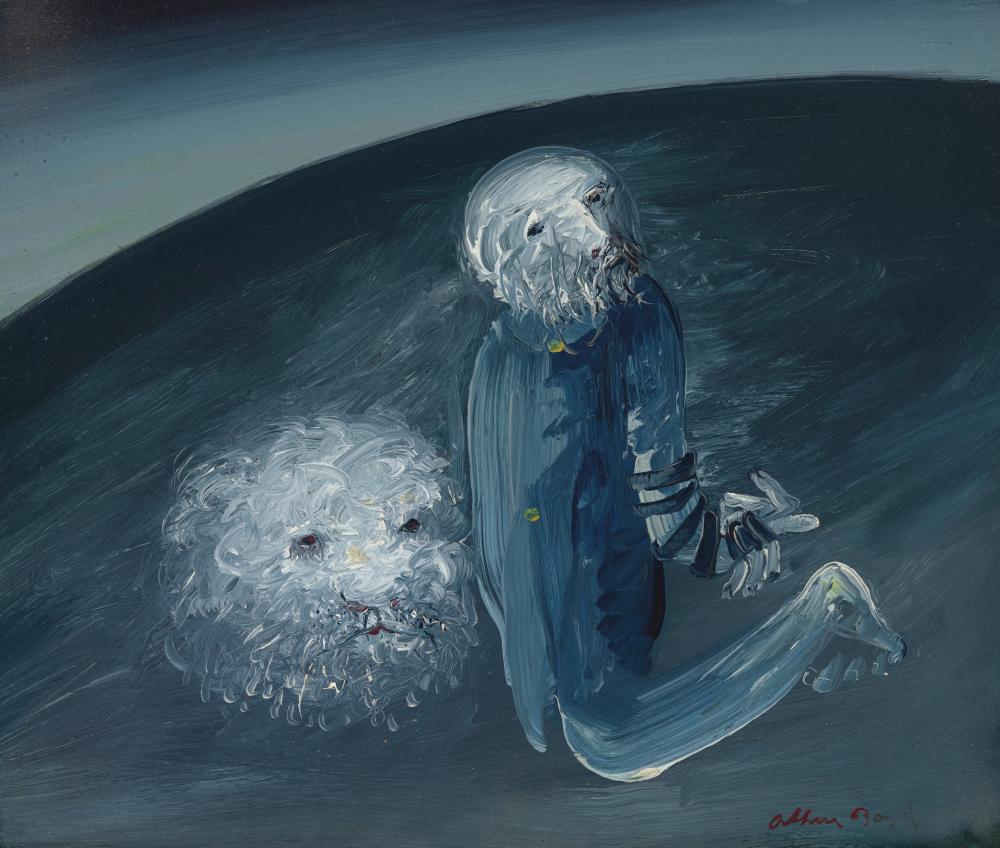
Main Image: Arthur Boyd, Daniel in the Lions’ Den. Image Credit: Lawsons
Second Image: Arthur Boyd print, St Francis beaten by his father