
Adam Burt
There is a line I have heard a lot, and it’s starting to irritate me.
Gen Z have it easy.
You were born with the internet, smartphones, & streaming services. Endless information. Better mental health language. More choice, more tools, more voice. So when your generation says it is tired, anxious, lonely, disillusioned, overwhelmed, or not sure what the point is, the older reflex is often not compassion. It is an eye-roll. Come on – we had it hard too – get on with it. Stop whinging. Stop overthinking. Stop making everything a thing.
That is the Gen X reflex, or at least it has been mine. We were the “you’ll figure it out” generation. Buses home by ourselves, and then left to our own (Gameboy or Game & Watch) devices. Two-minute noodles. No bike helmets. No Life360. No public processing of every feeling. You fell off, got up, walked it off and kept moving. And there was some good in that.
Resilience matters. Work matters. Discipline matters. Nobody is helped by building a life around grievance & victimhood. But there was something hard in it, too. Cold, even. I know, because I have carried it.
And lately, I have realised I have not only been reading your generation wrongly. I have also been reading Jesus’ story of the prodigal son too narrowly. The younger son gets most of the attention. He takes the inheritance early, walks away from home, wastes the lot, and ends up broken, hungry and ashamed. He is the obvious sinner, the obvious failure. The obvious cautionary tale. It is easy for older generations to look at Gen Z that way. You had so much, and superficially it looks like people might struggle to understand how you ended up lonely, anxious and lost.
But that reading is too easy, I think, because Jesus gives us another son in Luke 15. Critics of Gen Z need to first examine their own heart, with a particular focus on the older brother. He stays home, and he works. He does the right thing. He does not make a scene. He does not embarrass the family. He keeps the rules, and he gets on with it. And when grace arrives, he is furious.
Not because he hates goodness, but because he has mistaken work for love. He has confused endurance with holiness. He has turned faithfulness into a ledger. That is the part of the story I now find most confronting. Because I have been and often still am that older brother. When young people have said, “This feels impossible,” I have too quickly heard, “I do not want to try.” When your generation has said, “I am anxious,” I have too quickly heard, “I am fragile.”
When young men have gone quiet, withdrawn, or disappeared into screens, jokes, gym routines, gaming, sarcasm, or just a kind of silence that everyone pretends not to notice, I have too quickly thought, “They are ok, they just need to toughen up.” I was wrong.
I am not saying responsibility does not matter. It does. Choices matter. Sin is real. Laziness is not noble. Bitterness is not wisdom. But I have too often reached for those truths as a shield against compassion. I have judged before I understood the world you are standing in. Because the data now makes something clear – your generation has not simply been handed ease. You have been handed pressure.
In Australia, home ownership among 25–29-year-olds has fallen from 50% in 1971 to 36% in 2021. Among 30–34-year-olds, it has fallen from 64% to 50%. A recent housing affordability report found that servicing a new loan now takes about 45% of median household income, while saving a standard 20% deposit nationally takes nearly 12 years. Renters are being squeezed too, with tenants now spending a record 33.4% of income on rent. That is not a vibe, it’s maths.
The old promise – my world – was pretty simple – work hard, save, buy something modest, build from there. That promise has not disappeared for everyone. But it has become much harder, especially if parents cannot help with a deposit. For many young Australians, the gap between effort and security now feels cruelly wide.
Education has changed, too. HECS was introduced when older Gen X had either finished university or were close enough to avoid the full weight of what it became. Younger Gen X like me faced HECS too, but in its earlier and generally lighter form. In 2024, The Australia Institute reported that the average HECS-HELP debt for Australians in their 20s had risen from $12,600 in 2006 to $31,500. Many young adults now begin working life already carrying a debt that my generation did not carry in the same way.
Then there is mental health. This is where I most want older men like me to stop talking for a moment. The Australian Institute of Health and Welfare says that by 2020–22, almost 39% of Australians aged 16–24 had experienced a mental disorder in the previous 12 months – the highest rate of any age group. For young men, the rate rose from 23.2% in 2007 to 32.4% in 2020–22. A 2026 UNSW-led analysis of 24 years of HILDA data found that adolescents and young adults had the steepest mental health decline between 2019 and 2021, with only a partial recovery by 2024. Older Australians were comparatively stable over the same period. That matters. It means this is not just young people discovering new words for ordinary sadness. It is not just social media performance. It is not just weakness.
Something real has happened.
The Year13 and Scape Gen Z Wellbeing Index reported that more than half of surveyed young Australians aged 18–24 said they suffer from anxiety. More than a third reported loneliness.
More than a third reported depression. Forty per cent reported social anxiety. Forty-three per cent reported low self-esteem. It also found that the proportion of young Australians currently or previously in mental health therapy had increased from 48% in 2023 to 53% in 2024. We can argue about causes – we can talk about phones, lockdowns, housing, family breakdown, social media, cost of living, climate anxiety, pornography, loneliness, loss of faith, academic pressure, work insecurity and the collapse of shared meaning. But we cannot honestly say nothing is happening.
And among young men, the danger is often hidden. Too many young men do not say, “I am not coping.” They say nothing. They go missing while still sitting at the dinner table. They turn pain into jokes. Or anger. Or laziness. Or sarcasm. Or endless scrolling. Or numbness. Or the desperate need to look like they do not need anyone. And too often, men like me have rewarded that silence because it looks familiar. Old blokes call it toughness. Sometimes it is despair, wearing work boots or holding a gaming console.
The Australian Bureau of Statistics reported that more than three-quarters of people who died by suicide in 2024 were male. Suicide was the leading cause of death for Australians aged 15-44. I do not know how any father reads that and shrugs.
I do not write this because I think you are broken. I write it because I love you. I also write it because I feel I need to repent.
The prodigal son story is not only about the boy in the far country. It is also about the man in the field who cannot rejoice when grace comes home. The younger brother was lost in rebellion.
The older brother was lost in resentment. One broke the rules, the other kept the rules but missed the heart.
That is the warning I need. Because when I hear older generations talk about Gen Z, I hear a lot of older-brother language. We worked harder. We complained less. We did not have therapy. We bought what we could afford. We got jobs, and we did not expect the world to care about our feelings.
Some of that is true. Some of it is myth. Some of it is selective memory. But even where it is true, it is not the whole truth. The older brother’s problem was not that he worked. Work is good.
His problem was that he used his work to keep score. He looked at his brother’s pain and saw only irresponsibility. He looked at his father’s mercy and saw only unfairness. He looked at the party and could not rejoice because someone else was receiving grace. That is a miserable way to live, and is also a miserable way to parent.
I can think of too many times when I have tried to fix the problem before I had properly heard the person. Too many times, when I have seen quietness and assumed everything was fine.
So here is my repentance. Not the performative kind. Not the “sorry if you were offended” fake nonsense kind. Actual repentance. A turning around. I am sorry for the times I have heard your generation’s pain as weakness. I am sorry for the times I have confused emotional honesty with self-indulgence. I am sorry for the times I have measured your adulthood against the world I entered, not the world you are entering. I am sorry for the times I have thought, “Just get on with it,” when the better response was, “Tell me what it feels like from where you are standing.” I am sorry for the times I have valued resilience but forgotten tenderness. I am sorry for the times I have been more committed to being right than being near. And I am sorry for the times I have expected young men to become strong without giving them permission to be honest.
The Christian answer is not to pretend the younger son made no mistakes. He did. The Bible calls sin sin, but never leaves the sinner there. The younger son really did need to come to his senses. But the Christian answer is also not the older brother’s smugness. It is the father. The father sees more than failure. He sees a son. The father runs. He embraces. He restores. He celebrates.
And then, just as importantly, the father leaves the party to plead with the older brother, too. That detail breaks me. The father wants both sons home. The son who ran away and the son who stayed angry. The son covered in shame and the son covered in self-righteousness. Both need the father.
I cannot fix the whole world you are inheriting. I cannot make housing affordable by myself. I cannot remove every pressure from your generation. I cannot make social media harmless. I cannot guarantee a straight career path. I cannot protect you from every disappointment, temptation, anxiety or failure.
But I can do some things, like listen before I fix. I can ask better questions, and I can refuse to confuse quietness with strength. I can take mental health seriously without making it your whole identity. I can tell you that work matters, but it is a terrible god. Tell you that money matters, but it cannot tell you who you are. Tell you achievement matters, but it makes a poor saviour. Tell you feelings matter, but they are not always Lord. Walk with you in failure, knowing it is not final.
And God is not waiting at the gate with folded arms. He is watching the road. So I can promise you this – I will always do what I can to help you come home. Home to us and home to truth. Home to courage and home to responsibility. Home to joy and home to the Father who loves you more than I ever could, which makes no sense to me given I don’t feel it possible for anyone to love you more.
I do not want to be the older brother standing outside, arms crossed, angry that grace is being served. I want to come inside and to sit at the table. I want to celebrate what God is doing in you, even when I do not fully understand the road he is taking you on.
I am proud of you.
Not just when you achieve. Not just when you are impressive. Not just when you are easy to understand. Not just when your life makes me feel like I did a good job. I am proud of you because you are my son. And I love you.
Always.
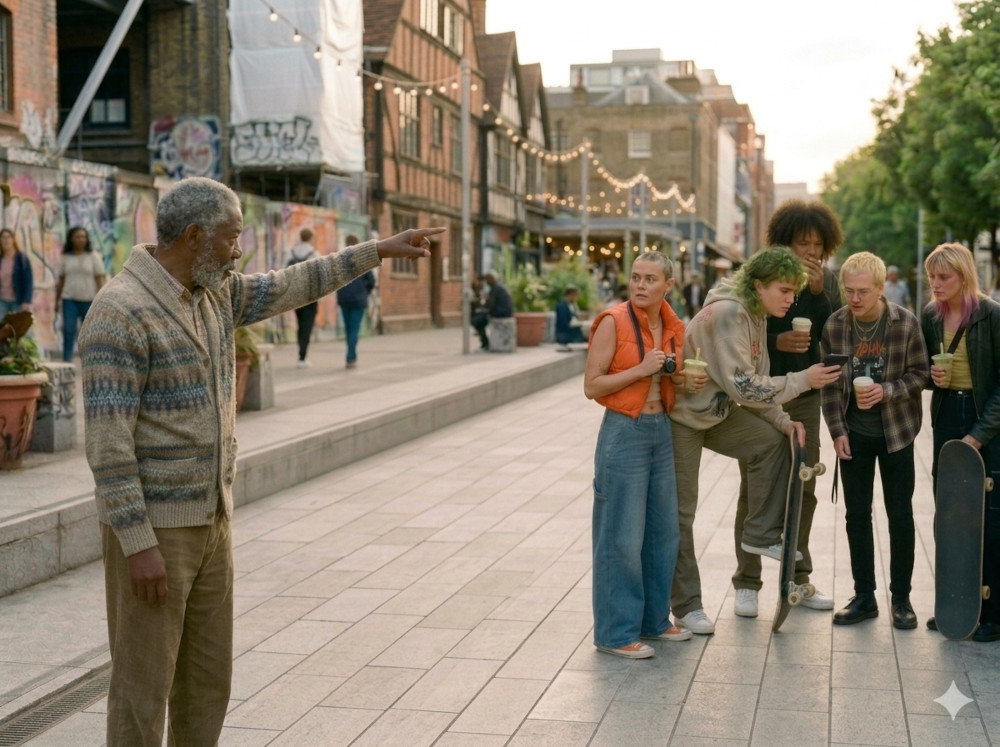
Image: AI generated by Neon Banana