
Charles Brammall
I am a bit of a Victor Hugo tragic. I have been to his home in Paris and taken photos of many of the paintings there. Some of them are breathtaking and quite odd. My wife and I have just this minute seen the musical of his piece Les Mis (for the first time in our lives), in its “arena spectacular” form. (It wasn’t really in an arena, thank goodness.) It was nothing less than indescribable. Pilo-erecting no less.
And there’s a reason the show keeps getting quietly “preached” from stages and arenas globally, that would never call themselves pulpits. Beneath the barricades and the belting, it is a drama of grace, mercy and forgiveness. Of regret and guilt, that feels uncannily at home in the categories of God’s Words. Even though its creators were not writing a tract, and would I’m sure, bristle at the suggestion that they were.
Jean Valjean, the smouldering, slow-burning centre, is not merely improved over the course of the tale- he is interrupted. The mercy of the Bishop, an almost reckless absolution, lands on him as sheer gift, not as a transaction. No bargaining, no probation, no “pay it back later when you can.”
In Bible language, it looks like justification (being put right with God) by grace alone, and the fruit that follows looks like sanctification, being made holy. He morphs into a different species, and the difference keeps costing him. He gives, hides, and confesses. Suffers, and finally releases. He earns nothing, but is given everything, and cannot unknow it.
And notice how the narrative refuses to sentimentalise that gift. Grace does not make Valjean’s life easier. It makes it harder, sharper, more exposed, viz. 2 Timothy 3:12 –“All who want to live a godly life in Christ Jesus WILL be persecuted.”
Valjean must live with a new conscience that will not let him rest in convenient half-truths. When he tears open his own safety to save another man mistaken for him, the story is not rewarding good behaviour. It is showing what grace does to a man’s spine. He stands differently now, and it hurts.
And set against Javert, if Valjean is a living parable of grace received, the former is a tragic study in grace refused, somewhat Judas-style. He has a moral universe as clean as a ledger, as unbending as iron. Crime must be balanced; the scales must settle; the law must be its own justification. He is, in a strange way, devout, pharisaical in the best way, unbesmerched. But his devotion is to a system that leaves no room for gift.
When he encounters mercy, Valjean sparing his life, it does not console him, but rather unravels him. He cannot metabolise a world in which the guilty are pardoned without remainder. Christian preaching often turns here to the older brother in Jesus’ Lost Son story- pacing outside the party. Or to the bleak, haunted figure of Judas.
The latter parallel is not that Javert betrays innocence for money, but that both men, having confronted the abyss between their moral logic and divine mercy, cannot accept forgiveness as a real option. They judge themselves without appeal, and insist on a verdict that cannot save them.
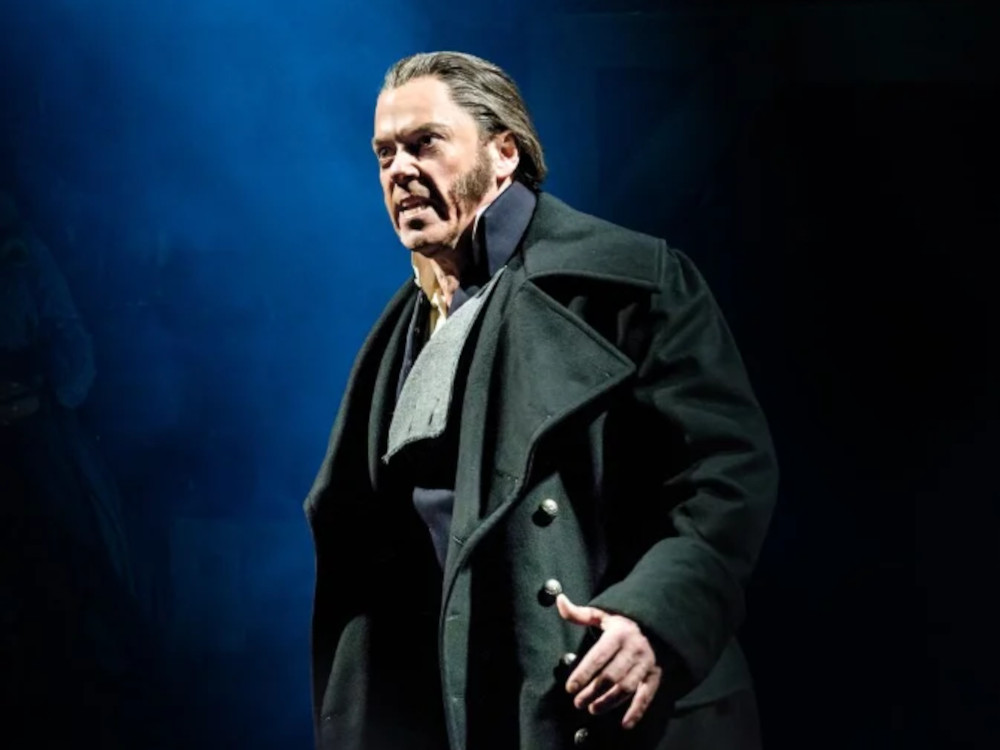
Jeremy Secomb’s rendering of this moment in the production we’ve just seen was (literally) awfully powerful, inviscerating – one felt he was going to split asunder. It was one of the most remarkable theatre performances I’ve ever witnessed.
In that sense, Javert’s “second act” is a long-tightening knot of conscience that will not loosen. He is not merely rigid, but internally at war. His categories: law, order, and righteousness, have served him all his life. Suddenly, they no longer cohere. Mercy has appeared, not as an abstract idea, but as an embodied act that contradicts everything his very identity is constructed upon. He can NOT bend, so he breaks.
Guilt in Les Mis is not therapeutic, heuristic, or something to be talked down or reframed until it feels manageable. It is theological ruminating on the Divine’s ruminations thereafter. It exposes, presses, and then questions with a sort of gentle terror: will you accept a mercy you cannot repay? Valjean answers yes, again and again, often with trembling, sometimes with delay, always at cost. Javert answers no, once, and decisively, and that no echoes into silence.
There is also a fascinating undercurrent here that Christians sometimes recognise with a start. Valjean does not merely receive forgiveness once; he must go on receiving it, living from it, and allowing it to define his responses to the other. Grace becomes not a moment but a climate. Javert, by contrast, cannot survive in such a climate. He requires a fixed barometric pressure of justice. When the weather changes, he cannot breathe, but asphyxiates.
Is the show “evangelical,” “Catholic,” “progressive,” or a kind of works salvation dressed in stirring music? It resists neat labels, and perhaps that is part of its power. Its moral imagination is deeply shaped by the Hugo’s Christianity- a broad, humane, often Catholic-inflected vision in which mercy stands above law, the poor are honoured, and conscience is a sacred theatre in which God and the soul meet without intermediaries.
There is a sacramentalist hew here: the Bishop, candlesticks, and almost absolutionist language. But no developed doctrine of the cross in the specifically Biblically atoning, justice, substitutionary sense. No tight Pauline (or indeed Johannine, Jacobean) argument about justification. Instead, enacted Biblical parables. A man forgiven much, so loving much. Another man unaccepting that such forgiveness is possible.
And yet, for all that, believers often feel strangely at home reading the novel and watching the show. Because while the categories are not systematised, the instincts land in familiar places. Grace precedes transformation. Mercy produces moral change. Law, on its own, cannot save, but only awakens us to awareness is sin. If anything, the show exposes the inadequacy of a purely legal framework more ruthlessly than many sermons dare to.
The creators themselves were not writing confessional theology. Co-composer Schönberg speaks of stage, music, and emotional truth more than doctrine. His colleague Boublil has emphasised story, justice, and human dignity.
Their source, Hugo, critiqued aspects of denominational Christianity at the same time as creating some of the most arresting scenes of Christian mercy in all literature. So the piece carries Christian DNA without belonging to a single ecclesial tribe- theologically promiscuous in the best possible way. Drawing from multiple streams and refusing to be pinned down.
As for the performers, do these themes merely sit on the page, or do they get under the skin of those who embody them?
Geronimo Rauch, who has carried Valjean across major productions including arena spectaculars in the 2020s (and the one we have just seen), has spoken about the role as an emotional marathon. He has described the Bishop scene as something that must be played with absolute sincerity or it collapses into sentimentality.
Actors in this role often talk about a kind of moral fatigue, the sense that Valjean is always giving, always relinquishing, always choosing the harder path. Rauch has not publicly framed this in explicitly evangelical language, but he has acknowledged that the role forces you to grapple with forgiveness in a way that is not merely technical.
John Owen-Jones, another celebrated Valjean, has similarly described the part as spiritually demanding. He hints that living inside that arc
night after night
alters how you think about mercy, responsibility, and the cost of love. Not conversion narratives, perhaps, but certainly confrontation.
And then there is Javert, that austere, unyielding soul. Different actors have noted how unsettling it is to inhabit a man who cannot accept grace. It is one thing to play anger or pride; but another to play a conscience that collapses under the weight of its own logic. Over a long run, some have said, the character becomes less a villain and more a warning.
Which brings us to Jeremy Secomb, an Aussie, and brother of West End star Jonathan, has built a reputation for bringing a kind of granite intensity to Javert.
Actors like Secomb often speak about the role not in doctrinal categories, but in psychological and moral ones. Javert is not played as a moustachio-twirling antagonist; but as a man of integrity whose integrity has nowhere to go when confronted with mercy.
That is a far more unsettling proposition. To play him well, you have to believe in his worldview, at least enough to let it breathe. And then fracture, nay implode. That surely must have a habit of lingering.
It would be surprising if the material did not press on him at least “spiritually”, if not Christianly. Night after night after night he stands at the precipice of that same abyss; law on one side, mercy on the other. And choses, as the character must, the path that cannot sustain him. That surely must have a habit of lingering.
I have heard scattered anecdotal accounts of cast, musicians and audience; crew and reviewers even, encountering, perhaps for the first time, the idea of undeserved mercy. No longer as mere proposition, but as story that feels uncomfortably true.
The Bishop’s act, in particular, has a way of bypassing defences. It is so unnecessary, lavish; extravagant, outrageous, that it forces a question: what if this is what God is like? I firmly believe we will meet some chosen ones in glory who at least began to surrendered to Jesus through this art work…
The conversation will be fun: “Oh, which production were you at?” “Oh, the ‘26 Arena Spectacular with Secombe as Javert. His performance is what brought me to Christ actually.”
I fervently beg God that Secomb will be with us in the new creation.
Probably more commonly than people being led to Jesus by the show, are we who already believe but find ourselves exposed. We recognise, sometimes with a wince, our inner Javert, the part which prefers a controlled moral universe to a destabilising grace. We also find, perhaps with relief, that Valjean’s path is not a straight line but a SERIES of returns to mercy (see my recent article on “The 3 Repentances”).
So the paradox stands, and deepens. A musical not written to introduce people to Jesus, keeps staging, night after night, a drama that looks suspiciously like it. A man receives mercy he did not earn and becomes merciful in ways that cost him dearly. Another refuses mercy he cannot control and collapses under the weight of his own justice. Actors inhabit these truths until they become muscle memory. Audiences watch, and sometimes something in them shifts, even if only slightly.
If you were trying to smuggle an evangelistic (or at least “pre-evangelistic”) sermon into a theatre (we used to have our Entertainment Church in a little old parochial bowling club, where the beer taps were about 2m from my lectern), with no altar call, no explicit doctrine, and no tidy conclusions, you might not do it very differently to a performance of The Miserable Ones. And if you were trying to resist that sermon, you might find, like Javert, that it is harder than you expected to keep your footing, when grace walks onto the stage.
Please pray with me for cast and crew:
Dear Lord of all,
Thank You for working through Victor Hugo to bring us a secular art piece with so many reflections, ripples, and echoes of the Gospel of Jesus’ death and resurrection.
Amen
Our Father
we beg You to bring into glory with Jesus Jonathan Secomb, Schonberg, Geronimo Rauch, John Owen-Jones, Boublil, and all of the casts, crew, musicians, audiences and reviewers of every Les Mis production.
Amen
Praise you Lord of Hosts,
for the book’s and show’s Gospelesque content, allusions, themes, and foreshadowings. We urge You to use these to bring Your chosen ones to fall before Jesus in adoration. May His mighty Name forever be praised.
Amen
Image: Image Source: Johan Persson https://mustsharenews.com/les-miserables-singapore/