
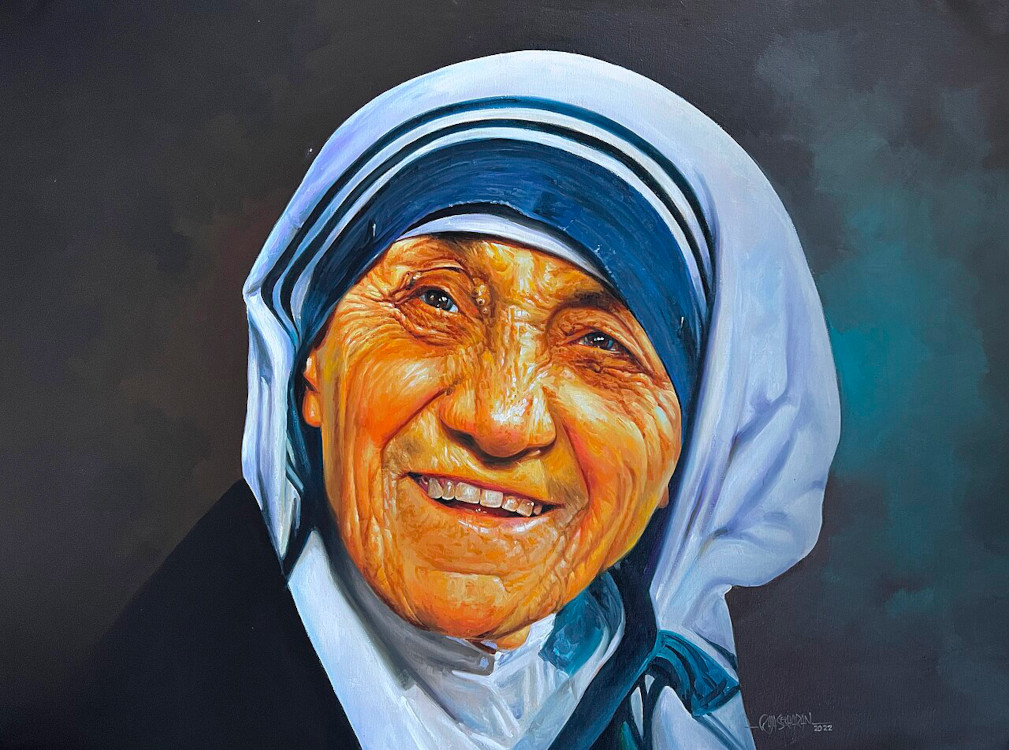
Charles Brammall on Mother Teresa
It happened in a convent meeting, not in front of TV cameras or Nobel committees, but behind the closed doors of the Missionaries of Charity.
A young sister had spent months organising practical improvements for one of the congregation’s houses. The changes were sensible, volunteers supported them, and local medical staff championed them. Resources were available. Confident she was serving both the poor and the order, she presented her plans to Mother Teresa.
Teresa listened quietly, then when the sister finished, her Mother reportedly looked at her and said in essence, “That is not our work.”
The proposal was rejected- there was no discussion, committee rumination, or collaborative problem-solving. The decision was final.
The Mother was (and is, officially), a saint to the world, but a tyrant to some. There was an (until recently) hidden cost to her extraordinary leadership, and reputedly, not to her.
Former sisters would later describe scenes like this as completely typical. Teresa could be astonishingly gentle with dying beggars, but unexpectedly uncompromising with the women who worked beside her every day. Many loved her, many revered her, but some admitted they feared her.
That paradox lies at the heart of almost every serious modern biography. Hagiography. The public met a smiling nun wrapped in a white sari. Her sisters often encountered an extraordinarily demanding superior. Neither picture is entirely false nor tells the whole story.
The Public Saint:
Very few twentieth-century Christians became global symbols in the way Mother Teresa did. She won the Nobel Peace Prize, addressed the United Nations, and even Popes sought her advice. Presidents wanted photographs with her, and Journalists described her as “the living saint.” To millions, she represented compassion itself.
Yet historians writing since her death have painted a much more complicated portrait. She was neither a fraud nor a monster, a woman whose remarkable strengths often became remarkable weaknesses.
“She Was Very Difficult”:
One striking feature of the literature is that criticism comes not only from enemies like Christopher Hitchens, but also from admirers. One of her authorised biographers, Kathryn Spink, never disguises Teresa’s formidable personality. Navin Chawla, another sympathetic biographer, repeatedly portrays her as possessing an almost immovable will.
An academic biography summarises her character bluntly: “Mother Teresa had her flaws as well- she was stubborn, difficult to work with, and demanding.” That is a remarkable admission, coming as it does from a biography that is overwhelmingly favourable.
The issue, then, is not whether she could be difficult- almost everyone agrees she could. The real questions are why she was like this, whether it helped or harmed her mission, and whether her leadership reflected Christian servant leadership or something closer to authoritarian control.
Two Teresas:
One of the most consistent themes running through memoirs is that there seems to be two different Mothers.
Visitors encountered warmth; Journalists, humility- and the dying, tenderness. But her own novices and sisters often encountered discipline.
This difference has been noted by numerous observers. Those inside the order saw the expectations, but those outside saw the smile. And never did the twain meet.
Scholars of leadership styles recognise this pattern immediately. Founders of movements frequently invest enormous emotional energy outwardly, while expecting extraordinary sacrifice inwardly. Examples range from military commanders to pioneering missionaries to technology entrepreneurs. The same traits that inspire followers often exhaust colleagues.
An Extraordinary Founder… But an Administrator?
Because they are not the same skill. History repeatedly demonstrates that visionary founders are often mediocre administrators. And there is growing agreement among historians that Mother Teresa belonged in this category.
She possessed astonishing gifts for inspiring people, and inspired thousands of women to dedicate their lives to serving the poorest of the poor. She inspired millions of donors, persuaded governments, and attracted volunteers from every continent. And these achievements required exceptional leadership.
But administration is a different animal. As the Missionaries of Charity expanded into more than one hundred countries, Mother Teresa retained astonishing levels of personal control. It is said that she insisted on approving new foundations herself.
Major decisions remained centralised, delegation was limited, and institutional systems developed slowly.
The LA Times, after interviewing numerous Roman Catholic people familiar with the order, observed that she delegated remarkably little, with one observer remarking that the sisters “do not seem to have the freedom to be themselves.” Many organisational experts would identify this as classic founder syndrome.
The founder trusts personal judgement more than institutional processes, and that approach often works brilliantly while the founder is alive. But it frequently creates difficulties after the founder dies.
A Leader Who Inspired… and Intimidated
Many sisters adored her, but others felt deeply intimidated. Yet these are not mutually exclusive. Several former order members have described entering Teresa’s office with genuine fear. Not fear of abuse, but of disappointing her. She expected obedience. That is, immediately.
She rarely explained her decisions and readily interpreted her workers’ attempts to discuss matters with her as resistance. To modern Western readers, this appears harsh, but within traditional Catholic religious life, it was more commonplace.
Nonetheless, even priests sympathetic to her mission occasionally found negotiations exhausting because once Teresa believed something represented God’s will, persuasion became well nigh impossible. This was one of her greatest strengths. And limitations.
The Poor Came First:
Here lies another paradox. Very few historians would question that (like Jesus, especially as presented in Luke’s gospel) the Mother genuinely loved the poverty-stricken. Yet that love sometimes meant that those closest to her received relatively little emotional attention (unlike Jesus).
Family members of great leaders often report similar experiences. The public receives their best; colleagues receive their demands. The missionary receives the compassion, the staff member receives the expectations.
One biography observes that highly qualified volunteers often had the greatest difficulty understanding or working with their boss, whereas idealistic young volunteers generally adapted much more easily. And that observation is psychologically revealing. Professionals expected consultation, but Teresa expected obedience, and the resultant clashes were almost inevitable.
From Whence Did This Come?
To understand Teresa’s leadership, we must return to her childhood. Born Agnes Gonxha Bojaxhiu in Skopje in 1910, she grew up in an Albanian Catholic family marked by intense religious commitment. Dad died unexpectedly when she was only eight. And historians believe this transformed the family. Mum Drana became both a parent and a spiritual mentor.
She instilled two principles that never left her daughter:
First, every poor person deserved dignity.
Second, everything belonged to God.
Drana reportedly never allowed her children to eat unless an extra place had been set for someone poorer than themselves. So generosity became instinctive for young Teresa, her DNA.
But so did discipline. Later Jesuit spiritual formation reinforced absolute obedience, self-denial and decisive action.
By the time Agnes became Mother Teresa, compromise was almost entirely foreign to her personality. In fact, anathema. She had learned that God called, Faith obeyed, and Questions came later.
Type A Personality?
No responsible psychologist can diagnose someone retrospectively, but our Abbess did exhibit many traits commonly associated with what older psychology literature called a Type A personality. She displayed extraordinary persistence, breathtaking deep conscientiousness, and Exceptional self-discipline.
She had no tolerance for wasted time, a jaw-dropping capacity for work, and a tendency to assume others could endure what she endured. That is, not having good awareness of others, and in that way, neither good self-awareness either. And these characteristics made her extraordinarily effective in founding a global movement. But they also meant she was arduous and complex to work alongside.
Great leaders often seem to unconsciously assume that everyone shares their stamina. And almost no one Teresa was associated with ever did, nor would they now. She appeared genuinely surprised when sisters became exhausted, as she regarded hardship as normal Christian discipleship (as the Bible does). But many younger sisters experienced it as relentless pressure.
In the next part, I will examine the testimony of former sisters, priests, and bishops, and volunteers, in greater depth. Including documented accounts of inconsistent leadership, criticism from clergy, and her theology of suffering, the publication of her private letters. And the Biblical question: whether her teaching on salvation reflected justification by grace through faith alone, or the distinctive sacramental theology of Roman Catholicism.
To be continued…
Image: painting of Mother Teresa by Rajasekharan Parameswaran. Image Credit: Wikimedia and the artist