
Allan Starr reports on a survey of NSW Presbyterians
For over twenty years, some within the Presbyterian church in NSW/ACT have been actively seeking to move to male-only eldership. I myself recently attended a Presbyterian church in NSW for some years. I offer no comment on this proposal in this post.
Recently, a survey was conducted within the church regarding views on the potential impacts of this proposed change. This survey was conducted to ensure compliance with relevant WHS guidelines. A report has been written, and the committee tasked with conducting the survey have advised that ‘this report is not confidential’.
The results were striking, and I share some of the stats.
In response to the question whether quality of leadership would be affected, 12% of church members/adherents felt the impact would be positive, and 56% felt it would be negative. 3% of deacons, 14% of elders, and 27% of ministers felt the change would have a positive impact. 57% of deacons, 54% of elders, and 25% of ministers felt the change would have a negative impact. Others said no impact or unsure.
In response to the question whether one’s emotional and/or psychological well-being would be impacted, 10% of members/adherents felt the impact would be positive, and 49% felt the impact would be negative. 9% of deacons, 10% of elders, and 25% of ministers felt the impact would be positive. 66% of deacons, 43% of elders and 20% of ministers felt the impact would be negative. Others said no impact or unsure.
With regards to the incidence of conflict, bullying, or harassment, and the willingness of staff/volunteers to report it, a large chunk of the various groups said there would be no change (these percentages varied from 28% to 58%). Having said that, however, EVERY group agreed that the likelihood of increased incidence was greater than the likelihood of reduced incidence, and EVERY group agreed that the likelihood of reduced willingness to report it was greater than the likelihood of increased willingness to report it.
20% of Presbyterian churches in NSW/ACT have one or more female elders as well as male elders, and 20% of the churches that responded to the survey also have female elders, suggesting the survey response was very representative. However, it should be noted that the results are actually slightly skewed because 31% of the individual responses came from churches with female elders. Even so, the results are still striking.
It should also be noted that some responses which predicted an improved emotional or psychological state if the change went ahead, were not due to supporting male-only eldership but simply reflected a desire for the debate to be over.
Whilst this survey did not actually ask for people’s views on male-only eldership, the questions posed and the results certainly enable one to deduce reasonably accurately the level of support for this change across the various leadership and church member groups.
It is very evident that the proposed change has very little support amongst those ‘in the pew’ or amongst those serving as deacons, and not much higher amongst those serving as elders. The support is highest amongst ministers, but even here the support does not appear to be a majority.
Please join me in praying that if this comes to a vote at the Assembly next week, those who vote will prayerfully keep the survey results in mind. Those on both sides of this debate in the NSW/ACT Presbyterian church sincerely believe they are guided by the Bible on this issue, but this issue is causing ongoing pain for people on both sides of the debate and many have left the Presbyterian church as a result.
A new proposal is desperately needed to break the cycle.
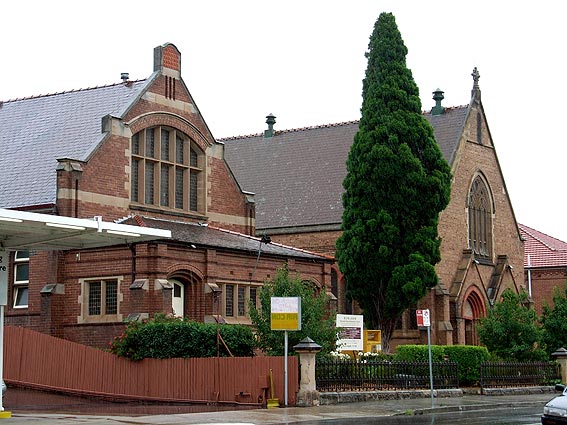
Image: Burwood Presbyterian. Image Credit: Sydney Organ
Some History in teh later 1960s the General Assembly of the Presbyterian Church of Australia, the court that determines doctrinal issues for the whole church (ie in every state) declared that admission to the eldership was a matter of Governance and thus a matter for the State Assemblies and that both men and women were eligable to be ordained and inducted as elder as this was not a doctrinal issue. As a result all states (with perhaps the exception of QLD resolved to allow women to be elders) In 1974 the GAA (the last before Union) resolved after Barrier Act procedure, that women were eligible to be ordained as ministers, this being deemed doctrinal as the GAA was responsible for the training and ordination of ministers as distinct from elders. After much debate this change was rescinded in 1991. Since the 1967 GAA resolution women have been ordained and inducted in every state except perhaps Queensland except that all states bar NSW have over time resolved at a State level to discontinue ordaining women as elders.Several attempts have been made over the years to have the GAA change its 1967 ruling that eldership was a matter of gvernance and not docctrine and each time that move has been rejected, as have repeated attempts by various members of the NSW Assembly to have only male eldership which to this date have been unsuccessful, often after at times vitriolic debate and at times the denigration of those who support eldership being open to both males and females (although the reverse sadly is also true).. I was ordained as a minister in 1988 into a church that in my view rightly and biblically ordained both men and women as both ministers and elders. At time I have been alienated and abused because of my understanding of both the Bible and its application to the issue of eldership in the Presbyterian church as I disagree with the male only eldership interpretation of the Scriptures, the translation or I suggest mistranslation of the word “authentein” and in the very nature of what an elder is in the PResbyterian church which I would contend is the equivalent to the diaconate of the NT Church and not to presbuteroi/episcapoi. Sadly I know of many men and women who have left the Presbyterian church because of the “anti-women” push which as I understand the Sriiptures is not an issue of “because the Bible says so” but rather “how I interpret the Bible on the issue”. I dont disagree with what the Bible actually says, but what it is claimed to say, ie interpretation. The ultimate cost of this ongoing at times bitter debate over the 38years of ordained ministry has been significant and health impacting, and considering we live in a nation where at best 10% know Jesus Christ aas Lord and some n90% on the broad easy way that leads to destruction for this by comparison unimportant/non salvation determining issue of whether men or men and women can be elders to have been a significant focus of the Assemblies and courts of the church for over 40years is something that satan rejoices as it means we continue to ignore the lost, those who our Lord saw not a sinners dead in sin but as sheep lacking a shepherd.
We are told, “A bishop then must be blameless, the husband of one wife, vigilant, sober, of good behaviour, given to hospitality, apt to teach;” 1 Tim 3:2 but the verse But I suffer not a woman to teach, nor to usurp authority over the man, but to be in silence.” 1 Tim 2:12 rules out the woman as being able to teach.
The scripture, “let us have grace, by which we may serve God acceptably with reverence and godly fear.” Heb 12:28 should also be taken in account. If a Church is not reverent nor in godly fear, it is not acceptable. If it is not acceptable, it is not a Church.
Interestingly, in my experience at least, elders rarely teach in the Presbyterian church; that seems to be done by the minister(s). So, perhaps the concern you seem to be expressing is groundless. In any case, it is up to the local minister who teaches/preaches. As for the interpretation and application of the specific verses you quote, I make no comment in line with my lack of comment in my piece!
1) Presbyterian Church does not have Bishops, never has had. Interesting translation, “teach, nor to…..” fairly sure the Greek reads ” teach and to…….”
If you are a minister of the Church, you are sadly lacking if you are not aware that Bishop, means elder, or overseer.
clearly it is you who have little knowledge of Greek and the Bible. Firstly as you know I am a minister and have been so for nigh on 40 years and secondly I do know my Greek and while Bishop” can be a translation of the Greek “episcopoos” , a better translation is overseer, and it NEVER means elder, as that is the correct translation of a completely different Greek word “presbuteroi”, and the Presbyterian Church has NO BISHOPS and never has had, the local Presbytery being the equivalent to the “Bishops” in the Episcopalian, ie Roman Catholic, Orthodox and Anglican denominations
Excuse me for using A.I but it is nice and fast. “the Greek words for “elder” and “bishop” can refer to the same office in the New Testament. This is one of the clearest linguistic points in early‑church polity.
🧩 The two key Greek terms
πρεσβύτερος (presbyteros)** — “elder,” literally “older man,” but used as a leadership title
ἐπίσκοπος (episkopos)** — “overseer,” later translated “bishop”
🧠 How the NT uses them
The New Testament uses these two words interchangeably for the same church leaders.
1. Acts 20:17 + Acts 20:28
Paul calls the elders (πρεσβυτέρους) of Ephesus (v.17), and then tells them the Holy Spirit made them overseers (ἐπισκόπους) (v.28).
Same group, two titles.
2. Titus 1:5–7
Paul tells Titus to appoint elders (πρεσβυτέρους) in every town (v.5).
Then, describing the same role, he says “for the overseer (ἐπίσκοπος) must be blameless…” (v.7).
Again: same office, two terms.
3. 1 Peter 5:1–2
Peter speaks to elders (πρεσβυτέρους) and tells them to “exercise oversight” — the verb form of episkopos (ἐπισκοποῦντες).
The elder does the overseeing.
🧭 What this means
In the New Testament era
Elder = overseer = bishop
Different words emphasize different aspects:
presbyteros → maturity, dignity
episkopos → responsibility, supervision
In later church history
The terms became distinct offices:
Presbyter/priest
Bishop (higher rank)
But that distinction did not exist in the apostolic period.”
If you have read the Bible, even in Greek, then how do you account for the following, “Let your women keep silence in the churches: for it is not permitted unto them to speak; but they are commanded to be under obedience, as also saith the law.
And if they will learn any thing, let them ask their husbands at home: for it is a shame for women to speak in the church.
What? came the word of God out from you? or came it unto you only?
If any man think himself to be a prophet, or spiritual, let him acknowledge that the things that I write unto you are the commandments of the Lord” 1 Cor 14:34- 37 This phrase, “the commandment of the Lord is not often used in the Bible. It must then be showing the importance of what is being said. “The women must remain silent.” But perhaps it does not mean this in the Greek manuscripts. Could you please tell us what it does mean?
Hmm. Bishops in the Presbyterian churches. An interesting innovation. But, I suppose they ARE of the plene esse of the church. Semper Reformanda!
Clearly I was wrong when I wrote “The support is highest amongst ministers, but even here the support does not appear to be a majority.” Clearly the support was a majority. Obviously my prophetic skills are lacking!