
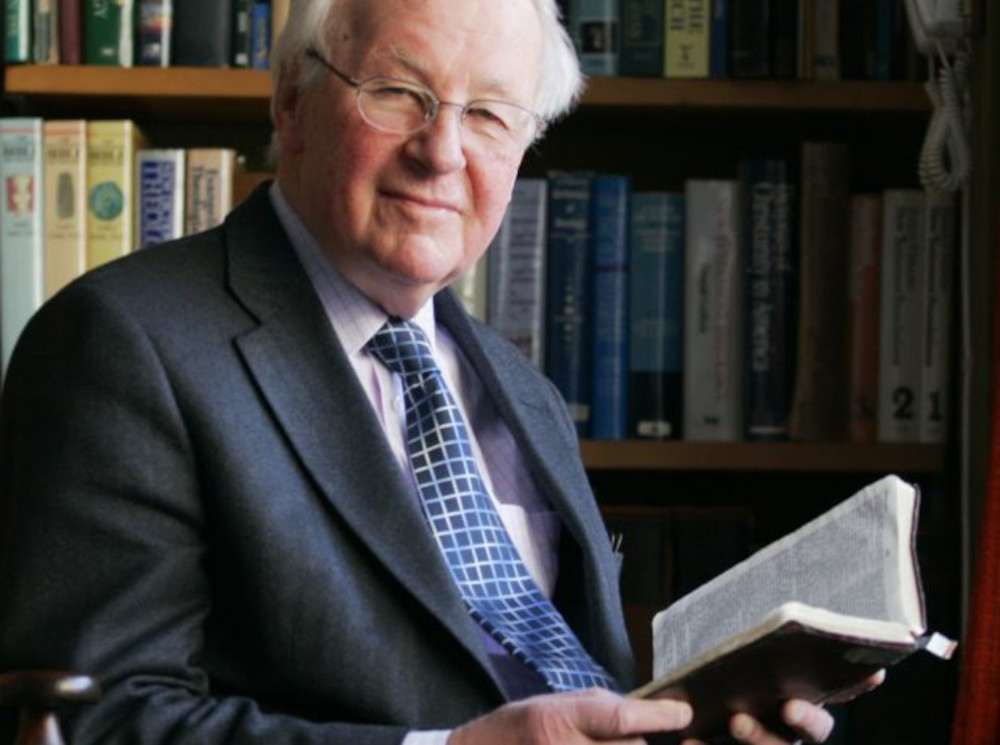
Part two of Charles Brammall’s series on annihilationism
If John Stott had spent his career as an eccentric theologian on the fringes of evangelicalism, his remarks about annihilationism would probably have attracted little notice. Evangelical history contains no shortage of obscure writers who have questioned the traditional doctrine of hell. Most disappeared into footnotes. Some never found publishers beyond their own denominational circles. A few gathered small followings before fading from view.
Stott belonged to an entirely different category.
I admit with humility and deep timidity that I, too, find the concept of eternal conscious punishment emotionally difficult. In fact, I think it would be strange to have a (God-like) passion for the lost and NOT feel that. And I know I am on holy ground at this point (or unholy!?). But I suspect I’m not alone among other Bible-loving, Bible-submitting believers in finding this doctrine (while true), tricky to assimilate emotionally. I know of at least one fine Bible College Vice Principal who certainly does.
But my question is this: whether it is wise, good, and Godly to raise that kind of question publicly, especially if one has the kind of global influence among Christians that Stott had. Or whether, precisely BECAUSE of his profile, it was important for someone such as him to do so.
Maybe he did it intentionally- to provoke us to more integritous thought, incisive theology, and a higher view of the Scriptures? Among evangelical writers and preachers, it is certainly not rare to find deliberately rhetorical, provocative presentations. Their raison d’être is presumably to nurture a deep response in us (including sometimes anger), with the ultimate aim of conformity to Jesus, keeping in step with His Spirit, and repentance.
* * * *
By the time Stott cautiously suggested that conditional immortality deserved serious evangelical consideration, he had become one of the most trusted Bible teachers in the English-speaking world. His reputation rested not on novelty but on reliability. He was known precisely because he did NOT chase theological fashions.
His instinct was almost always conservative in the best sense of the word: preserving what Scripture taught, refusing speculation where the Bible was silent, and carefully distinguishing between certainty and inference. That reputation had been forged over more than half a century. And to understand why his comments produced such shockwaves, it is instructive for us to first understand the man himself.
A Privileged, Disciplined & Distant Childhood
John Robert Walmsley Stott was born into 1921 London in a prosperous and highly educated family. His father, Sir Arnold Stott, a distinguished physician, was respected in Medicine for his skill and integrity. His mother, Emily Caroline (Nee Holland) Stott, possessed intellectual refinement and encouraged academic excellence within the family.
The household was cultured, disciplined and thoroughly English in the best and worst senses of that description.
Education, etiquette and duty were esteemed. But Religion occupied a far more ambiguous place. The Stotts attended church occasionally, but relationship with God was not the living centre of family life.
Later in life Stott would speak of his conversion not as the continuation of an already vibrant spiritual upbringing, but as a decisive encounter with Christ that fundamentally altered the direction of his life.
Like many boys from professional families (including me), he was sent away to boarding school. Such schools shaped generations of Britain’s leaders. They instilled resilience and discipline, intellectual ambition and public responsibility. They could also produce emotional reserve and a lifelong reluctance toward self-disclosure.
But those who later knew Stott spoke fondly of his characteristic combination of warmth and reserve. Deeply compassionate without sentimentality, he was also personally kind without emotional demonstrativeness.
Friends frequently commented that beneath his gentlemanly exterior (I imagine he was one of those fellows who used a butter knife even when he was on his own), lay considerable emotional depth, carefully governed by remarkable self-discipline. Those qualities would later shape both his preaching and his handling of controversy.
Rugby School, and an Unlikely Mentor
The decisive turning point for John came at 16 yrs old as a student at The Rugby School. Into the school came an Anglican clergyman, Eric Nash.
Known universally by the nickname “Bash,” he became one of the most influential yet least publicly recognised evangelical leaders of 20th-century Britain.
He possessed no international platform, wrote relatively little, and never sought celebrity. But he invested himself in ministry to schoolboys, convinced that if future leaders could be won to Christ and discipled thoroughly, the effects might ripple through generations. The oft-maligned “80/20” rule. History proved him astonishingly perceptive.
Among those profoundly influenced by Nash were numerous future bishops, missionaries, and professors, clergy and evangelical leaders. Few individuals have exercised greater hidden influence upon modern British evangelicalism.
His ministry to schoolboys combined intellectual seriousness with deep personal concern.
Christianity, Nash insisted, was not inherited by family tradition, nor secured by church attendance. It required personal repentance, personal trust in Christ and personal submission to Scripture. These themes would remain central throughout Stott’s own ministry.
During a school mission in February 1938, Nash preached on Rev 3:20,
“Behold, I stand at the door and knock.”
For many years, popular evangelical preaching interpreted this verse as an evangelistic appeal to unbelievers. Although modern biblical scholarship generally understands it differently, God often works through imperfect exegesis as well as perfect doctrine.
That evening, John Stott believed Christ himself was addressing him. Years later, he recalled opening what he described as “the door of my personality” to Christ. It became the defining event of his life.
Unlike many (sometimes merely alleged) conversion narratives, Stott’s account was never dramatic in the emotional sense. There were no visions, extraordinary experiences, or mystical phenomena. Characteristically, his description centred upon decision, surrender and dependence on God rather than overwhelming feeling.
This too would become a hallmark of his ministry. He distrusted emotional manipulation, preferred conviction to excitement, and believed that enduring discipleship required transformed minds as well as hearts. Rom 12:2- “Do not be conformed to this age, but be transformed by the renewing of your mind, so that you may discern what is the good, pleasing, and perfect will of God.”
An Appetite for Scripture
Following his conversion, Stott developed an intense hunger for Scripture. Friends later recalled that even as a young man, he approached the Bible with unusual seriousness. He read systematically rather than selectively. He asked questions of the text before asking how it applied to contemporary life. He learned early that faithful interpretation required patient study, historical awareness and intellectual honesty.
These habits never left him. Indeed, they became foundational to his philosophy of ministry. Long before the phrase “expository preaching” became common in evangelical circles, Stott was convinced that the preacher’s first responsibility was to understand what God had actually said before attempting to explain what it meant.
His oft-repeated conviction was simple but profound: “The preacher’s task is to bridge two worlds.” One world was the biblical text. The other was contemporary culture. He believed that faithful preaching required understanding both without allowing either to dominate the other. That vision eventually found classic expression in his influential book Between Two Worlds, but its roots lay in these formative years of disciplined biblical study.
Cambridge: In Fide Scientiam (Faith Seeking Understanding)
From Rugby, Stott proceeded to Trinity College, Cambridge, one of Britain’s foremost intellectual centres. Cambridge during the early 40s was a place of remarkable intellectual ferment. Europe stood engulfed in war, and ancient certainties appeared increasingly fragile. Questions concerning civilisation and morality, authority, and human nature acquired urgent practical significance.
For Christian students, the challenge was equally demanding. Could historic Christianity withstand modern intellectual scrutiny? Could biblical faith satisfy the university as well as the village church? Could one be intellectually serious without surrendering evangelical convictions?
For Stott, the answer became an emphatic yes.
He read modern philosophy, engaged with contemporary literature, and immersed himself in theology. Yet he never regarded academic learning as an end in itself. Knowledge existed to serve obedience, scholarship to illuminate Scripture, and Theology to strengthen the church. This integration of intellectual seriousness with pastoral purpose became one of the defining characteristics of his ministry.
Unlike some scholars, he never appeared to delight in obscurity. And unlike some popular preachers, he refused intellectual shortcuts. His rare gift lay in making profound truths appear accessible without making them simplistic.
A Ministry Begins
Following graduation and theological training, Stott was ordained in the Church of England. His ministerial home became All Souls Langham Place, situated prominently near Broadcasting House in central London. It would remain his church for the rest of his life, and such longevity is almost unimaginable today.
For decades, Stott served the same congregation, first as curate, then rector, and later rector emeritus. While invitations poured in from around the world, he consistently returned to his own people. And this loyalty gave unusual credibility to his ministry.
He was not merely a conference speaker. He was an under-shepherd of the Great Shepherd.
Week after week, he preached to ordinary Christians, baptised children, and buried those who died; married couples, counselled the grief-stricken, and wrestled with the practical realities of church life. I imagine he would have felt some of Paul’s pastoral burden, 2 Cor 11:28, “Not to mention other things, there is the daily pressure on me: my concern for all the churches.”
Consequently, Stott’s theology (“Thinking God’s thoughts after Him”) rarely drifted into abstraction. Real theologising never can. It is always eminently practical. And Stott’s remained anchored in pastoral experience.
The Expositor
If one word came to define Stott’s public ministry, it was probably “expositor.” He believed preaching consisted neither in entertaining congregations nor in displaying theological brilliance. Its purpose was to expose the meaning of Scripture.
Consequently, his sermons exhibited meticulous structure. Arguments unfolded patiently, applications emerged naturally from the text, and illustrations illuminated rather than dominated.
Humour appeared occasionally, although usually understated and self-effacing.
Above all, listeners sensed that the Bible rather than the preacher occupied centre stage, and this approach, driven as it was by a high view of scripture, influenced thousands of pastors. Many of us who never met Stott nevertheless learned to preach through his books, lecture recordings and conferences.
In an age increasingly captivated by personality-driven ministry, he consistently redirected our attention toward Scripture itself. Much like the Spirit’s constant self-effacing redirection of our attention to Jesus.
The Writer
Remarkably, Stott’s influence through print eventually exceeded even his preaching ministry. His books were translated into scores of languages.
They reached readers across Africa, Asia, Latin America, Europe and North America. Unlike many theological authors, he possessed unusual clarity.
Complex doctrines became understandable without being rendered trivial. Dense theological arguments became readable without sacrificing precision. And nowhere, perhaps, is this more evident than in The Cross of Christ.
Along with Morris’s “The Atonement”, it is widely regarded as one of the greatest evangelical books of the twentieth century. It combined historical theology, biblical exegesis, philosophical reflection and pastoral application into a coherent vision of Christ’s atoning work.
Its treatment of divine justice and divine love would later prove highly relevant to discussions concerning hell. For Stott, God’s wrath and God’s love were never opposing characteristics. Both flowed from his perfect holiness and found their fullest expression at Calvary. And this conviction goes some way to explaining much about his later reflections on final judgement.
He never questioned the reality of divine wrath, but merely whether Scripture taught that it required the endless conscious existence in torment of those under judgement. And that distinction would become central to the controversy.
A Global Leader
By the 60s and 70s Stott’s influence had become unmistakably international. He travelled tirelessly, lectured in universities, and addressed pastors’ conferences. He encouraged theological colleges and strengthened young evangelical movements across the developing world, including IFES, one conference of which I heard him preach at.
According to some, perhaps his most enduring international contribution came through the Lausanne Movement. The 1974 Lausanne Congress on World Evangelisation (sic) brought together evangelical leaders from around the globe, under the leadership of Billy Graham and others. Stott played a pivotal role in drafting the Lausanne Covenant, one of the most influential evangelical statements of the twentieth century.
The Covenant affirmed the authority of Scripture, the uniqueness of Christ, and the urgency of evangelism; the necessity of holy living, and the church’s responsibility toward both proclamation and compassionate service. Its influence in many conservative evangelical circles can scarcely be overstated. Even today it continues to shape evangelical mission worldwide.
Importantly, nothing in Stott’s later reflections on annihilationism represented any retreat from these convictions. He remained throughout his life a passionate advocate of evangelism. Indeed, one criticism frequently levelled against annihilationism— that it weakens missionary urgency— found little support in Stott’s own ministry. Few twentieth-century evangelicals worked harder to promote global evangelisation than Stott.
A Reputation for Humility
Perhaps the quality most frequently mentioned by those who knew Stott personally was humility. He possessed immense influence yet avoided celebrity, lived simply, and gave generously.
He welcomed younger leaders, listened carefully before speaking, and readily acknowledged uncertainty where Scripture itself appeared difficult.
And it is this final characteristic that deserves particular attention.
Stott distinguished carefully between doctrines that stood at the heart of the Christian faith and those where faithful believers might legitimately disagree. He defended the Trinity without hesitation, for example, the deity of Christ without qualification, and the bodily resurrection with complete confidence. (But the question was legitimately asked by some, which conservative evangelicals wouldn’t?)
But on secondary questions, however important, he preferred careful argument to rhetorical certainty.
Some interpreted this as weakness.
Others regarded it as one of his greatest strengths.
And it would certainly shape the way he approached the doctrine of hell. When Stott eventually questioned eternal conscious punishment, he did not present himself as a revolutionary overturning Christian tradition. Rather, as a student, lover, believer and obeyer of Scripture- asking whether, after centuries of interpretation, the church might profit from looking once more- and more carefully— at the biblical evidence.
That posture explains both the remarkable respect many evangelicals continued to show him, and the extraordinary disappointment felt by others. They were not reacting merely to a theological proposal, but to a trusted teacher whose judgement they had relied upon for decades. For some, if John Stott could question this doctrine, what doctrine might be questioned next?
The anxiety was understandable.
Whether it was justified is another matter entirely.
To answer that question, we must first examine the doctrine itself. What exactly had the Christian church historically believed about hell? Was the traditional doctrine as uniform as many assumed?
Or had there always existed quieter voices suggesting that the final fate of the wicked might be destruction rather than everlasting conscious torment?
The history proves more complex than either side of the modern debate has sometimes acknowledged.
In the next part, we’ll turn to the historical development of the doctrine of hell from the early church through the Reformers, tracing the emergence of eternal conscious punishment as the dominant view while also examining the lesser-known history of conditional immortality before John Stott.
Image: John Stott