
Are Catholics warned off converting? Some online sources think so.

This image is from Catholic Corner, a Facebook page that reports “The Vatican has released “A Journey of Hope,” a new document on interreligious dialogue marking 60 years since Nostra Aetate, signed by Cardinals Fernández, Koch, and Koovakad.
“The text discourages proselytism, calling “defensive entrenchment” in one’s own religious position outdated, and frames dialogue primarily as a path toward peace and fraternity rather than evangelization.”
A Journey of Hope, on the Vatican website is a continuation of the dialogue between Jews and catholics that began after the Holocaust and resulted in the Vatican II document Nostra Aetate.
Journey of Hope is based on a understanding that God has not abandoned the Jews. “God’s covenant with the Jewish people is irrevocable, and this continually challenges the Church. This does not mean, for Christians, that there are two paths to salvation[21] or that the covenant with the Jewish people runs parallel to the Christian way of salvation: the Church teaches that Christ is the one and only Redeemer. Nevertheless, this irrevocable covenant has theological significance. The more Christians come to know and love the Jewish roots of their own tradition, the better they understand themselves in the practice of faith, and the stronger their religious identity becomes—even though, for this to happen, Christians must know their own faith tradition well and be firmly rooted in it. When, with reference to Judaism, we affirm that we cannot do without one another, this also implies that the religious life of contemporary Jews, and not only that linked to the Old Testament, is relevant to Christians.”
Pope Leo XIV is quoted: “The conciliar Declaration Nostra Aetate (par. 4) emphasizes the greatness of the spiritual heritage shared by Christians and Jews, encouraging mutual knowledge and esteem. The theological dialogue between Christians and Jews remains ever important and close to my heart. Even in these difficult times, marked by conflicts and misunderstandings, it is necessary to continue the momentum of this precious dialogue of ours.” Christians and Jews, unable to do without one another, should continue to walk this path together until the end of time on earth. Together, they should await that day “known to God alone, on which all peoples will address the Lord in a single voice and ‘serve him shoulder to shoulder’ (Zeph 3:9).”
Out of Nostra Aetate, Journey of hope suggests dialogue with other faiths has been furthered, including Islam.
However, Journey of Hope rejects syncretism while promoting dialogue. “It is not a matter of founding one great world religion in which all beliefs are flattened. Such a possibility must be excluded out of respect for oneself and for others. Rather, it is a matter of building a fraternal society capable of accepting differences. This intention remains at the heart of interreligious dialogue, just as it was in the Declaration Nostra Aetate and in the efforts that have characterized the decades following its promulgation. Dialogue does not consist merely in presenting one’s own doctrines or comparing worldviews. Today, in the face of those who foment divisions and stir up conflicts, believers of different traditions—and above all their leaders—while remaining aware of their irreducible differences, are called to seek, with clarity and hope, the conditions necessary for peaceful coexistence.”
Journey of Hope faces the issue of persecution: “it is necessary to highlight the persecution suffered by Christians in various parts of the world at the hands of extremist religious groups. Every persecution on religious grounds is always a violation of human dignity, and there is an urgent need to find a common response which, in the spirit of Nostra Aetate, promotes respect, dialogue, and peaceful coexistence among all and toward all.”
Catholic jargon can be hard to read. When Proselytism is condemned, it is coercive or agressive practices catholics are condemning. Here is a Journey of Hope passage that protestants might see as problematic: interfaith “dialogue often requires ‘inexhaustible patience’ and cannot be reduced to a simple generic consensus. Rooted in the Church’s evangelizing mission—of which it is an essential dimension—it presupposes a sincere commitment, a deep understanding of the other, and recognition of the freedom of conscience as the foundation of every authentic relationship.” A suspicious reading of that passge might suggest it is saying dialogue equal proclamayion of the gospel. But the deep listening, and understnading the person we are wishing to reach for Christ is part of a process – and the “z:” in “evangelizing mission” alerts us to out catholic friends using familiar words differently.
###
Red faces in Lambeth: The BBC reports “The Archbishop of Canterbury has withdrawn an award given to a Muslim cleric who praised Osama Bin Laden.
“Hafiz Muhammad Tahir Mehmood Ashrafi received the award for reconciliation and interfaith cooperation from Dame Sarah Mullally last week, on the 25th anniversary of the 9/11 attacks.
“Lambeth Palace faced a backlash after it emerged Ashrafi praised Bin Laden – the architect of the 2001 attacks – as someone who had “been fighting for Islam against the Russians, Americans and British”, in comments from 2007.
“Ashrafi also reportedly said he would give Bin Laden the title Saifullah, which means “Sword of God”. He told the BBC his remarks had been “totally taken out of context”.
The astute Ian Paul, an evangelical leader in the Cof E was prescient, postingbefore the backdown. “am struggling here. My archbishop has given an award to a man who supports the blasphemy law in Pakistan, including the death penalty, who claims “Jews and Christians” are using the war in Iran to gain their nuclear weapons, who claims that suicide bombings are lawful, and dresses his wife in the full niqab. And on September 11th of all dates. What am I missing here? How is this not going to do profound damage to the reputation of the C of E?”
###
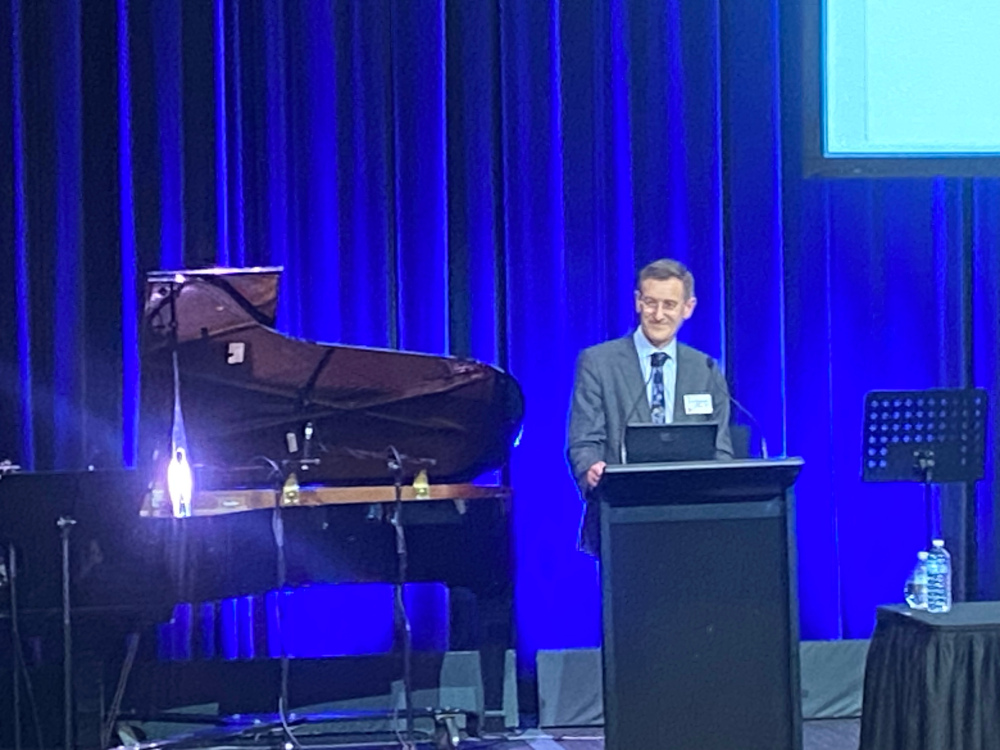
Converting the Conversion Act. Bishop Michael Stead ruefully conceeded to the Sydney Anglican Synod he had been briefing church ministers poorly about the Conversion Practices Ban Act 2024, in a speech to the Sydney Anglican Synod. “As you might remember, the act came into effect in April 2025, and at and around that time, I provided a number of briefing sessions on how the act might or might not impact pastoral practise. My advice at that time was based on assurances that had been given to faith leaders about the scope of exemptions in the act, which were included at the specific request of the faith leaders that the government had consulted to ensure that the act would not prevent a person of faith from seeking help including prayer to live in accordance with their faith. And it wouldn’t prevent faith leaders, people from any faith calling on members of their congregation to live in conformity with the teachings of that religion; praying with somebody at their request and telling them what the Bible says and saying, “You should live this way.”
Stead went on to say that the Attorney General and Anti Discrimination NSW took a different view, that prayer directed at changing someones sexual orientation ior suppressing its expression woas against the law.
Christians should be clear on what the law is – whether they wish to follow it or not.
Here is what a relevant section of what the Conversion Practices Ban Act 2024 says:
3 Meaning of “conversion practices”
(1) In this Act, a conversion practice means a practice, treatment or sustained effort that is—
(a) directed to an individual on the basis of the individual’s sexual orientation or gender identity, and
(b) directed to changing or suppressing the individual’s sexual orientation or gender identity.
(2) For subsection (1), it is irrelevant whether a practice, treatment or sustained effort directed to an individual on the basis of the individual’s sexual orientation or gender identity is based on an incorrect assumption or belief about the individual’s sexual orientation or gender identity.
(3) A conversion practice does not include—
(a) a health service or treatment provided by a registered health practitioner that—
(i) the registered health practitioner has assessed as clinically appropriate in the registered health practitioner’s reasonable professional judgement, and
(ii) complies with all relevant legal, professional and ethical requirements, or
Examples of health services or treatments that do not constitute a conversion practice—
any of the following health services or treatments assessed by a registered health practitioner as clinically appropriate—
• genuinely assisting an individual who is exploring the individual’s sexual orientation or gender identity or considering or undergoing a gender transition
• genuinely assisting an individual who is receiving care and treatment related to the individual’s gender identity
• genuinely advising an individual about the potential impacts of gender affirming medical treatment
(b) genuinely facilitating an individual’s coping skills, development or identity exploration to meet the individual’s needs, including by providing acceptance, support or understanding to the individual, or
(c) the following expressions if the expression is not part of a practice, treatment or sustained effort, directed to changing or suppressing an individual’s sexual orientation or gender identity—
(i) an expression, including in prayer, of a belief or principle, including a religious belief or principle,
(ii) an expression that a belief or principle ought to be followed or applied.
(4) To avoid doubt, the following are examples of what does not constitute a conversion practice under this section—
(a) stating what relevant religious teachings are or what a religion says about a specific topic,
(b) general requirements in relation to religious orders or membership or leadership of a religious community,
(c) general rules in educational institutions,
(d) parents discussing matters relating to sexual orientation, gender identity, sexual activity or religion with their children.
Carefully wording prayers would seem an obvious resonse to this writer.
image: Bishop me chapel Stead addresses the Sydney Synod