

An Obadiah Slope column
Please turn your irony detector on: Allegra Spender, Teal member for Wentworth, the weathiest part of Sydney’s East, has moved a bill to drastically trim religious schools’ right to hire staff and cut back their ability to discriminate against LGBTQIA students.
Anti Abortion activist Professor Joanna Howe has leapt into the fray, mounting a petition against the Spender Bill. https://www.drjoannahowe.com.au/saveourschools
Obadiah wonders whether an open advocate for voting for One Nation – with Prof Howe endorsing One Nation at the latest Abortion demo in NSW – is the best choice for an attempt to get Labor to oppose the Spender Bill. After all, Howe leads a movement of people who have promised never to vote Labor. So how convincing can a Joanna-Howe-organised petition be?
###
Obadiah feels he has to assure readers that the next bit was written by AI (But wouldn’t it be fun if it was): Australia’s largest ministry education consortium, The Australian University of Theology, has told teaching staff that they are not allowed to penalise or prohibit students for writing essays using AI. This means that unless it’s an invigilated exam or a viva (which 40% of the assessment must be), AI is fair game.
This means that exams, which were becoming fewer, will be coming back. It’s been suggested to Obadiah that churches might like to stick graduates in a room with a pen and paper to write a sermon, which could be a good idea.
This reminds Obadiah of his father studying Architecture in the 1930s, being locked in a room for 24 hours with his drawing materials. By the time Obadiah was also studying Architecture, there were occasional eight-hour projects that kept us in the studio.
Growing the church is a growing movement: If you thought that the Sydney Anglicans’ and Reach Australia’s – target of 5 per cent annual conversion growth for their churches was ambitious, look south and see what the Melbourne Anglicans have just done.
For The Harvest is the Anglican Diocese of Melbourne’s “vision and working strategy” for the next decade. “A renewed Church proclaiming Christ across Melbourne and Geelong, so that every person may encounter the love of God,” is the vision.
The opportunity: a church attendance of 20,000 in 2026, growing to 40,000 by 2036.
People serving in recognised ministry and leadership roles growing from 5,000 in 2026 to 10,000 in 2036.
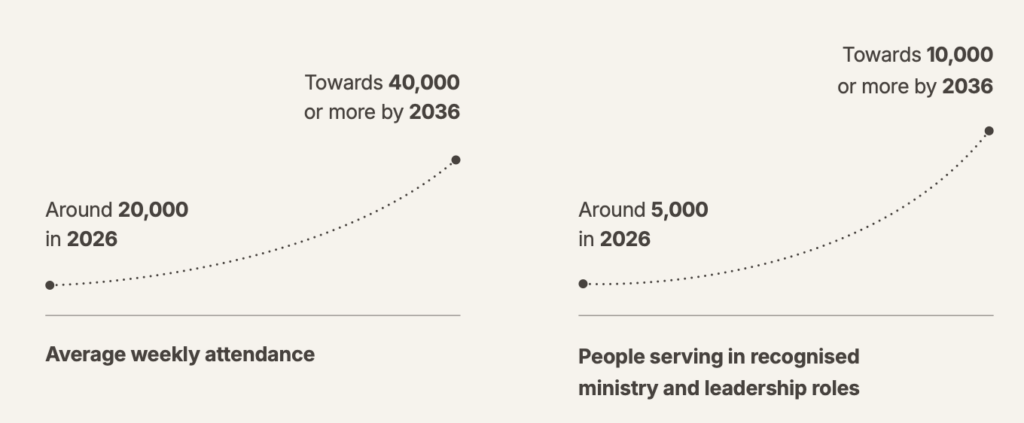
One difference with Sydney is that each local church has not been given a goal. Instead, for the harvest says, “These are diocesan horizons, not quotas for individual churches or ministries.
“They show the scale of the opportunity and the disciples, leaders and support renewal may require, and they turn us to prayer. Baselines, definitions and counting methods will be confirmed and reported transparently.”
This may reflect a different culture, with the majority of churches in Melbourne, compared to Sydney, not being yet ready to be challenged with a numerical goal. Although not every parish in Sydney is enamoured of the 5 per cent target.
But the renewed vigour and determination to win people for Christ in Melbourne and Geelong is something that deserves admiration.
###
Two graphs that look the same: Here are two graphs from widely different sorts of Anglicans that oddly look the same. The top one is an attendance graph from The Episcopal church, and the second is from our very own Sydney Anglicans. Obadiah thinks they look spookily alike – a gentle decline, Covid valley, and a partial recovery.
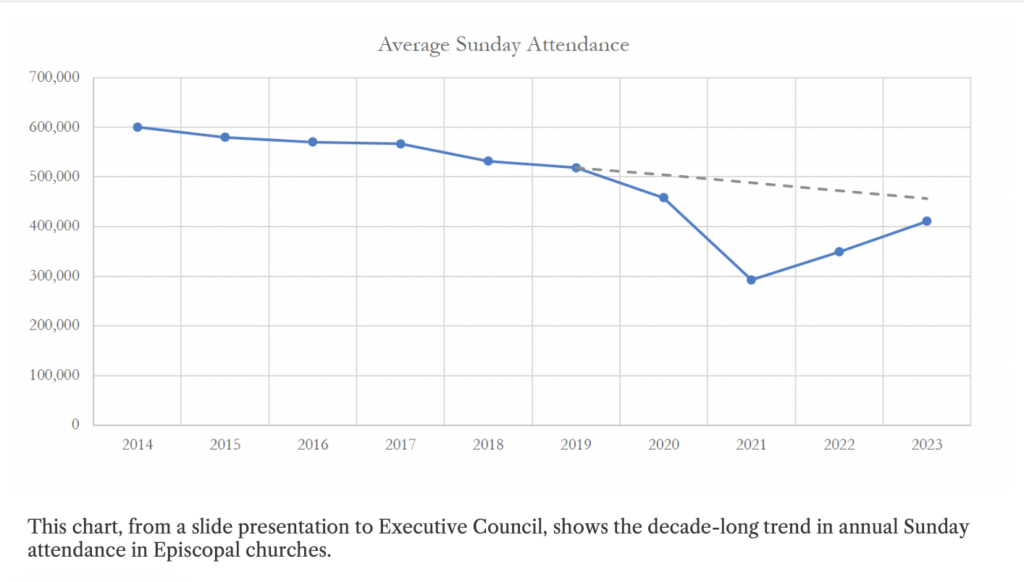
Source: Episcopal News Service

Source: Sydney Anglican Synod papers 2026
Two church organisations’ COVID bouncebacks, but with a key difference. The Episcopalians’ graph returns them to a continued steady decline. The Sydney results restore them to a plateau. Will Sydney break through the plateau next time? It will be big news next year. The likelihood of that is based on the idea that the bounceback includes newcomers.
Here’s how the two churches reported on their graphs.
The Episcopal Church: (Episcopal News Service summary) The Episcopal Church on Nov. 8 released its latest summary and analysis of the data collected in the parochial reports that are submitted annually by more than 100 dioceses and more than 6,000 congregations, offering a snapshot of a post-pandemic church that has in some ways recovered, yet still is grappling with long-term denominational decline…
The results represent a one-year snapshot of the church in 2023. Its 6,754 congregations were down from 7,067 in 2010. Episcopal churches reported 1.5 million total members last year, down by about 500,000 members over the past decade.
Worship numbers are much lower, with about 410,000 people attending Episcopal services on a typical Sunday in 2023. That figure was a significant rebound from pandemic lows to years earlier. In 2021, average Sunday attendance fell to 310,000 before rising to 370,000 in 2022. The latest increase, though still lower than pre-pandemic numbers, indicates attendance is back in line with the church’s longer-term trends.
Sydney (a report from the Standing Committee to Synod): “Attendance declined by approximately 16% between 2013 and 2022 before rebounding by around 22% between 2022 and 2025, resulting in total attendance slightly above 2013 levels (when considering the 80% of parishes for which 2025 data is available).”
In essence, the Standing Committee team focused on attendance and assumed flat attendance overall for the missing parishes. Hence the dotted line on this graph.
The report suggests “The actual number is expected to be higher still.”
In detail, “The reported 2024 attendance across the 52 parishes who did not complete their 2025 annual statistics was 9,525 (refer Table 6). If one were to assume no change to the combined attendance of these 52 parishes since 2024, and were to add this data to the 2025 diocesan attendance Grand Total (38,744), it would yield a 2025 attendance figure of 48,269.”
###
Putting the Gospel above Politics: Seth Cain, an Anglican minister from the US, on his eponymous Substack advising evangelical ministers against culture wars.
First, be clear on the unchanging ethics of Scripture, but don’t get stuck in the culture war cul-de-sac labelling everything left of centre as “woke.” It’s predictable and exhausting. It sounds self-serving. You can be theologically conservative and all kinds of traditional without patrolling all the boundaries and wringing your hands. You can hold to orthodoxy without being reactionary.
(In the Legacy cafeteria days, I invited a guest preacher, a former Anglican rector from the AMiA, to give me a break after 8 straight months of preaching. He couldn’t help but dog-whistle his politics in the pulpit. Incidentally, his parish shuttered a few years later. I’m certain this stuff didn’t help.)
Secondly, if you overtly signal to the younger people visiting your parish that belonging to your Anglican Church is adjacent to being a political conservative in this grossly polarised morass of American nonsense, you will do two things: You’ll only get a ghetto of who you already are, and you’ll simultaneously signal that you and your parish lack a broader Kingdom imagination worthy of their attention or attendance.
You’ll make it easy for them to sort you. Don’t let them sort you. Christians should never be easily sorted by prevailing political and cultural divides that are inevitably shaped by Mammon, Aphrodite and Mars. If we are easily sorted, then we’ve lost the plot.
###
Plus ça change, plus c’est la même chose: [“the more things change, the more they stay the same] Pastor Gary Coleman on starting at Parramatta Baptist in the early 1980s:
“When we came to Parramatta Baptist, I introduced an overhead protector. And I went to visit a 90-year-old lady at what was then the Parramatta Hospital, which is opposite where the bridges go across the river now. And I introduced myself. She said we had a new pastor at church, and it’s very strange. He writes on the wall and makes us sing songs we don’t know.”