
Moving a motion for Sydney Anglicans “to think wiselyand theologically about immigration and nationhood,” Chaneg Torres, a lay member of the Sydney Synod (church parliament), gave a speech that Dean Sandy Grant described as a model for the Social Issues Committee report that the motion sought.
This motion seeks the Social Issues Committee’s wisdom to respond to what I think is an increasingly important question for Christians to be equipped to think about: how should we think about immigration and nationhood when our ultimate political identity is as members of the Kingdom of God, under the rule of King Jesus?
I speak as someone who loves Australia and is deeply grateful to be an Australian, and also as someone from Wahroonga Anglican, a church with a great diversity of ethnic backgrounds.
The first thing this motion affirms is that governments have a responsibility to wisely determine immigration policy settings for the welfare, peace and good order of the people under their care. Christians can have genuine prudential disagreements about immigration policy. Scripture does not give us an immigration policy, but as the motion affirms, scripture is clear about God’s heart and sovereign care for all people and nations, and his particular heart for the vulnerable and dispossessed, which includes the refugee and the foreigner, which of course has implications for how Christians think about a just immigration and social policy framework.
And that flows into the next part of the motion: Christians are called to seek the common good of the earthly nation in which God has placed us.
Jeremiah urged the exiles to seek the welfare of the city in which they lived. The Bible tells us to honour governing authorities and submit to them, to pray for them, to give them what we owe in terms of taxes, and to live such godly lives among the pagans. And Paul was of course happy to assert his rights as a Roman citizen. So there is nothing un-Christian about wanting the good of our country Australia, particularly its people, and valuing our Australian citizenship.
But, most importantly, our earthly citizenship can never be our ultimate identity, and therefore conflicts about national identity and immigration must be seen in that light.
St Augustine wrestled with the issue of placing our hopes in earthly political arrangements, when Rome seemed to be collapsing around him. Christians should seek the good of the people in the earthly city and cooperate with them where we can, he argued, but they ultimately belonged to another city: the City of God. Their ultimately loyalty could never be for the earthly city, for a Rome whose common object of love is ultimately the lust for domination. For the Christian, we belong to a city, a new political community: the church, whose common object of love is our Lord Jesus.
It’s remarkable how often the New Testament uses political categories to describe who we are as God’s people. Paul tells us in Philippians 3 that our citizenship is in heaven. Ephesians 2 says that through Christ we are no longer strangers and aliens but fellow citizens with the saints. Peter tells us that we are sojourners and exiles on earth, but have been made a holy nation. The writer to the Hebrews says that God’s people desire a better country, a heavenly one, where God has prepared for us a city, to which we truly belong.
That profoundly shapes how Christians should engage in debates about national identity and the question of immigration and who is considered in and out.
Because fourthly, the kingdoms of this world will pass away. Christ’s Kingdom is forever.
Revelation gives us that magnificent picture of the Lamb who was slain being worshipped by people from every tribe, language, people and nation. Christ has purchased with his blood a multi ethnic people for himself and made them one new people – a new political community under King Jesus.
Interestingly with that image, eschatologically, our ethnic and national identities are not necessarily obliterated. But they are relativised by something infinitely greater: our common belonging to Christ.
And so, the fifth point, our heavenly citizenship must affect how we love the people God has placed before us.
St Augustine in On Christian Teaching speaks helpfully about rightly ordering our loves. We are commanded to love everybody, but how do we order that properly? For Augustine, to love our neighbour is to love the neighbour God has actually placed in front of us. In many of our parish contexts, that may be immigrants or refugees, people from very different ethnic or cultural backgrounds to us, that God has placed in our area to seek out and show Jesus’ love to. Sitting beside us in church may be precious brothers and sisters who have come from all sorts of different places around the world.
Our common identity in Christ must take precedence over ethnic-based nationalism. We belong first to an alternate polis, an alternate political community: a new holy nation gathered under King Jesus.
And lastly, as the motion states, the scriptures do invite us as God’s people to consider our identity in light of the memory of being foreigners, once alienated from God: “remember you were once foreigners in the land of Egypt.” The book of Ruth invites God’s people to think of their identity as being open to the incorporation of foreigners.
So in terms of our cultural moment, debates about immigration and national identity are becoming increasingly intense in Australia and throughout the West. Many people in our churches, and particularly young men, are encountering widely viewed angry and anxious online arguments about ethno nationalism and demanding the “re-migration” of those who don’t share the dominant ethnic background of the country.
We should therefore be equipped to think about these questions theologically and wisely, with the help of the Social Issues Committee.
To close, I think there is valuable work to be done in helping Sydney Anglicans hold these truths together: that governments have genuine responsibility to pursue the common good, including through immigration policy; that Christians may love and seek the welfare of their earthly nation; but that our ultimate citizenship is heavenly, our ultimate loyalty is to Jesus Christ, and the priority for our affections are those brothers and sisters whom Christ has redeemed from every tribe, language and nation and the neighbours God has placed in our lives.
This work by the Committee would help our churches model good neighbourliness in the midst of what will be growing social division around immigration, model within our church families the multi-ethnic aspect of God’s Kingdom, while also thinking well about what Governments are open to prudentially doing for the common good.
Thank you and I commend the motion to the Synod.
The motion passed on the voices.
The motion
Synod, noting the increasing intensity of debate about immigration and national identity globally and in Australia, affirms –
(a) the right responsibility of the Commonwealth Government to wisely determine immigration numbers and composition for the purpose of establishing peace and good order for the welfare of the Australian people,
(b)that Christians are called to seek the common good, including the good of the earthly nation that God has placed them in,
(c) God’s sovereign care for all people and nations and his particular heart for the vulnerable and dispossessed,
(d) that Christian identity must ultimately prioritise the reality of belonging to the Kingdom of God, our true citizenship being in heaven, from where we await our coming Saviour,
(e) that all the kingdoms of this world will ultimately pass away and be placed under Christ’s rule, and that he has purchased a people for himself by his blood from every nation, tribe and tongue and called them to be a renewed, holy nation,
(f) that the reality of our heavenly citizenship as members of God’s multi ethnic people, and our ultimate loyalty to the Lord Jesus, must lead to a priority of love for our Christian brothers and sisters who may come from different ethnic, racial and cultural backgrounds; and for our neighbours regardless of their ethnic, racial or cultural backgrounds, desiring their earthly good and that they too would be part of God’s new people,
and therefore requests that the Social Issues Committee prepare a paper to assist Sydney Anglicans to think wisely and theologically about immigration and nationhood, and the way that the Gospel proclamation that Jesus is Lord should shape Christian thinking, including the ways Scripture uses the experience and memory of being foreigners to shape the identity and conduct of God’s people.
(Mr Chaneg Torres / The Rev Dr David Höhne)
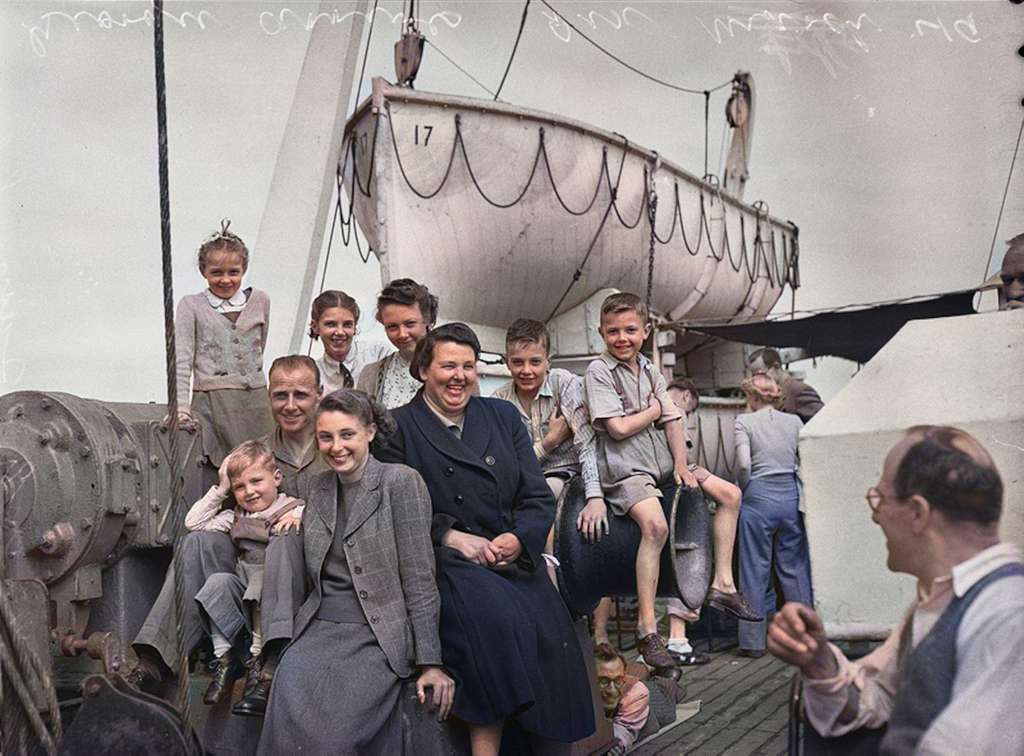
Image: British Migrants arriving in Sydney 1949, on the deck of the Georgic. Image Credit: state Library of NSW / Picryl
Original transcription replaced with supplied text