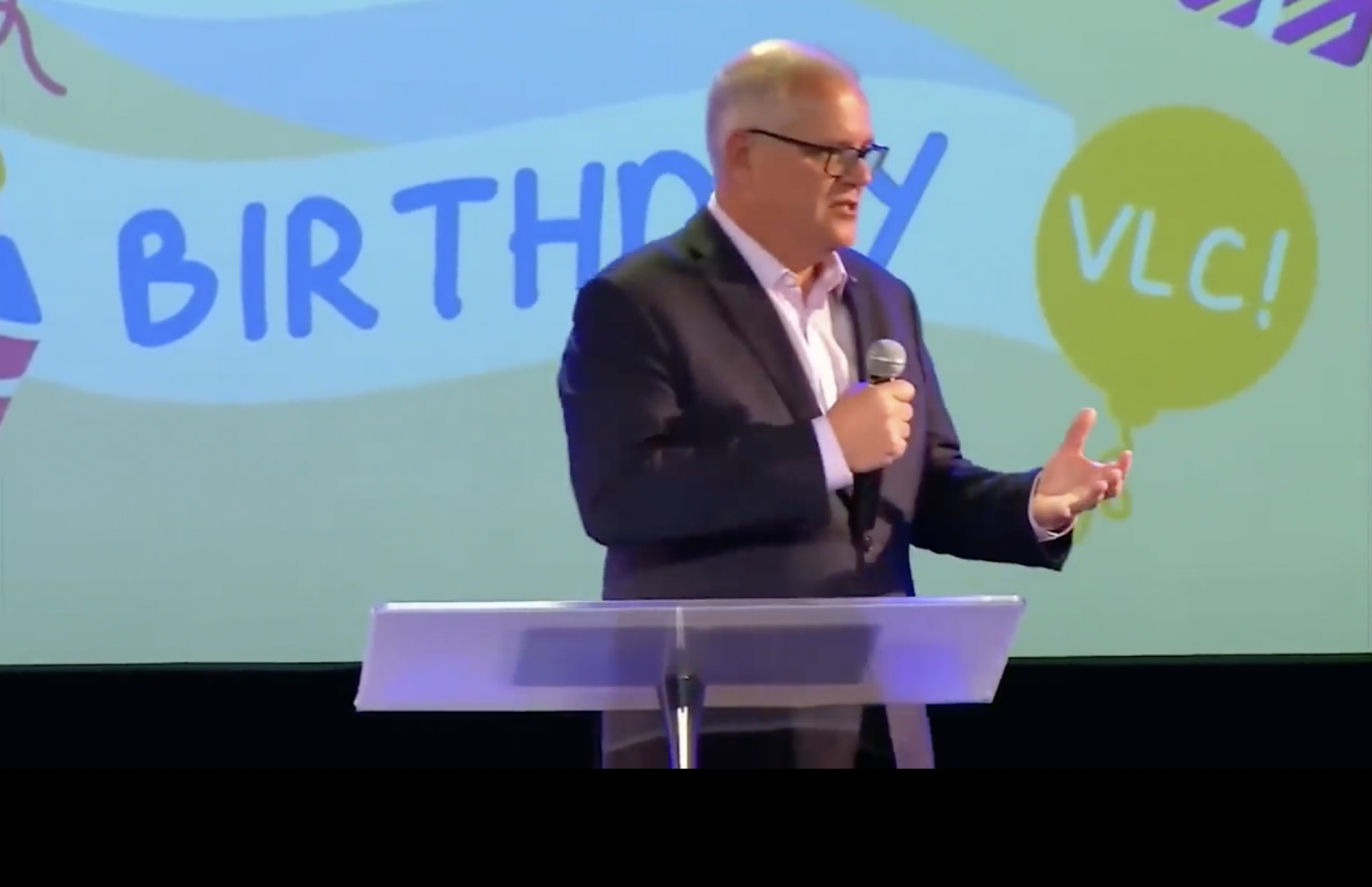
Former PM Scott Morrison has called for national standards for Islamic with government sanctions. He was speaking at a conference in Jerusalem for International Holocaust Remembrance Day, organised by the Israeli Government’s Diaspora Affairs Ministry.
Here is a transcript of Morrison’s plans for a mechanism to scrutinise Islamic teaching in Australia. He describes how the United Arab Emirates has curtailed extremist Islam to introduce the idea that religious liberty is not unlimited.
“No freedom is absolute, and with such freedom always comes responsibility. In Western liberal societies, religious leaders have responsibilities not only to their own congregations but to the wider society. Religious institutions must maintain sound governance to ensure proper teaching, accountability, and discipline. Christian denominations in Australia learned this painfully through the Royal Commission into the institutional response to child sexual abuse.
“Accountability was rightly imposed on these institutions, and reforms followed. While strong structures exist for most Christian and Jewish denominations, the governance of Islamic institutions, religious institutions in Australia is inadequate and requires urgent reform. Islamic leaders have a pastoral duty to protect their communities from radicalisation. And I believe most take this responsibility very seriously. However, stronger institutional frameworks would assist them, but it would also expose those who do not share their commitment.
“And it is time that the Islamic institutions in Australia adopted nationally consistent self-regulated standards, including a recognised accreditation work from arms, a national register for public-facing roles, clear training and conduct requirements, and disciplinary authority for their governing councils. This requires a peak body that goes beyond representation to being given the authority and tools to enforce membership standards. This does not currently exist in Australia. Religious education should promote coexistence, civic responsibility and respect for Australia’s pluralism, explicitly rejecting antisemitism, sectarianism, and incitement.
“Teaching should be transparent, with English translations available. Religious leaders must also clearly reject political Islam and transnational movements that weaponise faith for power rather than worship and warn their faithful about such movements. Mosques and Islamic organisations should commit to safeguarding standards supported by independent complaints and review bodies with order powers that extend to dangerous teaching and unhealthy influences, particularly amongst the young. Stronger governance also requires proper incorporation, capable boards, conflict of interest controls, transparent financial reporting, especially where overseas funding is involved.”
Some problems with the Morrison plan
A quick response came from Bishop Michael Stead, an expert on the politics of religious freedom and Chair of the NSW Faith Affairs Council. The ABC reported “Anglican Bishop of South Sydney Bishop Michael Stead argued Christians aren’t united under one single body (for example, Anglican, Catholic) and Morrison’s ideas were “not reflective of any religious body”.
“I think the idea that you’re going to have one peak body that’s going to be able to dictate to all is not realistic in our current context,” Bishop Stead says.”
Another example is the smaller Jewish Community, the aftermath of the Bondi Massacre has seen the mainstream bodies such as the Executive Council of Australian Jewry sandwiched between the emerging Australian Jewish Association on the right and the non Zionist Australian Jewish Council on the left.
Stead mentioned two hierarchical denominations, Catholic and Anglican, that might be thought to have effective measures for controlling hate speech. And in the Anglican system, the case of Stephen Sizer, the Church of England minister banned from ministry until 2030 for alleged antisemitic writing and social media posts that included linking to conspiracy theories about 9/11.
A current example in the Presbyterian wing of Christianity is the defrocking of a white supremicist miniter by the Reformed Presbyterian Church of North America (RPCNA) this month.
So it is clear that the Catholics, Anglicans and other denominations have mechanisms that could succeed in removing a minister for hate speech.
At the other end of the scale, there are churches, which are simply independent, which possibly are members of a network, but one without powers to disciple a minister, or much of a history of doing that.
And the extreme end are cult-like Christian groups like the Train family that committed the Wieambilla shootings. It is shameful but true that Christianity has its violent extremists. And there’s no denominational or fellowship mechanism to rein them in over hate speech, the kind that precedes violence. For Morrison’s plans to work, we would need rules to organise Christians into “official” churches, a move which could look much like the Chinese registered churches, thankfully short of the government appointing the leaders as happens in China.
Stead pointed to a further intrusion into religious freedom. “It seems that the reason that this is being done is for some kind of external auditing process,” he told the ABC.
“If we’re suggesting that there’s some external body that’s going to act as the kind of the religious thought police, then I think we’ve got issues of the government seeking to interfere in the free practice of religion.”
Morrison was speaking into a very different religious society from that of Australia. In Israel, most Rabbis are paid by the state, making his suggested reforms very feasible. In Israel, not downunder.