From the Two Pennies Facebookers
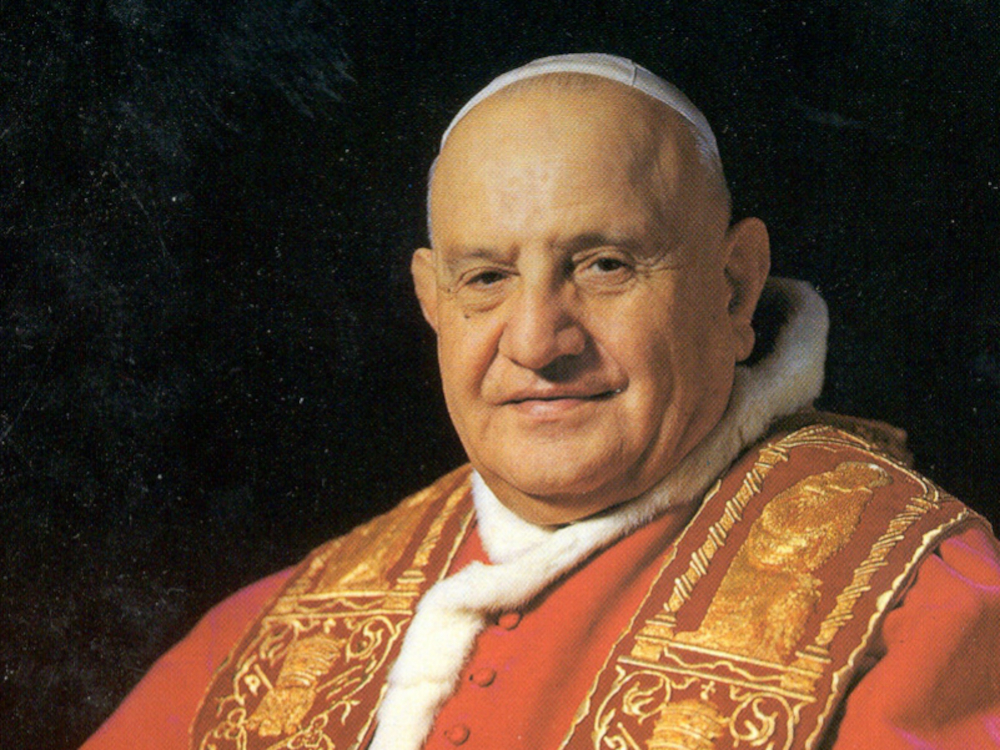
He was supposed to be a caretaker pope. A placeholder. The cardinals thought he had a year or two in him at most.
Angelo Giuseppe Roncalli was born in 1881 in a village near Bergamo, northern Italy. His family worked land they did not own. He entered the seminary at 11. He was ordained a priest at 22. The First World War put him on a stretcher in army hospitals. In 1925 the Church sent him to Bulgaria. In 1935, to Istanbul.
The Vatican did not send ambitious men to Istanbul. It was a polite way of putting someone on a shelf. Remember that posting. It turned out to be the hinge on which everything turned.
Turkey stayed neutral in the Second World War. That neutrality made Istanbul the crossroads of a continent trying to kill itself. Every road out of occupied Europe ran through it. Spies filled the hotels. Desperate people filled the embassies.
In 1942 a man named Chaim Barlas came to see him. Barlas ran the rescue committee for the Jewish Agency. He described what was happening to the Jews of Bratislava.
Roncalli answered him. So will it be. If God helps me, we shall get it done.
Barlas kept coming back. Every time news arrived from Poland, Roncalli clasped his hands and wept. He recorded it himself, in his diary. Poor children of Israel. Every day I hear their moans all around me.
So he worked through what he had. He wrote to King Boris III of Bulgaria — a friendship built during his decade in Sofia. He asked Boris to let Bulgarian Jews leave. He wrote to the Vatican. He cabled Pius XII. He used every contact his years of diplomatic irrelevance had quietly accumulated.
In December 1943 the Chief Rabbi of Palestine cabled him directly. Italian Jews were about to be shipped to the camps. Roncalli cabled the Pope. The deportations paused.
Franz von Papen, the German ambassador to Turkey — once Chancellor of Germany himself — came to see Roncalli with an offer. Join us against the godless Soviets.
Roncalli’s response has been recorded. And what shall I tell the Holy Father about the Jews who have died?
By April 1944 Roncalli was routing immigration certificates and Turkish transit visas directly into occupied Hungary, stuffed into canvas mail bags carried by the nuns of Sion. He wrote to the Vatican representative in Budapest on April 4, 1944, confirming that papers he had already sent had saved the lives of the people who received them. He had just collected three more packages from the Jewish Agency.
Then Hungary got worse. Adolf Eichmann arrived in March 1944. Trains were leaving for Auschwitz every day.
An American named Ira Hirschmann came to see him. Hirschmann was with the War Refugee Board, sent by Washington to find anyone in the region who would help. He sat across from Roncalli and described what was happening. Roncalli listened. Nodded at every point. Then he pulled his chair closer.
He asked Hirschmann quietly whether he had contacts inside Hungary who would help.
Hirschmann said yes.
Roncalli paused. Then he asked whether Jews would agree to be baptised. He already knew the answer to that question, because he already knew what the nuns were doing: handing baptism papers to Jewish children at checkpoints. The Nazis accepted them. Nobody verified them. The papers were the point. Not the sacrament.
Hirschmann later said Roncalli handed over thousands of certificates on the spot, no conditions attached. And that Roncalli stated it plainly: not one of these people becomes a Catholic.
It was paper. That was all it was. Paper that got a person past a checkpoint.
They called it Operation Baptism.
Historians have argued about the scale for four decades. Monsignor Verolino, who worked inside the Budapest mission, denied the large numbers outright. Others believe Hirschmann confused the baptism papers with the immigration certificates. Nobody disputes the mail bags. Nobody disputes the visas. The range historians give for Hungarians saved on Roncalli’s papers runs from 12,000 to 50,000. Nobody agrees on the number. Nobody denies the operation.
On June 24, 1944, Barlas brought him the Auschwitz Protocols. Two men had escaped the camp and written down in precise detail what happened inside it. Roncalli read it and wept. He sent it to the Vatican immediately. He cabled Pius XII repeatedly.
No answers came back.
Letters in Roncalli’s own hand survive. He criticised the Vatican for not doing enough. He wrote that he could not understand why the men with the power to act would not use it.
Israel has never named him Righteous Among the Nations. Yad Vashem’s position is that the risk element required for the designation is not met, and that a diplomat must have defied his own superiors — not worked through them — to qualify. Roncalli worked through the Vatican system, not against it. People have disputed that ruling for 25 years. They are still disputing it.
Somebody’s grandmother walked past a checkpoint in 1944 holding one of his papers. She never learned his name. He never asked her to learn it.
He had 19 years left.
The Church moved him to Paris in November 1944, then to Venice in 1953 as Cardinal and Patriarch. On October 28, 1958, the cardinals elected him Pope. He was 76. Every observer agreed he was a transitional figure. A caretaker. A man chosen because he would not cause trouble and would not last long.
In 1959, he removed one word from the Good Friday liturgy. Perfidious. It had appeared in front of the word Jews for centuries. Roncalli cut it out.
In 1960, a delegation of American Jewish leaders came to see him. He opened his arms. He said: I am Joseph your brother. His given name was Giuseppe — Joseph.
On October 11, 1962, he opened the Second Vatican Council. It was the most significant gathering of the Catholic Church in a century.
On June 3, 1963, he died. He was 81. They called him the Good Pope.
In 1965, the Council issued Nostra Aetate. The Catholic Church formally declared that the Jewish people bore no collective guilt for the death of Christ. A charge that had stood for 1,900 years. A charge that had fed pogroms across Europe for nineteen centuries. Gone.
A sharecropper’s son from Bergamo had started with a rubber stamp and a canvas mail bag in a city the Vatican had forgotten about.
He finished by making the oldest institution in the Western world stand up and say it had been wrong since the beginning.
The caretaker rewrote everything.
Tag someone who should know the name Angelo Roncalli — Pope John XXIII.
Image: John 23 Image Credit: Jim Forest Flickr, cropped
THANK YOU